Family, friends, nature, books, writing, a good pen and journal, freedom of thought, culture, and peaceful co-relations - these are the things that occupy my mind, my heart, my time...
Scientists and sensitive human beings across the world are telling us to pay attention. The trees, plants, animals around us have complex lives, intelligence, friendships, and responses not unlike human emotions.
Not this year, until now, did I turn to Mary Oliver’s poetry. I don’t know why except perhaps the numbing worry about erratic leadership, a pandemic, and climate change right here right now, and isolation.
In “Beside a Waterfall” Oliver draws our attention to the beingness in all the living world, our deepest connection with each other, the exchanges that give us life and purpose.
The National Council for Science and the Environment and Project Drawdown will host a conference, January 5-9, The NCSE Drawdown Conference to address solutions to a “planet under pressure”. The conference is free to students, $200 for the five-day, full conference. $75 for one day with Project Drawdown is also available as well as scholarships if you cannot afford the full registration.
I encourage as many of you as possible to register for the conference or some part of it. The reason? This is about coming together in partnership that builds trust among partners that may believe their mission is incompatible with the other, or partners have never thought to work together.
Project Drawdown offers a listing of scientifically researched solutions that may surprise you, especially in terms of the greatest contributors to the global carbon dioxide or pollutant concentrations. For example, refrigeration is at the top of the list of CO2 contributors. And, solving food waste is another.
This conference and these two very effective organizations are working on Applied Solutions that simultaneously address the economy, injustice, health, and building regenerative systems that secure life on Earth.
See a Powerpoint Presentation by both organizations hosted by the Sustainability and Security Forum to learn what is unique about the approach to solving common problems while protecting the Earth’s well-functioning.
From the Bookshop, a new book by Graciela Chichilinsky, a climate expert who created the Global Thermostat, is described HERE in a book interview with the author.
Like me, you may be wondering how our country can ever come together again as one nation. In every way, we appear to have moved into a new reality, two “countries” in our borders.
What separates us? Misunderstanding that results in two visions of not only who we were and who we are but also of what we are.
We are reminded by historians and previous presidents that democracy – a principle – is what we were founded upon and there are never any guarantees that we can keep it, as John Adams famously warned us at our very beginning.
There is no denying that social media and even our news networks polarize the public discourse and give easy venue to every voice no matter how glorious or how despicable. These changes have occurred in such as short span of time that most of us don’t recognize the impact unless we have the fortitude to turn it off — the constant electronic feed of images, information, and angst.
To save ourselves and our Republic, we each now must make a decision. How will we take responsibility in our own circles of influence to grasp hold of the treasure of that idea – a democratically motivated public – to save it and to improve it?
I would offer this. M. Scott Momaday, author and Kiowa elder, has written in A Man Made of Words, that words matter — words carry in them a force for good or evil, repair or destruction. Words also carry a nation’s experience and deep culture and history.
We must use words with care, more care now than ever. How can you and I speak, write, and create words that will bring us together again for that noble goal of creating a self-governing society in which each individual is treated equally, his or her rights considered as sacred among us?
How can we each use our voices to unite the nation again, and even though we may disagree, use words of respect and acknowledgement while disagreeing?
Our republic, a representative form of government, is built on words. We can oppose ideas as a loyal opposition, i.e. loyal to the ideal, the principle, that is the basis of our national identity.
What might happen if each of us choose our words with democracy in mind, with the knowledge that words can protect it or destroy it?
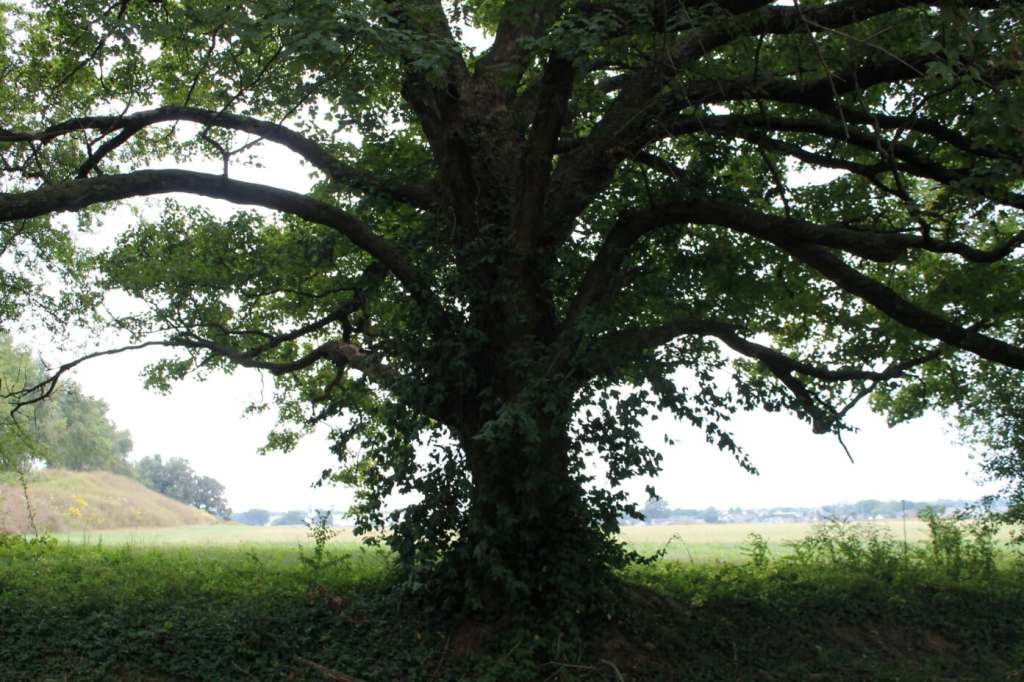
Who doesn’t love a tree? Its beauty, fruits, colors and graceful lines. Trees are important characters in the play of life. We pass by them everyday but most of us have little understanding of all the things trees are doing. Yes, we’ve all learned the O2- C02 exchange between living creatures and trees, but there’s much more going on. If we knew about it all, might we value trees more, not cut them down and plant the native trees of our region? Here is one older tree that sits in a hedgerow near a medical complex in the industrial park near my apartments.
It is a sugar maple. It is a “mother tree” providing benefits to all the trees and plants, and animals that are part of its area of influence. It has provided a hard wood for human needs and provides syrup that is used by animals and humans, insects and myriad organisms. But, its most important contribution may be its brilliant colors in the Fall.
Trees also provide other critical benefits to human health by providing the connectivity in the natural environment from which health arises.
Diana Beresford-Kroeger is a scientist and writer whose work is devoted to understanding the numerous roles of trees in the ecological health of natural habitats, plants and wildlife, and of the human species. Follow the link below to learn more.
Hurricane Sally swept through Pensacola, Florida leaving a trail of destruction, disconnected power lines, and broken water mains. But among the trees of the city, it was the native Coastal Oaks that danced in the wind and stood true in the after calm.
Native trees, plants, and species are adapted to the place where they originate. There is a reason that they are there, adapted, and contributing.
Trees are the hope of our time. Research about the function and role of trees in ecosystems across the world is unfolding rapidly. Diana Beresford-Kroeger, a biochemist, teacher, and tree expert, is actively teaching the public around the world about the function of their native trees. Much of her work will amaze you. Two films are critical to watch. The Call of Trees: The Forgotten Wisdom of Trees is one film that I recommend that you watch. The other is an interview from VanCouver that will show you how she advises cities and regions. Very practical steps and hopeful vision of the world. Restore the Trees!
You can also go to YouTube and type in her name to find dozens of wonderful presentations. Let’s all plant 1 native tree each year for 6 years! We’ll change the world for the better if we do.
In July I turned 75. Over a long life I’ve accumulated myriad experiences across this nation. First, as a child of a career military family, and then as the wife of a Vietnam War veteran and conservative businessman. Later, after an egregious divorce and the shattering of our family, I experienced near poverty, grief and loss. I wandered for years, in gorgeous natural places, and met some of my best friends who helped me and my children pull our lives together. I have learned about this country by direct experience, not by the false narratives I’d been taught as a child.
A measure of a life is how one learns, grows, changes with experience and knowledge; how one softens soulfully in kindness and compassion as the understanding dawns that every person, and every living thing, shares a similar struggle to live, love, and find happiness. This process is not even but occurs in giant leaps, regressions and rescue, and a certain God given striving to be the best person possible no matter what. And then, accepting how we fail at that. Just accepting it.
My vision, contrary to what we think about aging, has sharpened. I see a country on the verge of destroying itself. I see gross injustice for the majority of Americans. We’ve achieved horrendous outcomes that measure us as a third world country in the ways that we do NOT care for each other. Not surprised, however, for the economic system that has driven this country from its beginning is based on values that presaged these outcomes.
The man who now leads this country is exemplary of our immaturity. A man who has not learned, grown in wisdom, nor recognizes our shared humanity which lifts no life above another. Until we remove him from office, we risk falling further into disgrace, disorder, and dissolution.
Once we remove him, then we must examine honestly how we regard each other, and GROW UP. Democracy is serious business and it requires serious citizens who engage in its work and provide guidance to our leadership. We must require that the people we elect are mature people who realize what is at stake should they play games, hold grudges, lust after money and power, and misuse the privilege of leadership.
We have serious problems: injustice, climate change, Covid-19 pandemic, and failed international leadership and cooperation. We must elect women and men who show the character of people who learn, grow in wisdom and compassion, and who can cooperate with others to achieve outcomes for all.
As I listen to residents and advocates in Louisville regarding the black community’s cry for justice for Breonna Taylor, I could not help but think of Isabel Wilkerson’s book, Caste: The Origins of Our Discontents.
Wilkerson describes eight pillars of caste designed to keep black citizens in their lowest caste designation:
I Divine Will and the Laws of Nature
II Heritability
III Edogamy and the Control of Marriage and Mating
IV Purity versus Pollution
V Occupational Hierarchy
VI Dehumanization and Stigma
VII Terror as Enforcement, Cruelty as a Means of Control
VIII Inherent Superiority versus Inherent Inferiority
At present I am reading Caste in which Wilkerson methodically describes the historical events and people who laid down and built a system of privilege and safety that is designed to keep African Americans impoverished and disempowered. The system is based upon the essential belief that anyone with a drop of black blood is unworthy and incapable, good only for the lowest labor jobs that keep the most privileged in wealth, privilege, and safety (the dominant caste).
Breonna Taylor is now being implicated with involvement in a drug trafficking operation. Yet the police officers who made mistakes and killed an innocent young person on a drug investigation gone awry, are walking free. The attention is on the black community, on Breonna and her friends, and not on the action of the police officers.
We can observe how this system works as we observe the police, justice departments, and privileged citizens blame the victim, divert attention from the violence of police officers to the victim, the family, and the black community itself. As Wilkerson describes, “terror and cruelty are used as a means of control to keep an entire group of sentient beings in an artificially fixed place.” [Caste, p. 151]
Then there was the murder of George Floyd. The policeman who crushed his neck and killed him with assistance from three other officers are free on bail. Attention is on the community, high crime, and minor misdemeanors. Not on the brutality of police who clearly overreacted. All these “conditions” relate to the oppression of people in the lowest caste.
Now, Jake Blake. Again, we see the terror, the cruelty by a police officer perpetrated on an unarmed black man actually walking away from him. The law forbids police to use deadly force unless they are themselves at risk of bodily harm.
I am strongly urging readers in the dominant caste to read Wilkerson’s book to learn how the American Caste System was built, the values of the men who built it, and how we all participate in maintaining it by our ignorance or our lack of caring about it.
Note: Wilkerson compares the American Caste Structure to India’s caste structures, and to the systematic elimination of Jews built by the Nazis.
In the most frightening chapter of the book, Wilkerson relates how shocked she was to learn about the Nazi’s study of America’s enslavement of African Americans to the lowest level of caste, much like India’s untouchables, and that the Nazi’s believed, and wrote about, their aversion to our system because it “went too far”. [Chapter 8, p. 75]
See how Shaun King, a civil rights advocate, describes the problem:





 Susan Feathers