How We Learn: new discoveries

I am adding a recent TED ED – PBS program, “Unstoppable Learning,” which includes four researchers in the field of learning. I recommend that you get a cup of coffee or tea and sit down and listen all the way through. Education is undergoing radical transformation as new research is directing experts and parents and hopefully some day, educators, to bring education into the 21st Century:

TED Radio Hour 

And here is a play list of 10 educational TED talks which explore more of what we are discovering how children learn and where is education going:

Ten Educational Talks

Previous Post Below

How we understand the learning process is evolving in tandem with cognitive and brain research in the 21st century. These studies are causing many educators and psychologists to rethink public education. What is being discovered has real implications for environmental educators and anyone concerned with the development of generations of ecologically attuned individuals.

New developmental and cognitive science research points to the role of play, music, movement, story telling and memory as fundamental to intelligence, resiliency, and creativity. What we have typically thought of as enriching the creative, spiritual life of individuals has direct correlates with development of higher cognitive skills.

Adele Diamond was recently interviewed by Krista Tippet on OnBeing.org. Diamond is a cognitive scientists. Listen to what she has learned about developing the prefrontal cortex – the newest area in human brain evolution – and seat of our highest brain function.

Diamond describes how play, movement, and creative contexts for learning develop important skills that students will need in the 21st century. Cultural traditions are also being studied for their role in higher learning skills. She gives the example of the traditional talking stick and circle used by indigenous cultures. By promoting listening and delayed responses (discernment and judgement), children learn skills that promote better friendships and relationships  based on recall of experiences during the listening process. Spiritual teachers might call this development of attention. These traditional methods can be incorporated into classroom activities. In a time when our emphasis is on learning content (to pass the national standards tests) we have cut out the most important learning tools (art, music, physical exercise, play, and time for exploration). What we need to develop Diamond refers to as executive functions. These are mediated in the prefrontal cortex.

Time in nature is also important to brain development as explored by Richard Louv.

Nature Deficit Disorder is a condition Louv identified in children who spend inordinate amounts of time indoors, usually on electronic devices, rather than spending time in a natural environment with all its sensory stimulation, exercise, play, beauty, and opportunities for observation.

The Dalai Lama’s Mind and Life Institute invited experts and spiritual leaders to reflect on this new science of learning. Listen to the sessions on Mind, Brain, and Matter. In the discussions the scientific method of inquiry was compared with typical Buddhist inquiry methodology. These sessions are lengthy but very rich. I suggest that you take each one as an opportunity to relax on your couch or easy chair and give it your whole attention.



The deeper meaning of belonging

From the Center for Humans and Nature, an interview with Lauret Savoy in which she asks us to look more deeply into what it means to be a citizen of this country– not just a political belonging but something much greater. In particular, where does slavery, or injustice or exclusion fit into Leopold’s perceptions about a Land Ethic? Savoy recently edited a book, The Colors of Nature, with Alison Deming.

Amazon Book Review: From African American to Asian American, indigenous to immigrant, “multiracial” to “mixedblood,” the diversity of cultures in this world is matched only by the diversity of stories explaining our cultural origins: stories of creation and destruction, displacement and heartbreak, hope and mystery.

Little Life Dramas

Just two weeks ago I left full time work to begin a new phase of working for myself, part time, and on a rolling schedule that includes exercise, writing, better eating, and…time to notice the little life dramas around me.

Yesterday a swallowtail landed on my parsley plant, which has flowered on long stalks. She stayed there for several hours moving from flowering head to flowering head and glued an egg under many flowerlets. Over night these are now 1/8″ larvae who will devour the entire bush over several weeks becoming plump and long. When they’ve eaten it all up, they will find a place to suspend themselves and proceed to pupate. The dry cast looks dead but later on it will be empty. The new butterfly emerges and flits away. This occurred last year on the same bush. I thought I would have to replant the parsley but instead it came resoundingly back, seemingly refreshed, and lasted all fall and through the Florida winter.

I have also noticed on the basil (grown from last year’s harvested seeds) a big beautiful bumblebee busily drinking from each little white bloom on the flowering stalks. I picked some shiny, broad basil leaves for my sister but the bee seemed unconcerned in his haste to drink it all.

These little dramas in the lives of other species happened atop the Bay Oaks condominiums in my potted garden.  Not only do I enjoy providing habitat for my fellow lifers but I love picking fresh herbs for meals. A neighbor suggested that I put fresh basil or rosemary in my iced water and Presto! I had a new refreshing drink.

I wonder, would I have noticed these little life dramas had I been rushing to and from work; would they have happened while I was shut in a building with no ambient light or air?

Caterpillar to Butterfly

The sky was dark, the wind was cold,
And leaves began to fly.
A caterpillar, striped with black, said,
“I must say good-bye.””I’ll stick my bottom to a stem.
My skin is getting old.
I’ll change it for a bumpy skin,
Of brown, alas, no tips of gold.”

The north wind sang a lullaby,
As snug and safe she lay.
Then May came, and by and by,
Her dry skin dropped away.

So now a pretty insect sat,
And spread her wings to fly.
She sailed the sky on midnight wings –
A black swallowtail butterfly!

Read more: http://inspirational-poems.net/butterfly-poems/361-caterpillar-to-butterfly#ixzz37pzcQn1f

Wakulla Springs – Incredible Videos

img_0957.jpgWorking on a new essay about Wakulla Springs I happened upon a series of the best natural and cultural history videos of the Wakulla Springs in Florida. Wakulla Springs is one of the world’s largest artesian springs and part  of an underground freshwater network underlying Florida.

In these short videos you will learn about wildlife, the purchase of the springs and building of the famous lodge, the Hollywood movies, Army’s maneuvers there during the war years, and incredible views of wildlife–better than any I have seen before.

Each of the 5 minute videos (habitat, bird life, development – includes incredible footage of the lodge fire, military maneuvers, and Hollywood films from Tarzan to The Creature from the Black Lagoon, to Airport 77, and archaeology of the springs, diving and underwater life)are superbly crafted.

Staying at the Wakulla Springs Lodge is a true Florida experience.

Check it out.

More Places Underfoot

In October of 2004 four friends and I arrived in Anchorage, Alaska for a five-day backcountry trek before attending the North American Association for Environmental Education Annual Conference. The five of us were serving as environmental educators in various capacities and we all lived in the desert. So, naturally we anticipated freezing to death and had each spent hundreds of dollars at REI outfitting ourselves for the Alaskan fall weather. Stepping from the plane, we were relieved and surprised by balmy fifty-five degree air! A burly-faced Alaskan explained it was the Pineapple Express—an occasional trade-wind from the Hawaiian Islands that “takes a hard left up the Pacific coast” and blows tropical breezes over the Alaskan archipelago and beyond.

We rented a van in Anchorage after settling in at a comfortable hostel at $25 per night. Leaving behind the confining spaces of our respective workplaces, our female energy, like water, ran free, gurgling here and there. We began a woman’s journey as rich and multilayered as an ancient Tell with its visible present and deeper layers of forgotten pasts. Over five days we melded into a mobile community, sharing deeper aspects of our lives in a natural setting like no other. Along the way other women crossed our path whose life stories fit like colorful pieces in a hologram.

Journal Entry:
Rain makes popping sounds on our water proof gear, spills down slender Aspen trunks, and makes rivulets between tangled roots that crisscross the trail. Our voices like wood winds – a light rolling melody – play in the silent woods. Around us streams and rivers pour forth pewter-gray waters. [Earlier the ranger explained that Alaska’s glaciers are retreating in the global warming of the Earth, the glacial silt freed in heavy liquid flows.]

Our jackets make colorful splashes of orange, aqua, and sky-blue in the misty green of the forest. White-trunked beech with fall’s last yellow leaves still clinging to their branches, drop a soft, yellow carpet on the earth. We are alert to the presence of grizzlies. One impaled a red salmon from the river with a long, sharp claw at the entrance to the trailhead where the ranger reflected that as far as he knew grizzlies had never attacked a group of five or more. Grrreeeaat, we mumbled. Someone makes a joke about entering the food chain. I am not amused. We come upon a steaming pile of grizzly scat. I am looking behind me often.

We search for velvet brown moose passing behind dense trees up ahead and chat excitedly like kids let out of a school house for recess. Far from our desks piled high with projects, notes, and timelines, far from incessant e-mail and the glow of computer screens we begin a new rhythm.

Up from black stones – Alaska’s bones – emanates a deep vibration, slow and strong, retraining our erratic energies. With the gentle wash of a steady light rain, our false identities drain away. We are swept away in the beauty and rawness of the landscape and the wild creatures that still walk its paths and swim its waters in fair abundance.

The following day we leave the Eagle Pass area where we had hiked seven miles in back country to learn that a photographer and his girl friend were attacked and killed by two grizzlies. The incident happened only a few miles from where we had been hiking. This dramatically confirmed for me that nature does not have our plans in mind as she moves in her mysterious ways. The incident stayed with me the whole ten days we were in Alaska and forever imprinted on my mind that wildness is not a fuzzy bear to play with or a player in our imagined destinies. They are simply in their own homes and they are predators.

Alaska Lesson #1…Lesson #2 came that next week when I listened to scientists from Yellowstone National Park describe the role of top predators in the health of ecosystems based on what they were learning from wolf reintroduction in the Park. These are the bookends then of the human struggle to be safe, to protect livelihood while giving space to bears, cougars, and coyotes.

Alaska presses on the chest with its wild power – though diminished, still vital and instructive.


Dad

IMG_0188The word dad is said to originate from baby talk, dada, as does mom from mama. What’s more, these words occur across languages and cultures. They must derive from some ancient root that expresses itself in our babyhood as language emerges.

I am not sure when I began to speak, or call my Dad, dada or daddy. I do, however, remember when my own children began to call their dad “dada”. They were both very little and it was about the time they began to try to walk–as they were about to step into the big wide world.

Dads are funny, magical creatures who can sometimes appear as giants and other times as teddy bears.  They smell different than mom. Little girls remember their aftershave and boys remember their sweat.

My dad was gone a lot as a military man. Whenever he was home it was a celebration. He called us four girls and mom his “harem.” I remember how he complained he could never get into the bathroom. Back in the 50s houses had only one. There was always one of us primping in with the door locked. When he did get in he had to wade through our lingerie drying on every hook. His complaints were all in good fun. We all loved him dearly and we preened over him when he would let us. My older sister Bev and I scrambled to be the one to bring him his pipe or a cup of coffee.

All I knew was that dad brought home the bacon. He was the action person. Vacations, graduations, christenings and baptisms, birthdays, and award ceremonies were all made meaningful by his attendance.

Mom perked up when he came home and a feeling of safety pervaded when he was around. With dad there was always enough money and tools or vehicles or machines to do stuff.

He was a very funny person and even in his temperament. It took a lot to knock him off center. When I was in elementary school he would say, “Sure, you can go swimming…but don’t get wet!” When I was twenty he would reflect, “This too shall pass.”

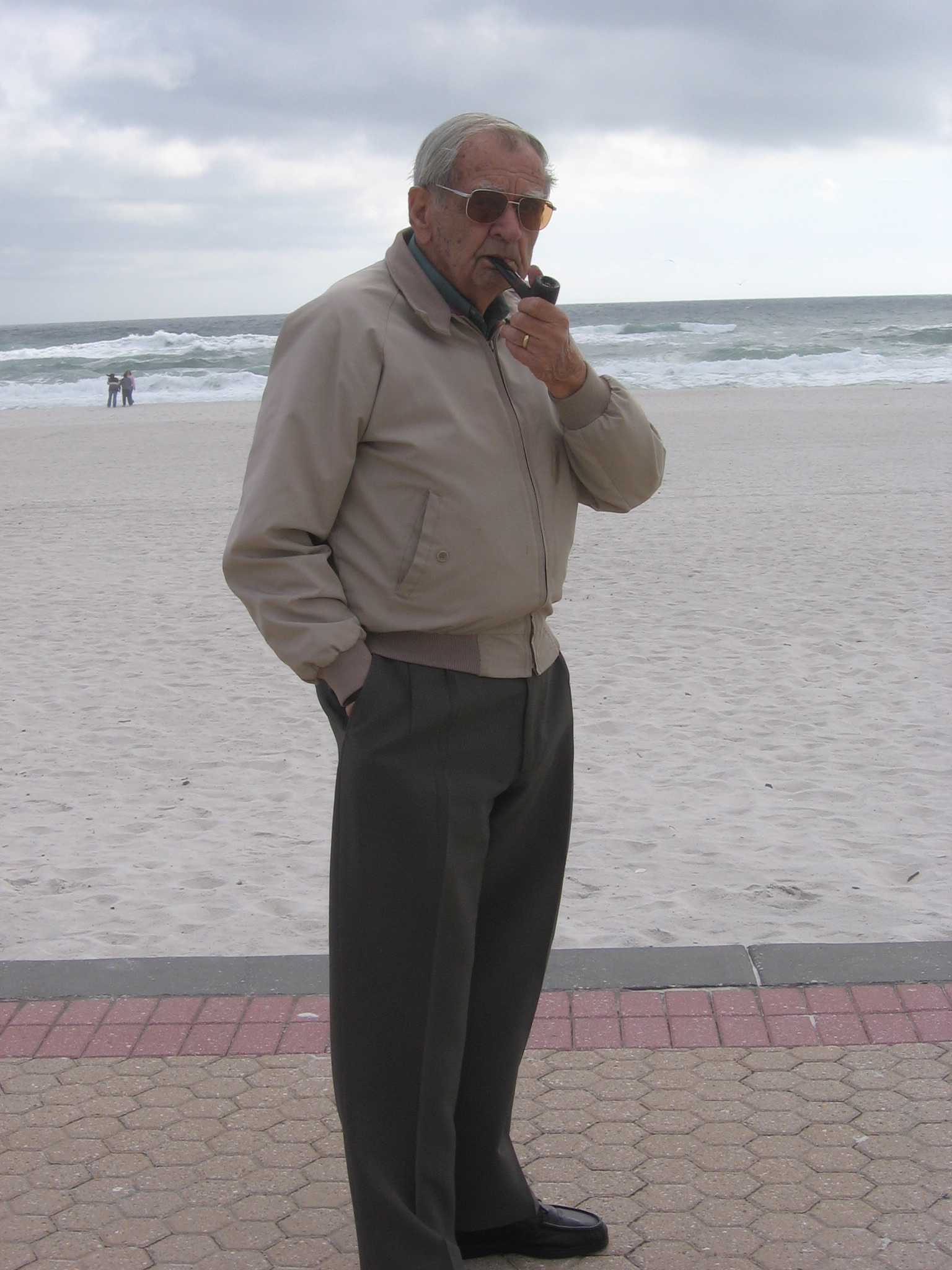
In his latter days on earth, in his 90s, he recited a lot of poetry. One day I recorded him as he sat smoking his pipe by the front windows of his condo. He liked to sit there and watch the “goings on”. Birds, them dern squirrels, and dwellers at Bay Oaks were all under his daily scrutiny.

Here is a short video of Dad reciting a couple of his favorites for me:


Quietude

I remember distinct stages in my life when time stood still.

The first stage was early childhood living in no measured world except by sunrise and sunset. Hours may have passed while I was deeply engaged in play and exploration, present to the moment only.

During this quietude of mind I was a keen observer of plants, animals, and people and their curious behavior and their lives. I studied my parents, how they spoke to each other and to me and my siblings. I noticed when they spoke to neighbors or strangers—the subtle changes, deference made.

School days ended the quiet world I lived as a young child. I learned about clocks, schedules, thinking about the past and planning for the future. One classroom club I joined was the Busy Bees. I must have signed up for a lifetime membership because the next thirty years I lived the life of a bee in a hive of fellow bees. The continuous hum and bustle of bee life was joy and motivation. There was much to get done and I wanted to learn everything I could about being a bee.

Then something happened that called me away. Deep was that call that drew me to an open field and big sky above. There were sounds: trickling brooks, the cry of a hawk, rustling in the tall grass. The warm sun caressed my hair and skin welcoming me back. Voices spoke within me. I was reminded who I was born to be. I was not a bee, they said. I was bound to be a butterfly.

That was the second period of quietude.

Life sweeps us along in its currents and soon I was bobbing over stones and around isles, racing in torrents and languishing in still pools but always going somewhere without cessation. Then I met an Indian woman who taught me to stop…wait…consider. She had me sew little bags of rose petals by hand and to chant the Rosary. I lit candles, painted golden boxes, stayed quiet in my dark, cool trailer in the roasting desert near Yuma, Arizona. She read from the Upanishads and Sufi teachers, Iroquois saints, and the Webster’s Collegiate Dictionary. Time had no meaning; the sun rose and the sun set but made no egress or exit through the blanket-shrouded windows of her home. I unwound my glistening wings and fluttered a while.

That was the third period of quietude.

Life then became a walk, sure-footed and true. I chose to be here or there. I wrote about my experiences and read about those of my fellow beings, leafy, furry, scaled, feathered, four-legged and two-legged. Quietude came and went in those days but stayed finally when I turned fifty.

This was the fourth period of quietude.

Quietude took residence in me.


Under the Sea Wind – Rachel Carson

Carson 3Under the Sea Wind was Rachel Carson’s first book. It was released in 1941 and quickly became eclipsed by Pearl Harbor and the nation’s declaration of war. Sales were slow. Carson was disappointed. However, she contributed one of the finest examples of American nature writing. The little book of stories later became popular in its genre. I have a thumb worn, beloved copy printed in that year which I fortuitously uncovered at Bookman’s in Tucson, Arizona many years ago. In my Carson collection I also have a first edition copy of The Sea Around Us, the cover frayed and the binding in need of repair.

Why do I treasure these books so much? I believe it is the uniqueness of Carson’s perspective on wildlife and the intricate webs of life to which each is inextricably connected.

Carson did something in Under the Sea Wind that was unprecedented: she wrote adult stories about the life of a particular individual species giving them a first name derived from their scientific name. For example, she begins the book with the story of Rynchops, a black skimmer (Rynchops niger). It is the flood tide when she describes a strange black bird and its mate swooping low over the marshlands. The sun is setting and we learn that Rynchops and its kind migrated up from the coast of Yucatan and are summering on the Outer banks in marshes and barrier islands there. Rynchops drops his huge lower beak as he glides lower over the water, scooping up small fish. Rynchops has remembered this island from previous migrations as a good place to mate and raise the next generation.

Readers are gently inducted into a story – a drama – as real as any account of man or woman, and along the way they are learning about the ecology of the land and growing appreciation for the struggles and triumphs of just one natural character in Nature’s pageant.

While I am aware of many children- and youth-book authors who have written accounts about the life history of animals, I am not aware of any who have repeated what Carson so beautifully crafted when she was still working for the U.S. Fish and Wildlife Service. There is also something more about her writing: it is superb by itself, an example of clear, forceful language. She will remain my primary mentor for writing. See her wonderful book about the shore: Edge of the Sea. Also, go to Rachel Carson Council to learn about the amazing women who are carrying forth Carson’s legacy.


The Buddhist way-Principles to live by

This is such an important list to read often. It is a way to keep your personal compass heading true…thank you!

Thomas H. Greco, Jr.'s avatarTom's News and Views

The Buddhist way

1.  FREE YOURSELF FROM NEGATIVE PEOPLE.

Spend time with nice people who are smart, driven and likeminded.  Relationships should help you, not hurt you.  Surround yourself with people who reflect the person you want to be.  Choose friends who you are proud to know, people you admire, who love and respect you – people who make your day a little brighter simply by being in it.  Life is too short to spend time with people who suck the happiness out of you.  When you free yourself from negative people, you free yourself to be YOU – and being YOU is the only way to truly live.

2.  LET GO OF THOSE WHO ARE ALREADY GONE.

The sad truth is that there are some people who will only be there for you as long as you have something they need.  When you no longer serve a purpose to…

View original post 1,511 more words

On some far shore…

Its hard to know just what to say to our country’s veterans when we are in the midst of uncovering our neglect of their needs. As some have reported, its not new…even more shameful…but with this last revelation that some may even have died waiting for medical services perhaps we will finally put our house in order.

I grew up in a military family. My father was a career bomber pilot and flew 35 missions in the WWII Pacific theater with his wonderful crew of very very young men. (His WWII B-29 is in the header on this page. Mt. Fuji is in the background.)

My children will be at the 27th Rolling Thunder with their father –a combat helicopter pilot during the Vietnam war in the Army’s Americal Division. Rolling Thunder was established in 1987 to litigate for the continued search and rescue of Prisoners of War and Missing in Action. This is necessary because we just moved on after the end of that war, even shaming veterans by our silence and lack of praise for their service in a terrible, terrible war. Each year my children and their dad go, and each year they come back more inspired and closer than ever. See my daughter’s video journal of Rolling Thunder.

Dad on BeachMy dad passed away in 2012 and we sorely miss him. In the last years of his long life he was still having nightmares in which he smelled flesh burning from low-level bombing raids. 50 year later!

I believe that we are observing a new time during which our country is coming to face the full consequences of war on the best among us. The particular type of prolonged assignments, never knowing when it might be over, and observing your countrymen unaware of what you are experiencing on their behalf…must be enough to drive the strongest man or woman to despair. We Americans are losing our moral grip on important values and practices because we are distracted…distracted by money concerns, overwork, and entertainment.

On this memorial day, let’s renew our commitment to support peaceful solutions rather than armed conflict or drone warfare (a scourge on humanity) and to international actions as a global community when we do have to defend ourselves. Help any veteran whatever age they may be to know that their sacrifice was not in vain. Live up to it by voting and actively working to make this democratic nation more just and compassionate. It will only be as strong and as good as we are. But mostly, on this Memorial Day, take time to honor, thank, or help veterans in your family, neighborhood and communities. I am forever grateful for the men and women who have sacrificed so much of their own personal freedom and happiness to keep me safe.