A Brand New Kind of West

In 1878, John Wesley Powell submitted A Report on Arid Lands to the U.S. Congress. In it he proposed that land grants to settlers in the arid lands of the country be determined by the geology and physiology of the land. That may seem perfectly logical to modern readers, but in that time, myths about the productivity of the land dominated over reality. Manifest Destiny was a locomotive roaring across the lands of the west.

Powell’s ideas were based on science, as Wallace Stegner, in his brilliant biography of Powell’s service to the U.S., Beyond the 100th Meridian, dramatically illustrates.

NPR’s 2003 Program on The Vision of John Wesley Powell

Powell proposed that tracks of land for raising cattle or sheep be 2, 250 square acres, and irrigable land for farming be only 80 acres with water rights. Both of these proposals were based on the aridity and productivity of landscapes in the west which, for grazing, required much more than the 160 acres provided in the Homestead Act to find enough water sources for animals to thrive. He also demonstrated that the productivity of desert soils with the addition of water required only 80 acres–all one farmer and his family could reasonably manage.

Had government agencies deeding land to settlers west of the 100th meridian used scientific reasoning, we would have a different west today. As we did not, most of the settlers who obtained 160 acre allotments soon failed. Their land was not returned to the U.S. lands in public trust but rather it went to the banks who financed farmers production. Powell points out that the Homestead Act resulted in millions of acres of public lands going to corporations. Again, using scientific research Powell busted another popular American myth.

Powell further proposed that the government require land owners planning to use a given water source, such as a river, be required to form an irrigation district made up of nine potential land owners, to demonstrate they could successfully share the water over a three year period before obtaining title and water rights.  He based his recommendation on successful models of the Mormons in Utah and Spanish land owners of New Mexico Territory with their ejidos resource commons.

Science was the basis of Powell’ prescience regarding the development of the western lands of the U.S.  Today, science must help major Southwestern cities and regions rethink how to manage water among themselves. We will not be able to return to zero, but we can try to develop policies today that fit the landscape.

For the entire history of water development in the west, science has not dominated decision making but rather economics. Millions of Americans now live in cities where a reliable source of water is threatened, and millions of acres of agricultural lands, supporting American households and the world are on the brink of collapse due to long term drought conditions projected to last hundreds of years.

What kind of thinking and planning will be required to move us in the direction of a sustaining system for water usage in the West? How will our economic models need to change to run concurrent with the physical realities of the land and resources we wish to use?
Shhh: my book is about . . .

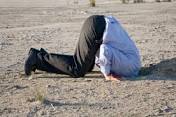
head in sandAs a new writer, taking on the task of a first novel with climate change as the protagonist is tantamount to declaring failure before lifting your pen.

Many dystopias have been written about climate change, and numerous Armageddon-style films produced which draw large audiences. Their stories are so outrageous that we count them as impossible. It may be an entertaining read or box office hit but these forms obfuscate the real threat we face.

When I first conceived the idea for writing Threshold, it followed on a years of reading climate science, talking to local scientists about changes they were seeing in local and regional environments, and reading the latest popular books written for the public’s understanding. The Weather Makers is one that comes to mind. The author, Tim Flannery, is an imminent zoologist who has continued to write about world-wide environmental issues related to climate change.

Yet, a great percentage of people still do not accept that climate change exists. Are we hard-wired to not accept climate change? What is it that defies logic, what we know, to respond instead to what we believe? Does it strike at our deep seated need to protect home and family, to disbelieve something as uncertain as uncertainty?

George Marshall devotes his professional life to studying these questions. In his recent book, “Don’t Even Talk About It: Why Our Brains Are Wired to Ignore Climate Change”, Marshall presents the results of interviews and research that make a credible case that our natural inborn defenses and beliefs keep us from responding. But, Marshall is hopeful because what we share in common is so much greater than what separates people about climate change. That fact may be key to bringing about a consensus to act in time.

Planning the book I had to consider who I was writing it for, who would be my readers. How could I write a popular story that gains the attention of people who normally would not read about climate change, may even vociferously deny it (like Ed Flanagan in Threshold). How could I invite everyone into a discussion about it, and what would I learn in doing so? These questions have occupied my mind over a decade, as I drafted, edited, put aside, and finally returned to finish the story.

TO BE CONTINUED


Pensacola Says Yes to a Climate Change Task Force

cropped-244.jpgLast night the City Council passed a resolution to establish a Climate Change Mitigation and Adaptation Task Force.

This has been over a year in the making. Introduced by Councilwoman Sherri Myers, and spearheaded by 350 Pensacola, the resolution was unanimously adopted as council members observe the impacts of a changing climate on our land and waters.

This is a huge victory for Pensacola. Experts agree that cities are the centers of climate change mitigation, having the most control over how their city handles its emissions, energy efficiency, and citizen participation in reducing its emissions footprint while innovating to improve quality of life. These strategies include green building, slowing traffic, improving public transportation, walking and biking lanes, and supporting local business. Making sure we protect water quality, build environments that reduce heat, embellish the natural environment, and enable all citizens to participate will be the concerns of this task force.

All these initiatives create jobs, save money, and set up the city to receive funding from foundations, state and federal agencies that are pouring more money into climate mitigation programs.

Challenges are: 1) the Mayor has not shown interest in the Task Force; 2) the State of Florida lacks leadership from the Governor and legislature to enact the policies and support to truly help cities make the energy and infrastructure changes that are necessary to become truly climate adapted. Citizen participation is crucial to bring leaders and experts to the task.  Check the City Council site to get to meetings and to contact council members to express your ideas. Write Mayor Aston Hayward to express your desire that he become an active participant with the Task Force.


What did you notice? Did you write it down?

At the Leopold Shack in Baraboo, WS

For more than a decade my peers and I have pondered why response to changes in the natural world go unheeded by the public. We pondered that “biblical floods and storms” are soon forgotten and that no “mountains moved” in our free, democratic society.

I was reminded of a key truth last month by the work of two scientists, Drs. Rick Brusca and Wendy Moore (The University of Arizona, Tucson). In a recently published study they showed that the lower and upper ranges of montane plants (such as coniferous trees) compared to a similar study in the 1960’s showed a dramatic move of plant ranges “up the mountain” – correlated with a decrease in rainfall and increase in average temperatures over the 6 decade interval. (Brusca et al. 2013 Catalinas)

Unless people travelling up Mt. Lemmon in the Catalina Mountain range had been paying attention and making notes, they had no idea that plants were no longer occurring in lower elevations but were found higher and higher up the mountain over just one lifetime. Dr. Moore produced a second study that recorded populations of arthropods (spiders, beetles, bugs, etc.) in the Sky Islands, the same habitat of the montane plant study. She created a baseline measurement similar to the scientist in the 1960s but for arthropods. Without the latter, no comparison could be made in the future to determine change over time.

Why is it important?

Without the long-term “sampling” or observations, humans don’t easily note changes that happen slowly over time. Take some of humankind’s early nature writers who have contributed vital observations that inform us today: Henry David Thoreau recorded in detail the changing of seasons, plants communities, and weather at Walden Pond in the nineteenth century.

For several years, Richard Primack has been prowling Henry David Thoreau’s old haunts in Concord, Mass., chronicling spring’s curtain-raiser, the arrival of leaves and buds. Thoreau carefully recorded the same details a century and a half ago. Primack, a College of Arts & Sciences biology professor, who pioneered the study of the effects of climate change on New England, has used Thoreau’s records to confirm that leaf-out arrives earlier today than it did then—a barometer of global warming. (He also checked photographs of leaf-out going back to the 1800s; those photos’ dates also indicate that spring came later in horse-and-buggy days.) ~ BU Today, Rich Barlow

Another great observer was Aldo Leopold whose records of temperature, blooming, birds, and other indicators are still used as a baseline today in the Wisconsin Sand County where he meticulously made his measurements with a cup of coffee at dawn. Today his daughter keeps track of over 700 indicators (blooming, birds, etc.) over each year cycle.


You do not need to be a scientist as Thoreau proved. You just have to pay attention, write it down, and be regular about it. The record may prove invaluable but in the mean time you will have a glorious time among birds chirping, flowers opening, and the heavens greeting you with a new day dawning!

How to Keep Records

Useful Methods for Phenological Study from Ecology Explorers