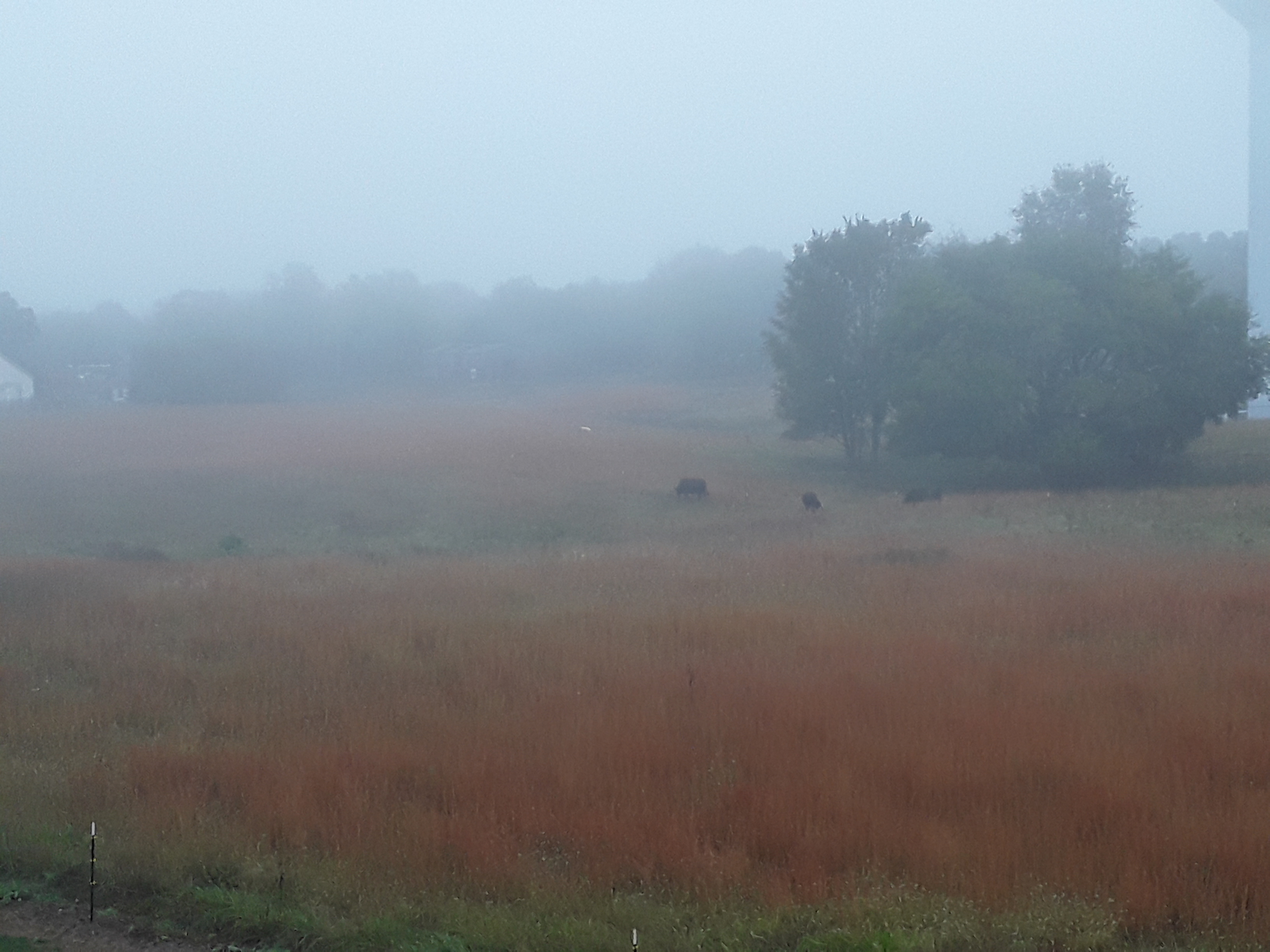
I woke to a dense fog hovering over Dream Meadows Farm. Sun filtered through the mist. A little later when I stood on my porch breathing in the fresh cool air, I noticed how the lawns and the farmland had turned emerald. Distant dogwoods are in their glory. Redbuds in full flower. Skies blue.
Everyday is a wonder.
The world’s problems and threats are still there but viewed from my porch this morning each seems possible to overcome or at least, prepare to face. When I remember to just stand in my own feet and be right here, right now, the world opens up to everything I have always yearned for. Right here all the time.
Grateful for this moment, this day. Be well my friends!
$65B wealth building during the Pandemic year – $7M per hour – is just Jeff Bezos’ profit among our 657 billionaires while millions of people struggle to pay the rent, buy food, and stay healthy. This, when Amazon decreased its pay to employees and they fight for unionization for basic living wages. See Chuck Collin’s article at the Institute for Policy Studies. And Democracy Now Interview with Collins here.
Mega wealth is a result of our capitalist system which, when left to the markets, favors the wealthy. But, now it has reached the level of a Hunger Games scenario. Suzanne Collins‘ masterworks for YA audiences, is a good read for us adults, and maybe more today than when it was first published in 2008.
When I see the super wealthy today, I’m reminded of the fawning, glittered things Katniss confronts on her journey to take back the real world for real people.
What are we going to do about this? Well, first, we need to have a fair taxation of wealth in the country because guess what? We are the people that made their wealth possible. Not that we intended it.
I’m done with unbridled capitalism, aren’t you? Go get your quiver and bow and meet me in the parking lot. Metaphorically speaking in case you are taking it literally. It’s code for Call Your Senator!
During WWII, Ray Davey conceived the dream of a community of reconciliation and peace. He eventually founded Corrymeela, an “‘open village where all people of good will’ could come together to learn to live in community.”
Over the years the community became distressed by the growing disharmony between folks living in Protestant and Catholic areas of the island. The divide had been there ever since the British Crown imposed an area in Northern Ireland where people loyal to the Crown could live with autonomy. Since then, the fissure grew wider and rumblings broke out from time to time until the division resulted in a brutal and violent time referred to as “The Troubles.”
In 1997 Mary McAleese was elected as President of Ireland. She was raised in Belfast, in one of the few Catholic families living in Protestant Northern Ireland. Her family roots were very old but not in predominantly Protestant Northern Ireland, but rather in Roscommon in the Republic of Ireland. Her parents had moved to Belfast for jobs. Thus, when Mary McAleese grew up, she knew many loyalist, protestant families, and on the whole her family was accepted by neighbors based on people to people relationships. When she assumed her responsibilities for leading the country, McAleese developed measures that were very similar to Corrymeela: “Together is Better” principle. Listen to an Audio Interview with McAleese on Corrymeela Podcast.You can also download a transcript of the interview.
During her 14-year presidency, Mary McAleese sought reconciliation among all the people of Ireland — a very high bar to achieve considering The Troubles and past violence among the nation’s citizens. Her national campaign was entitled, “Building Bridges”. Many of the activities under this program involved bringing people together in non-political ways, such as showing up to commemorate the violence perpetrated by one side against the other, when all joined in mourning together, commemorating, remembering. Few words were exchanged. During this time, McAleese worked to bring the British Monarch to Ireland, which had not happened for centuries. The Queen and McAleese planned together, resulting in a visit that provided healing in the Republic of Ireland. For example, Queen Elizabeth greeted citizens in Gaelic, causing many Irish nationals to weep in gratitude for her recognition of their culture. It sounds simple, but it had never been done. For centuries the Irish had been held as secondary citizens to a superior oppressor. Now they were recognized as equals by the Queen herself. It was ceremony of reconciliation. The Queen then visited, wordless, to all the places of mourning where Irish citizens had died in their fight for equality and self-determination.
This is beautifully chronicled in a recent interview of Mary McAleese by Padraig O’Tuama on the Corrymeela Podcast. (Scroll down to the first interview.)
I wondered after listening to Mary McAleese if the U.S. Democrats and Republicans might find a way to heal the political divisions that became violent on January 6 in our Capitol. Could we come together as neighbors, churches, states, and citizens…could we commemorate that day together as one of mourning with a mutual vow to never let that happen again? What do you think? What other nonverbal kinds of reconciliation might we do? Please comment.
Our democracy is in peril. So write the principals leading a nation-wide initiative to improve civics and history education. Led by the Educating for American Democracy (EAD) Principal Investigators—Danielle Allen of Harvard University, Paul Carrese of Arizona State University, Louise Dubé of iCivics, Jane Kamensky of Harvard University, Kei Kawashima-Ginsberg of CIRCLE, Peter Levine of Tufts University, and Tammy Waller of the Arizona Department of Education—EAD created a Roadmap as a guide for educators, communities, and citizens. Over 300 educators, students, and civic and history organizations contributed to the Roadmap.
EAD Vision Statement
“Our constitutional democracy is in peril. After years of polarization, the United States is highly divided, and there is widespread loss of confidence in our very form of government and civic order. For many decades, we have neglected civics and history, and we now have a citizenry and electorate who are poorly prepared to understand, appreciate, and use our form of government and civic life.
“At the federal level, we spend approximately $50 per student per year on STEM fields and approximately $0.05 per student per year on civics. A lack of consensus about the substance of history and civics—what and how to teach—has been a major obstacle to maintaining excellence. The Educating for American Democracy (EAD) initiative provides tools to make civics and history a priority so that we as a country can rebuild our civic strength to meet the modern challenges we are facing.
“The EAD initiative demonstrates that an ideologically, demographically, and professionally diverse group can agree about history and civics content, as well as pedagogy. This detailed consensus, presented in a broad Roadmap that allows states, localities, and educators to assess and reprioritize their own approaches, will encourage investments in civics and history at all levels.”
Regenerative Farming is a major solution to removing carbon dioxide, nitrous oxide, and methane in the atmosphere. Regenerative farming recognizes the ecosystem of soil (the pedosphere) as advanced R&D from Mother Earth in which dynamic relationships among communities of organisms and chemical recycling best address erosion, flooding, and greenhouse gas pollution.
Soil amendments commonly used by agriculture to grow food crops act to tamp down the functioning of the soil ecosystem. From the Industrialization of Farming (i.e. use of fertilizers, pesticides and insecticides) farmers have unknowingly drawn down the true wealth of soils. We were able to grow bumper crops of food but food produced is less nutritious, and pollinators and many beneficial insects have been reduced or eliminated. We are now contributing to the warming of the Earth by decreasing the soil’s natural sequestration of carbon. Healthy soils are the culmination of intricate, dense interactions among communities of soil organisms that deposit carbon in the soil, i.e. the ecosystem grows topsoil.
Go here to see a series of animations prepared for the public that demonstrate what we have learned about the soil networks and how they are related for a fully functioning pedosphere. This site was developed by Dr. Elaine Ingham, who discovered the soil food web nearly 4 decades ago and has pioneered this research ever since. “Widely recognized as the world’s foremost soil biologist, she’s passionate about empowering ordinary people to bring the soils in their community back to life.”
As I participate in the 2021 NCSE and Project Drawdown Conference, one thing is clear: bottom up, local action is healthy and potentially how the flame will be lit for broader action in states, nations, and international coalitions. Be sure to see this blog’s pages above for more details on topics.
“Living Labs” are projects which are experimental and provide living examples of climate action through innovation and working across disciplines. The Lake Superior Living Labs Network is a prime example. The Solar Commons project is a good example. It combines a nonprofit, a community land trust, an academic partner, and people seeking energy justice. Go here to read the model.
Another critical force in local climate change and sustainability leadership is the Community College. At the conference the discussion is about changing the role of Community Colleges as education about Nature more than Workforce alone, but combining these so that young people can train for and be employed in green jobs. At present, there are still a lack of good paying green jobs, but graduates of CC Sustainability programs are employed over other candidates as most companies must now address sustainability as part of their long term planning and/or disaster mitigation. See video below.
Scientists and sensitive human beings across the world are telling us to pay attention. The trees, plants, animals around us have complex lives, intelligence, friendships, and responses not unlike human emotions.
Not this year, until now, did I turn to Mary Oliver’s poetry. I don’t know why except perhaps the numbing worry about erratic leadership, a pandemic, and climate change right here right now, and isolation.
In “Beside a Waterfall” Oliver draws our attention to the beingness in all the living world, our deepest connection with each other, the exchanges that give us life and purpose.
The National Council for Science and the Environment and Project Drawdown will host a conference, January 5-9, The NCSE Drawdown Conference to address solutions to a “planet under pressure”. The conference is free to students, $200 for the five-day, full conference. $75 for one day with Project Drawdown is also available as well as scholarships if you cannot afford the full registration.
I encourage as many of you as possible to register for the conference or some part of it. The reason? This is about coming together in partnership that builds trust among partners that may believe their mission is incompatible with the other, or partners have never thought to work together.
Project Drawdown offers a listing of scientifically researched solutions that may surprise you, especially in terms of the greatest contributors to the global carbon dioxide or pollutant concentrations. For example, refrigeration is at the top of the list of CO2 contributors. And, solving food waste is another.
This conference and these two very effective organizations are working on Applied Solutions that simultaneously address the economy, injustice, health, and building regenerative systems that secure life on Earth.
See a Powerpoint Presentation by both organizations hosted by the Sustainability and Security Forum to learn what is unique about the approach to solving common problems while protecting the Earth’s well-functioning.






 Susan Feathers