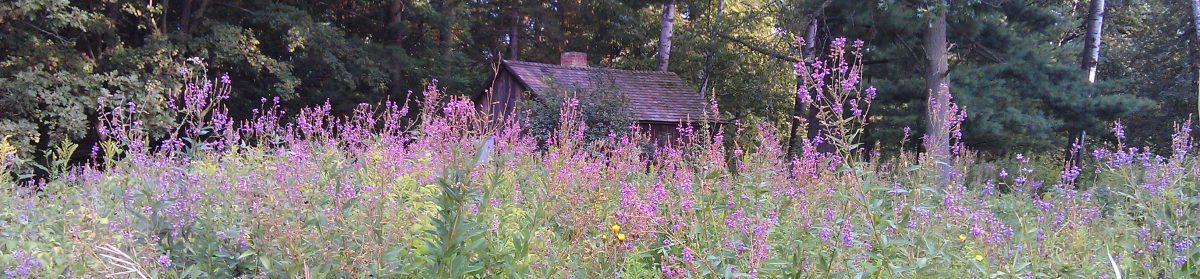
Listen to scholars, including Baird Callicott, Environmental Ethicist, author and Professor of Philosophy at University of Wisconsin. Susan Flader, Leopold scholar, introduces Callicott and describes how she became a Leopold scholar. Flader and Callicott co-edited The River of the Mother of God and Other Essays by Aldo Leopold (1991 University of Wisconsin Press). Callicott has a new book about to be released: Thinking Like a Planet: The Land Ethic and The Earth Ethic which addresses global climate change in light of values-ethics.
Outside My Door
The Earth sleeps in high limbs,
Swaying in tropical breezes,
Her cradle a nest of branches.
She slumbers coiled like a cat.
Her breast rises and falls
In the moon’s bright light.
She sleeps just outside
The door and waits.
To the Chief!
 On Veteran’s Day my family’s thoughts turn to the man in our family who served so well in the Pacific theater as a B-29 Pilot. His crew stuck with him through low altitude bombing over Tokyo and Saipan. There are many tales that abound from all the crew members, all passed on save one. Dad took his final flight over the Great Divide last December on Pearl Harbor Day.
It was not until I read Laura Hillenbrand‘s great book about Louie Zamberini, that I understood my Dad, his crew, and the Army Air Corps were the liberators of over 130,000 prisoners of war in Japan. I knew about the POWs but what I never comprehended, until I read Unbroken, was the brutality and suffering in those camps. When she described accounts of the POWs on spotting the brand new weapon of the U.S. – the Super Fortress (B-29) -and the distant flames from Tokyo – I felt such pride about my Dad and his crew members, whose daughters are our friends to this very day.
Dad lived a long life after WWII but it defined his life thereafter. Today I feel pride in my heart for Dad, his crew, my former husband Tom Williams, a Viet Nam War veteran pilot; for all the men and women today who go forth under difficult circumstances, whose families sacrifice as ours did (Dad reentered the Air Force after it formed post war and served for 22 years).
 From my beloved father I learned about a time when most Americans had very little wealth or personal power. When the war ushered millions of men and women from a life of poverty into an incredible surge of economic power and upward mobility for average Americans, the creation of the Middle Class.
I grew up in that era when the “sky’s the limit.” We live now in a new time altogether where even the poorest person has a high standard of living. Dad and his family had no social security, insurance, scholarships, etc. That all came after the war. We sought to do good things for everyone in that era of trust and positivism.
The year my father was born was 1917. That year President Wilson declared war on Germany, ushering in WWI. The suffragettes began a two-year vigil at the gates of the White House, were jailed, beaten and force fed when they went on a hunger strike for the right to vote. The Silent March, led by E.B. DuBois, took place in NYC to make President Wilson live up to his promises to African Americans. The Russians declared a Republic and Leon Trotsky and Stalin battled over the implementation. Seeds of discontent, triumph and defeat were laid down in that year when the first born baby of the Edgar and Hattie Mae Feathers clan saw the day of light.
How will our individual and collective actions lay down the seeds of the reality our next generations will experience? Are we up to the challenge? I like to think we are.
Reversing Course to Go Forward
 As we move into winter the beach changes dramatically. Signs of life are more subtle like this dune home and prints. There is a story of coming and going and of more than one creature. I also wonder what the interior of this home looks like. Dune vegetation sends out tendrils that hold the sand in place. (See the protected dunes near the Holiday Inn Hotel on Pensacola Beach or beyond the Portofino Towers. Some are about 25 feet tall, with shrubby trees and a variety of old growth vegetation.)
Coastal dunes protect the bay and community beyond from regular storms and wave surges that are a natural physical phenomenon on the Gulf of Mexico. Over the last 100 years these dunes have all but disappeared while human settlements have grown. Tourists visit who do not know dune ecology. Walking on living dunes is destructive. I always stand far away and use a telephoto lens to take these photos. But, even if we were all careful, even if there were no human beings around at all, the beaches would be carved away as they move with the current westward along the Gulf shores toward the Texas coast. This is the nature of Florida’s Gulf barrier islands. This has been true for all the geologic time that the Appalachian Mountains shed quartz crystals into streams and rivers through weathering. Those grains of quartz broke from the granite skeleton of the ancient mountains, rolled down rivers to the sea…to the Gulf where currents pushed them together and formed the spectacular Gulf Islands tourists come to see and photograph. This happened over millions of years. We short timers only see what is in front of our eyes; we really think that we can alter natural processes this vast and this old. That faulty perception threatens our lives and fortunes.
We are facing a decision locally about whether to re-nourish the beaches to support tourism (to the tune of millions of dollars). This is a process of bringing in sand from other locations to widen the beach temporarily. Beach renourishment happens all over Florida where hotels and other large structures increase erosion along highly mobile coastal environments.
Local ecologists recommend moving tourism to the mainland along the bay with only the recreational sports businesses remaining on the beaches. This would remove much of the hardscape that comes with hotels, walkways, and their infrastructure. These replace natural dunes and the vegetation that holds them together through storms and wave surges. Of course this is very controversial and not something most leaders or business owners support. It would take years to make the change but going toward a more responsive process, where humans adapt to the landscape and weather rather than forcing nature to adapt to human need, would be very enlightened. It signals a sea change in thinking that is very much in need as we move into a new era of unpredictable climate.
The transition is the difficult part but with keen minds and the right intent a plan could be formed where – rather than rebuild after a hurricane, or refurbish when a structure is in disrepair – the business would relocate to the mainland. Others may decide to do so ahead of time as the downtown becomes more vibrant and can support more hotels. Rather that selling the ocean front view, the emphasis could be on historic Port Panzacola and the lure to visit the islands.
The challenge would be how to use the historic downtown and bayfront to support a thriving tourism business supported by ferries and trams out to the beach – where recreation, nature study, and sea side fare would be the focus. Would harboring one of the most natural and beautiful landscapes in the world improve tourism?
We’d be unique, we’d be leaders and we might find a way forward that is even better than what we envision now.
Personal Tracking Device?
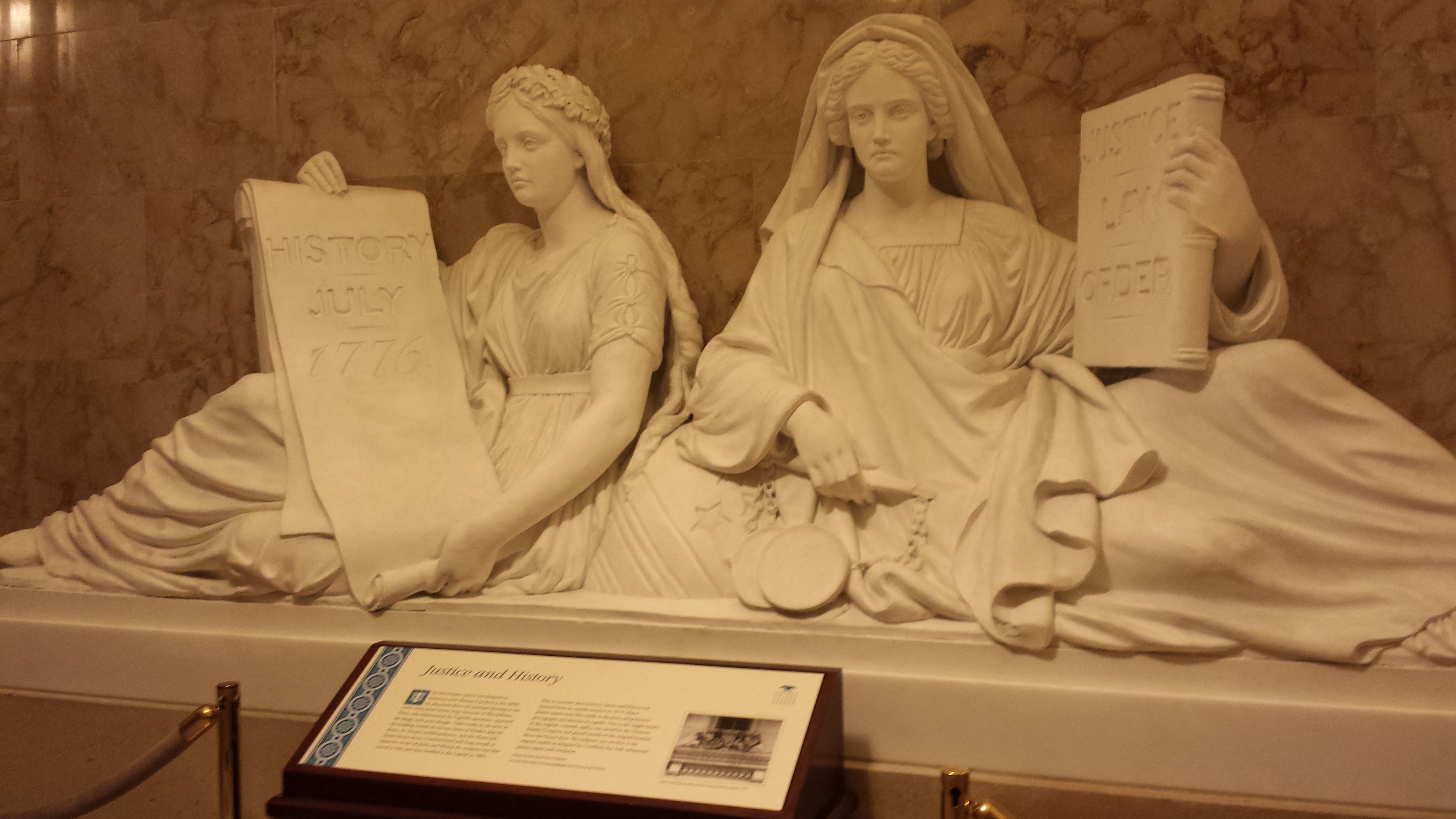 The adjacent photo of Justice and History in the Capitol Building seems apropos for this blog post.
During a visit to our nation’s Capitol, I explored the Mall’s museums, which is my habit anytime I visit Washington. Like our National Parks, these museums, free to the public, are one of each citizen’s greatest national treasures. I had learned ahead of time of a lecture series and book signings for a program, “Inventing the Surveillance Society“.
We are being watched. When we enter a building, place a phone call, swipe a credit card, or visit a website, our actions are observed, recorded, and often analyzed by commercial and government entities. Surveillance technologies are omnipresent—a fact underscored by the Boston Marathon bombing dragnet and the revelations of widespread domestic surveillance by the National Security Agency. We live in a “surveillance society” driven by a range of innovations, from closed-circuit TV cameras to sophisticated data mining algorithms. How did our surveillance society emerge, and what is the effect of ubiquitous surveillance on our everyday lives?
The question is how to find the right balance between privacy and security. The keynote speaker, David Lyon, director, Surveillance Studies Centre, Queens University, addressed the crowd assembled in the museum’s Warner Brothers Theatre with “Google’s Goldfish: Living with Surveillance.”
I sat next to a film maker for PBS. We both laughed when the keynote speaker suggested that a way to begin to reveal what we have created is to start calling things by what they really are. He held up a smartphone and said this is really a “personal tracking device.” My laughter faded as I began to understand how I had unwittingly participated in surveillance by letting Google and many other search engines have my personal information. Then it further dawned on me that I had shared my genetic material with 23 and Me! Who gains access to that information? Even when information is stripped of identifying data, it can still be trace back to me. Again the speaker demonstrated how the surveillance methods of pattern recognition are tracing my relationships: who do I communicate with; whose websites do I visit; who is on my Facebook friend list and so on.
I was not able to stay for all the presentations, leaving about 4:30, exhausted from a day of gloomy predictions from the DoD agencies at my workshop who portrayed an increasingly dangerous world where not just states, but individuals and groups have weapons of mass destruction.
What have we created? Blindly participated in developing?
Since the 1990s with the advent of digital technologies the U.S. military and government with communications industry have evolved a set of agreements and legally authorized processes to tap into phone and email data, internet metadata and use it to look for patterns to combat terrorism.
During the Keynote address, my purse fell open spilling out my license, my credit cards, my medical i.d.s under my seat. I tried to gather it all up, but during the lecture I imagined that some card I missed was under my seat somewhere. Everyone who came to sit behind me I looked askance to determine whether they might steal some personal information from me.
A featured speaker that evening was the author of The Watchers which chronicles the development of surveillance in the U.S. over the last 25 years.
Listen to the author, Shane Harris, during an interview with Terry Gross on NPR.
Changing Seasons
You know I am just realizing how much I’ve changed in the last five years. It happened without my knowing it but I am sure others around me have been aware. Its humbling when age begins to dull the blade on skills that have served me so well my whole life. I am talking about changes in the way my brain works.
I am 68. The way my brain processes now may be due to the priorities of the developmental period – a time when relationships become much more important and the details of daily affairs less so. Emotional nuances become my preoccupations; observations about the interactions among my peers and colleagues, my family members; appreciation of the difficulties younger people have in making decisions about how to live; how blindly we go as youth but feel so self-assured. I find humor in a lot of it and can’t get too excited about some of the typical “dramas” that seem to have an eternal life in human affairs.
This new found wisdom can be seen as lack of drive or determination, but when you’ve seen certain types of individuals cause an array of problems over a lengthy period of time and in numerous kinds of situations, one becomes philosophical about it. Now, I am less inclined to try to “fix it”. At the same time I don’t want to be around it.
While these changes in me can cause problems in a work environment which does not understand nor appreciate and respect this kind of maturity, I rather like it and feel more at home in the world than in any other time of my life, except perhaps when I was very young and too inexperienced to worry about the way things are on this lovely, stressed out planet.
There may be a significant decision coming up for me. I would like to apply what I know to a big problem. This site may be a good resource for me.
How to Shape Change
Lisa Wyatt Knowlton’s blog, Tinker, is one that I highly value. Here is today’s blog about an entrepreuer who created a prize so generous as might turn the head of a leader bent on dictatorship or corruption toward higher ground.
Where does money come from?
Rising Son
While reviewing authors who will be presenting at the Southern Festival of Books in Nashville this coming weekend, I came across Charles Scott new book, Rising Son: A Father and Son’s Bike Adventure Across Japan.
Charles Scott puts his corporate job on the line to ride connected bicycles 2,500 miles across Japan with his eight-year-old son, Sho, raising money for a global tree-planting campaign.
Pulse of the Planet
Go to NASA’s Vital Signs of the Planet for Key Indicators of the Planet’s health and function.
Go to Coyote Clan, Terry Tempest Williams’ personal website, to understand the planet’s soul and our relationship with land, water, sky, and wilderness.
Go to Living on Earth to learn how to bridge Faith and Reason.
Go to Moyers and Company for the words and wisdom, poetry of Wendell Berry.
Through these portals you will understand the Pulse of the Planet in 2013. We never hear these voices on daily radio and TV shows; rather we hear or watch the avarice in our halls of leadership. I just wanted to bring you this menu of thinkers, lovers, and human beings who truly have the pulse of our planet. Through them and others thinking and working in similar ways we can take heart that there is hope for democracy, for life on earth, and for our children. Perhaps you have knowledge of other similar “tribes”. Please share them here for other readers and for me! Namaste.
 Susan Feathers