A great book, is Our Ancient Faith, Lincoln, Democracy, and The American Experiment by Allen C. Guelzo, Historian.
According to our ancient faith, Lincoln said in 1854, “the just powers of the governments are derived from the consent of the governed…. Lincoln translated…to mean “that no man is good enough to govern another man without that other’s consent. I say that is the leading principle—the sheet anchor of American republicanism.” From Our Ancient Faith by Allen C. Guelzo, Chapter 1: The Cause of Human Liberty, p. 26.
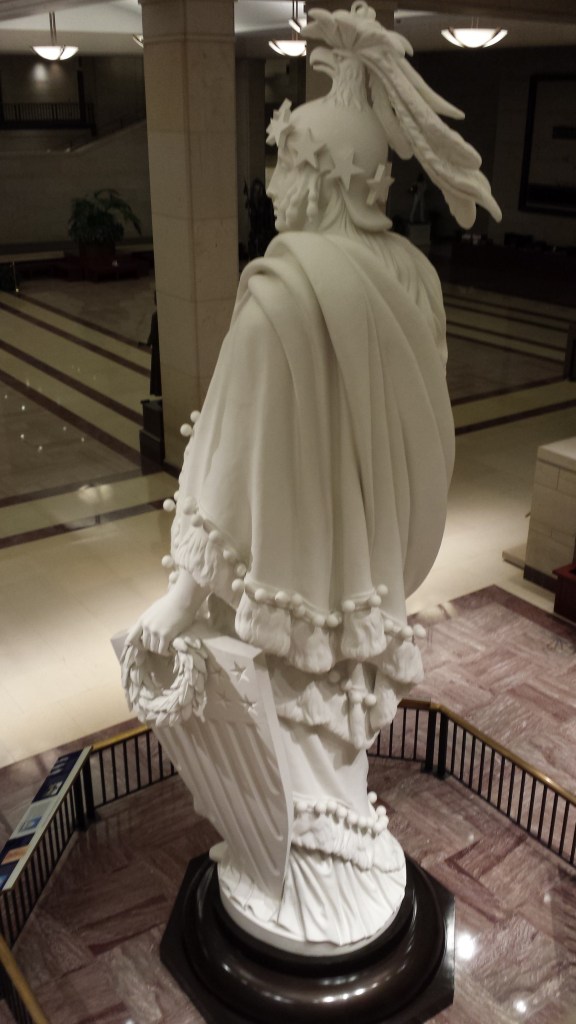
Freedom, Nation’s Capitol. Photo by Susan L Feathers, 2013
Citizens, those who love and cherish the ideals of our democracy, make it a weekly practice to write to your Senators and Representatives and to members of Key Committees. Here is mine today to Senator Elissa Slotkin who is a member of the U. S. Senate Agriculture, Nutrition and Forestry Committee.
We can never know whether what actions we take are heard but I have faith that if millions of freedom loving American write, call, email or visit their Congresspersons, the flame of democracy will never die in America. She may flicker now and then when despots blown in on hot air and untruths, or when we are temporarily fooled, but freedom has its way, always. We must remain undaunted!
As I would not be a slave, so I would not be a master. This expresses my idea of democracy. ~ Abraham Lincoln
I’ve tasked myself with reading more about our history and our changemakers. In Our Ancient Faith by Allen C. Guelzo, Lincoln is preparing for a debate with Frederick Douglas and jots down this idea above.
Democracy at its root is relational.
If an indiviudal would not be a slave, he must not deny the same to others. Consent of the governed is the fundamental principal on which our government carries forth the will of the people.
In these very turbulent times, most recently demonstrated in a violent asassination attempt on the life of former President Trump, the nation has paused to consider how this could happen and what caused the youmg man to engage in such an act. We also reexamine how separated we have become, how violent rhetoric has caused people to distrust each other exemplified in the last seven years of political divide, vitrieolic language and extreme othering.
Lulu Garcia-Navarre revisits Robert Putnam’s study of the state of our Republic in the New York Times (July 14, 2024). In light of a new 2oth year edition of his book Bowling Alone, updated to include social media, they discuss why there has been little progress, even worsening separation among us, deepening the loneliness epidemic and consequent fear of each other.
Putnam discusses Alexis de Tocqueville‘s famous studies of American democracy published in 1835 and 1840. He observed that we were joiners – members of dozens of clubs and group affiliations. We were intensely relational including both close relationships and more social relations from hunting to sewing clubs, societies and guilds.
Garcia-Navarre and Putnam exmine how these kinds of relationships over the life of a citizen facilitate democracy. This brings me full circle to consider how Abraham Lincoln described democracy as relational. If I would not be a slave, I would not be a master.
Would more frequent nonpolitical relating to each other prevent the growth of misunderstanding and mistrust among us?
Related to this is how our founders understood morality. Founders thought about how each person manages oneself: restraint, kindness, courtesy, honesty, etc. It had nothing to do with the imposition of values on free citizens. To founders it was about improving oneself and continually self correcting by personal inventory over a lifetime of striving to be the best person possible. Self management.
Perhaps this is honed in an array of relationships throughout our lifetimes and that is why we see a weakened American democracy for which our relational lives is its essence. See the National Constitution Center’s discussion of how our founders thought about morality as self control and self management. Character.
Our rights and duties to engage in Civil Dialogue is at the heart of democracy.
What do you think? Leave a comment so that we can discuss this matter.
Lincoln is a figure that bulks very large in any thinking that we have about democracy, and especially in times that we live in now, times of anxiety, times of concern, fears of crisis. And at moments like this, we turn back to the figure of Abraham Lincoln, because there was a time of crisis in which he lived. And yet our democracy emerged victorious from that, in large measure because of his leadership and his wisdom. National Constitution Center, We the People podcast with historian Allen Guelzo
Readers of my blog will know that I frequently refer them to the National Constitution Center in Philadelphia for nonpartison perspectives and resources about our founders and founding documents. A key function of the NCC is inviting scholars from varying perspectives for a deep dive into critical issues of our body politic in which listerners and readers are referred back to key events and Americans that have kept us on the path of a living democracy. Our principle of consent by the governed is foundational to preserving democracy in our time.
In this discussion with Allen Guelzo, we return to Lincoln in the Civil War in which a nation based on laws and reason are his guiding stars.
Please share this post with friends or on social media. The discussion with Jeffrey Rosen and Allen Guelzo is relevant to our current political strife.


 Susan Feathers