COP26 will begin this coming Sunday in Glasgow, Scotland. Read the major goals of the conference here.
See this informative paper that explains the COP26 and the path to Glasgow. It is a hopeful but realistic summary of where we are and what is at stake now. Good way to get ready for following the gathering of world leaders.
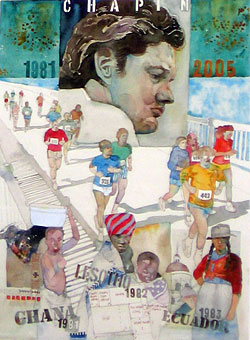
This adage is one that Harry Chapin used and exemplified during his short but consequential life. As I’ve lived into my 70s, four decades more than Harry got, his words resonate more than in 1981 when I learned he had died in a car accident on Long Island where he and his family lived.
Harry’s musicality and folk music became known to me at the time he left this reality for the one beyond. My community of Croton-on-Hudson, New York, was in the final preparations for the first Run Against Hunger–a 10K footrace up over the Croton Dam and winding down along the Croton River past the New York Aqueduct, into the hamlet of 6,000 residents.
My neighbor called me. He had produced some of Harry’s early records and was stunned and sad at Harry’s passing. Would we make the Run a memorial to Harry’s memory? he asked, and offered to pay for the t-shirts for the inaugural race. The Harry Chapin Memorial Run Against Hunger was born that day, with members of the Chapin family attending the first race, and 41 years later the 10K and fun run is an institution.
The point being, you never know what you might set into motion that may take root and grow in the hearts of thousands, even a whole community. In this way, the race has built a small medical facility, helped establish a farmer’s credit union, supported orphanages–all in Africa–and kept a local food bank alive and growing into one that works toward solutions to poverty.
The Harry Chapin Memorial Run Against Hunger will be run this year on October 17, Sunday, in Croton-on-Hudson coinciding with celebration of World Food Day as it has each year. If you are in the area, please go. The village is lovely, the area gorgeous, and the race inspiring. Walk the 3K or the fun run, or if you are able, run the 10K.
Florida is still a mysterious place to me. It may be red neck, a senior haven, conservative, environmental disaster, but it is also sophisticated, energized, liberal, and gorgeous country more varied than any state in the union. I have discovered to my surprise that Florida is a haven for great writers. Riding home last night our public radio,WUWF, featured Bob Kealing—an Emmy award-winning journalist and author. Kealing wrote Jack Kerouac in Florida: Where the Road Ends to chronicle events in Kerouac’s life that are little known. Kealing as journalist found people who were close to Kerouac and was able to find manuscripts and letters that fill in blanks in the life of the beat generation’s guru. He also helped establish the Jack Kerouac house and writer’s residence in Orlando where Kerouac lived with his mother. Explore this site and then listen to Bob Kealing’s 25 minute presentation at University of…
Power from the sun, wind, and water will again be how humankind goes about its day among the myriad forms of life sharing the planet.
Energy democracy, as it comes online for millions, will do away with the former world’s grasp of limited energy, an egregious form of autocracy that just about destroyed the living world.
Everyone in your baby’s life will have energy on the spot, for their homes, businesses, and transportation. All over the world. It’s in the cards, the stocks and bonds, and the science. It’s happening right now.
Its gonna be good, even as a lot of turbulence and rancor rises in the transition. Parents, grandparents, keep your eyes on the light. Show your babes how to be, what to do, and how to discern the truth.
Read
Above all do not lose hope. Look for the forces bringing a better world today and tomorrow, and follow and support them in everyway your can.
In 1959 my father, a Lt. Colonel in the USAF, was assigned to Ice Island T-3 in the Baltic Sea. The iceberg base provided a landing zone in the era of nuclear threat. However, there was a real physical threat to my father lurking in the shadows of the mess hall trailer.
Dad was a bomber pilot aging out of flight—a prospect he abhorred. Flying was his passion. My mother believed her husband was banished to the “North Pole” by a tyrannical general at Plattsburgh AFB.
Plattsburgh, New York is located near the Canadian border, a beautiful small town when we were assigned there. I skied at White Face Mountain and ice skated under the moon, ignoring the travails of adults. However, when Dad received his orders, it got my attention. He would be gone for a year, and Mom had just discovered she was pregnant.
Reality set in hard and stark. We women were moved from the three-story brick home on Officer’s Row to a Levittown-style house. Women and kids were ancillary baggage, last to be considered. My sisters and me took care of Mom. I matured early feeling responsible for her and my little sister.
The only communication with Dad was via Hamm radio. Our go-between in the mid-West became a friend. Desperate were our few conversations in the flickering voice transmission and static. Brief exchanges with Dad left me bereft. Mom was having trouble with her pregnancy—she’d given birth to us three girls and as many miscarriages prior to the Pill. At age 38 she was at risk. I worried constantly. I recall a quiet household. Waiting. Life on hold.
Then came the neighbor pounding on our door one Saturday morning, a Time magazine clutched in his hand. He held it up in front of him with one finger pointing to a small box in the corner where a polar bear glared and which read, “Colonel’s Wanted.”
My sisters and I hovered over Mom’s shoulders reading about the attack that happened one night as Dad left the mess hall. A polar bear foraging in a nearby trash receptacle suddenly turned on him. The reporter described Dad’s desperate attempt to flee in heavy gear and deep snow. He was saved from mauling when a pregnant female husky got in the way, and was mauled but held the bear off long enough for men inside to hear the ruckus, get a rifle and shoot the bear.
The husky survived and gave birth the next day despite her wounds, and not long after, Mom gave birth to a 10-pound baby girl, my sister Kathy. Several months later, Dad arrived at our doorstep looking very much like a bear. He’d gained 30 pounds, was white as a grub with dark circles under his beady black eyes and bushy eyebrows. A frightening countenance but nonetheless our cherished father.
He brought a wooden crate with him. The preserved skin of the polar bear– a parting gift to Dad, reminder of his frigid incarceration. It wasn’t until several years later that mom smelled a foul odor in our garage in Merced, California. The original preservation had been poorly executed and, alas, the bear skin never made it to a wall behind Dad’s desk.
Today, I recall that Time magazine photo of a ferocious polar bear and its cryptic message. The nuclear threat never materialized but the threat of human striving is manifest. T-3 is melting in the warming Northern Hemisphere. Polar bears are at risk in rapid ecological change. In the chronicles of a distant time there may yet be a photo of a human face and a final message, “Humans Wanted.”
Born into a military family in 1945 just a month before the end of WWII – the largest conflagration among humans in modern history – I have only known a great nation and people who believe in justice and freedom.
With each decade of my life I have participated in this nation’s great dreams and the struggle to fully realize them. I’ve learned about our collective warts and failings, even despicable acts upon our own people and people abroad, but I’ve never lost my faith in this Republic.
My parents, Millie and Ed Feathers, came from small towns in the South, working families, but strivers. They made sure their children got a college education, heretofore impossible for most working families. They had four daughters and all four of us have Master’s degrees.
Both my grandparents and parents believed in America, voted, read history, and as long as I lived at home, family time always included the discussion of ideas, politics, and social movements. They taught us to engage in our nation’s development. We did and we have remained so in our respective communities.
To be an American is to live up to high ideals of protecting the principles upon which the Republic was founded and working shoulder to shoulder with your neighbors to make this nation work for everyone and to protect fundamentals like the right to vote, and willingness to compromise when competing ideas threaten to tear the fabric of democracy in our hands.
These very basic but fundamental pillars of the Republic are embattled in this very moment. The only fix is for each American of any age to recommit to participate fully as a citizen, and that means protecting the right of vote and it means study, exchange of competing ideas, compromise, and faith that exercising these functions of a democracy will result in a strong nation.
If you want to live in a democracy, if you want America to be a bastion in the world for justice and freedom, then you have to work at it! I am exhausted with all the name calling and pointing to others to blame. Remember the old saying that when you point, three fingers are pointing back at you.
Stand up Americans, take personal responsibility, do your part, and soberly examine your part in the mess we have become. It’s mine and it’s your responsibility to get us back on a good path. This is true now just as it has always been at any point on our collective path to create a great democracy. If we fail, it’s mine and it’s your fault. Not some other person’s, party’s, or President’s fault.
We are in this together. Together we will fall or we will rise.
See this article in Forbes describing a new tool to follow sea level rise by region of the world, from decade to decade. NASA has prepared this new tool to help leaders and communities make plans to mitigate and adapt to rising sea rise as projected by the IPCC.
Tucson became my home from 1999 to 2008, but I had been a resident in the Old Pueblo when I was just a babe. Dad (Major E. B. Feathers at the time) was stationed at Davis Monthan Air Force Base in Tucson. I was 2 years old when we moved there. I remember photos of my mother, sister and me in sundresses and sandals in front of a house with a large shaded porch, cacti and sand.
Little did I know that I would one day return to Tucson as an adult. When I was just getting started in life, I had an early encounter with the desert by falling into an Opuntia (prickly pear). Mom recalled she was pulling needles out of my arms and legs for a month.
Global surface temperature will continue to increase until at least the mid-century under all emissions scenarios considered. Global warming of 1.5°C and 2°C will be exceeded during the 21st century unless deep reductions in CO2 and other greenhouse gas emissions occur in the coming decades.
Compared to 1850–1900, global surface temperature averaged over 2081–2100 is very likely to be higher by 1.0°C to 1.8°C under the very low GHG emissions scenario considered (SSP1-1.9), by 2.1°C to 3.5°C in the intermediate scenario (SSP2-4.5) and by 3.3°C to 5.7°C under the very high GHG emissions scenario (SSP5-8.5)24. The last time global surface temperature was sustained at or above 2.5°C higher than 1850–1900 was over 3 million years ago (medium confidence).
Based on the assessment of multiple lines of evidence, global warming of 2°C, relative to 1850– 1900, would be exceeded during the 21st century under the high and very high GHG emissions scenarios considered in this report (SSP3-7.0 and SSP5-8.5, respectively). Global warming of 2°C would extremely likely be exceeded in the intermediate scenario (SSP2-4.5). Under the very low and low GHG emissions scenarios, global warming of 2°C is extremely unlikely to be exceeded (SSP1-1.9), or unlikely to be exceeded (SSP1-2.6)25. Crossing the 2°C global warming level in the mid-term period (2041–2060) is very likely to occur under the very high GHG emissions scenario (SSP5-8.5), likely to occur under the high GHG emissions scenario (SSP3-7.0), and more likely than not to occur in the intermediate GHG emissions scenario (SSP2-4.5)2
Many changes in the climate system become larger in direct relation to increasing global warming. They include increases in the frequency and intensity of hot extremes, marine heatwaves, and heavy precipitation, agricultural and ecological droughts in some regions, and proportion of intense tropical cyclones, as well as reductions in Arctic sea ice, snow cover and permafrost.
It is virtually certain that the land surface will continue to warm more than the ocean surface (likely 1.4 to 1.7 times more). It is virtually certain that the Arctic will continue to warm more than global surface temperature, with high confidence above two times the rate of global warming. With every additional increment of global warming, changes in extremes continue to become larger. For example, every additional 0.5°C of global warming causes clearly discernible increases in the intensity and frequency of hot extremes, including heatwaves (very likely), and heavy precipitation (high confidence), as well as agricultural and ecological droughts in some regions (high confidence).
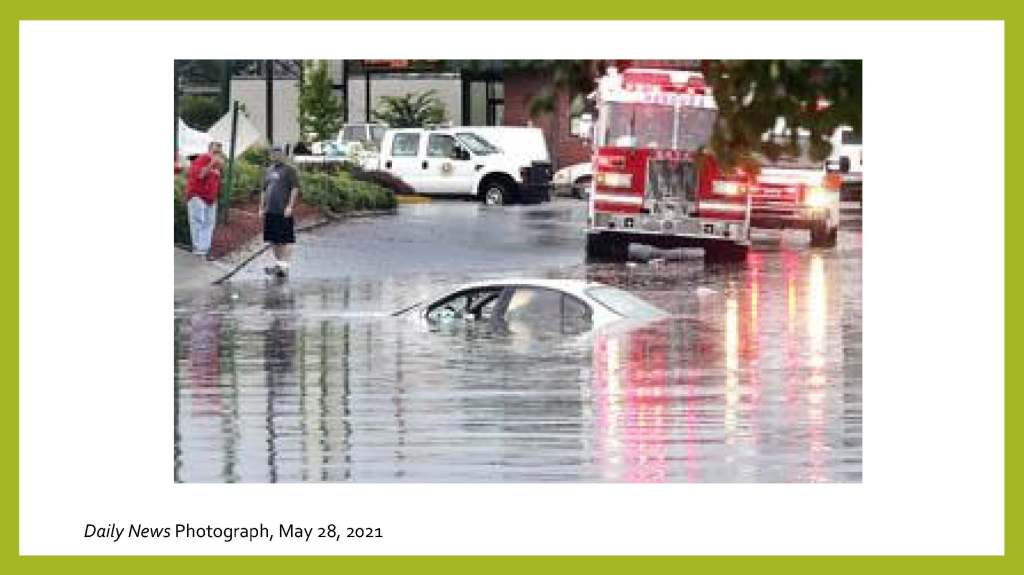
It is very likely that heavy precipitation events will intensify and become more frequent in most regions with additional global warming. At the global scale, extreme daily precipitation events are projected to intensify by about 7% for each 1°C of global warming (high confidence). The proportion of intense tropical cyclones (categories 4-5) and peak wind speeds of the most intense tropical cyclones are projected to increase at the global scale with increasing global warming (high confidence).






 Susan Feathers