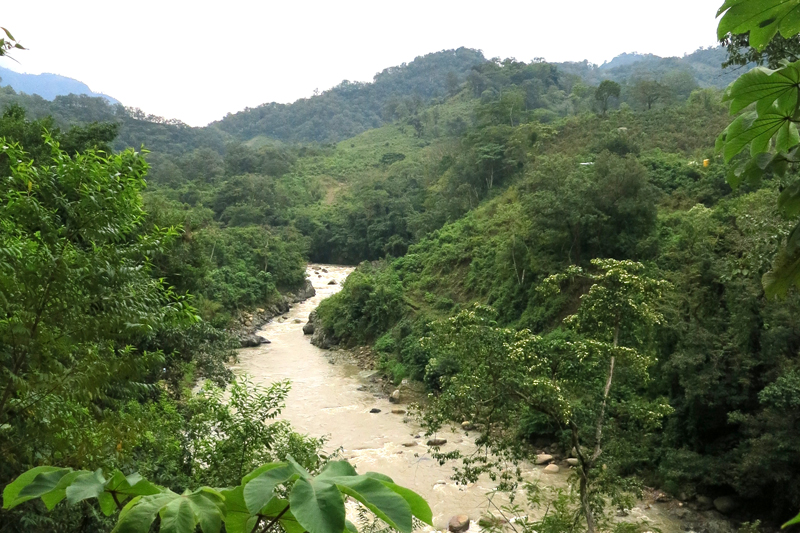
Last night the forces of authority, greed, and misogyny assassinated one of the world’s great defenders of the Earth: Berte Cáceres. Winner of the Goldman Environmental Prize for her defense of rivers in her homeland, she was murdered for leading indigenous peoples against the construction of the Agua Zarca Dam.
I think of the great women in America who defend the land under their feet: Barbara Albrecht in defense of Pensacola’s watershed, Madeline Kiser-Bieta in defense of Tucson’s watershed and Costa Rica’s rivers; Terry Tempest Williams in her defense of wilderness in Utah, and Florida writers like Jannise Ray in her defense of the Altamaha River and the Long Leaf Pine habitat; Anne Rudloe in defense of Gulf coastal habitat, and Marjory Stoneman Douglas for defense of the Everglades.
Women relate to nature through their bodies as well as their minds, as mothers who watch over their children. That is why women must lead today. Listen to this mother of mothers speak about her homelands. Under constant threats to her life, she persisted to speak for her people and their land, for the Earth.
For a look at how Terry relates to our public lands and actualizes her beliefs, here is a short interview with her on Democracy Now where she describes buying more than 1700 acres of public lands in a rather private sale of public land for oil leasing where an acre costs about a $1.50 for the right to drill and keep the profits. She is redefining “energy” in how she intends to explore these public lands. This is a very enlightening and motivating example of what one person can do to stop the destruction of critical, sacred habitat.
My grandparents were long time Republicans, small farming families from east Tennessee. Their values of self-reliance and Christian values remain in what is today a mostly Democratic family. Perhaps for that reason, I’ve always had an “ear” for the Republican side of politics and governing.
Moreover, I consider it an American citizen’s duty to consider both or all sides of politics before making decisions. Yet today, like no other time in my life as an American, can I remember when a candidate who openly supports xenophobia, hatred, and incivility, is rising to the forefront of the Republican party.
Historians liken our time to that of Germany and the rise of Hitler, another state where whites began to fear the “other.” In the 1930’s, Germans began to point a finger at one group as the reason for economic ills: Jews.
Donald Trump is rising on a wave of hate and frustration among white Americans feeling a threat to their economic security. This is part of a general loss of faith in institutions overall, a point made by Juan Cole on his blog, Informed Comment.
The fact is that our demographic is changing in color. If the idea of our Republic was to establish a white, Christian state with men in power forever, then it was never a Republic. What our forefathers did (when in fact the starting point was white, Christian, male) was to set into motion the idea that everyone can obtain the right to pursue their own happiness as long as they are willing to meet a basic set of criteria. And that criteria requires we participate actively in a democratic way of life. Discourse (the exchange of points of view for consideration by all), not debate (where one view wins over another) is a hallmark of democracy. Granted, Americans struggle to live up to these high ideals. But, that’s what makes us great.
History shows us that tolerance is a key component of American life, too, that we must all be able to listen to each other with respect, and to engage in reciprocity as we exchange ideas. That is really hard. But its required in a Republic.
What we have today are two forces rotting the core of our Republic: 1) good people who remain silent (of all political persuasions); 2) giving media time and voice to a demagogue who represents nothing about the American way of life. The latter is a function of the erosion of the free press into vacuous and dangerous entertainment.
Losing our Republic is possible in our lifetime. And, oh, what a tragedy when I think of what it took of our forebears to win it, and all the generations – Republicans, Democrats, and Independents – who have fought so hard to keep it, improve it, and rise to its ideal of civil discourse and cooperative living.
From my earliest memory, I have loved being in nature. I frolicked in the out of doors, savoring every second I could:
rolled down a hill with gravity pulling me faster and faster, out of control; jumped into a fragrant pile of leaves trusting it would cushion me;
plunged into a pool when the air popped with heat; shushed down a quiet, snow covered slope toward a tiny chalet, smoke twirling above its chimney;
rocketed a backhand, uncoiling the power of my body to propel a fuzzy ball on an accelerating arc to my opponent’s feet.
These are the gifts of being alive on Earth, this magnificent creation.
Only here can I be carried away by the scent of orange blossoms; only here can I gaze into the blue mirror of a lake at mountain peaks and passing clouds.
I come away from digital kingdoms that replicate at exponential speed; I come away to a world made whole, and wholly holy.
For years I sensed Earth’s wholeness, whenever I remembered and returned.
For years I pursued knowledge to understand why it was that way.
And then, I just accepted the world was made whole.
This is a very interesting news segment on Democracy Now about the Scalia impact on history and the Supreme Court, and what we might expect going forward on major issues before it.
*350 Pensacola posted this article about what Antonin Scalia’s death means for climate change:
Since the death of Justice Scalia, I have searched for a good review of Antonin Scalia’s life and legacy in interpreting the law of the land. While I do not personally share his political beliefs about Constitutional “originalism”, I respect a life lived with devotion to the law and to one’s personal beliefs. The reason I am posting this is to provide the perspective of at least some of the Republican Presidential candidates about Constitutional interpretation.
So, before we all rush off to join the conflagration considering Scalia’s replacement, here is an article by Mark Sherman from Saturday’s Christian Science Monitor that explore’s the man’s life and work. This gives citizens an idea of the impact of one judge’s beliefs and legal interpretations and the challenge to President Obama in replacing a Supreme Court Justice.
The Nation Magazine published an article this week that reminds readers of Eleanor Roosevelt’s message to a fear-racked American public following the bombing of Pearl Harbor.
Perhaps, on us today lies the obligation to prove that such a vision may be a practical possibility. If we cannot meet the challenge of fairness to our citizens of every nationality, of really believing in the Bill of Rights and making it a reality for all loyal American citizens, regardless of race, creed or color; if we cannot keep in check anti-Semitism, anti-racial feelings as well as anti-religious feelings, then we shall have removed from the world, the one real hope for the future on which all humanity must now rely. ~ Eleanor Roosevelt quoted in The Nation, “What can we learn from Eleanor Roosevelt in a time of Xenophobia?”, February 5, 2016.
Any Presidential Candidate who voices hatred for another religious belief or race leads us away from the great mandate of our national creed. David Woolner’s article follows The First Lady’s visit to a Detention Center, to President Roosevelt’s error in giving into the demands for internment by a fearful public. The article is extremely useful in the malaise of fear that pervades the American psyche today.
While the GOP field of candidates shrinks, we have only one Republican, Jim Gilmore, and the Green Party candidate, Jill Stein left to review. This series of blog posts examined the education and early influences of Presidential Candidates:
Gilmore enlisted as a volunteer in the U.S. Army after college and worked as a counter-intelligence agent in then-West Germany in the early 1970’s after intensive language training in German, in which he became fluent. He was awarded the Joint Service Commendation Medal for Service to NATO.
As a student, he received his undergraduate and law degrees from the University of Virginia. He worked as a grocery store cashier to help pay for his college education.
Married to Roxane Gatling Gilmore with whom he shares two adult sons, Gilmore divides his time between his two Virginia residences in Alexandria and his hometown of Richmond. ~ About Jim, http://www.gilmoreforamerica.com/bio/
We are just about finished with the examination of the education and early influences that shaped each of the Presidential candidates. This exercise was inspired by W.E.B. DuBois:
If we make money the object of man-training, we shall develop money-makers but not necessarily men; if we make technical skill the object of education, we may possess artisans but not, in nature, men. Men we shall have only as we make manhood the object of the work of the schools—intelligence, broad sympathy, knowledge of the world that was and is, and of the relation of men to it—this is the curriculum of that Higher Education which must underlie true life. On this foundation we may build bread winning, skill of hand and quickness of brain, with never a fear lest the child and man mistake the means of living for the object of life. ~ The Talented Tenth
MIKE HUCKABEE
Education and Early Life on Wikipedia:
Huckabee was born on August 24, 1955, in Hope, Arkansas,[11] son of Dorsey Wiles Huckabee and his wife Mae (Elder) Huckabee, conservative Southern Democrats. Huckabee is of English ancestry, with roots in America dating to the colonial era.[12][13] He has cited his working-class upbringing as the reason for his political views;[14] his father worked as a fireman and mechanic, and his mother worked as a clerk at a gas company.[15]
His first job, when he was 14, was at a radio station where he read the news and weather.[16] He was elected Governor of Arkansas by his chapter of the American Legion-sponsored Boys State program in 1972.[11] He was student council vice president at Hope High School during the 1971–72 school year. He was student council president at Hope High School during the 1972–1973 school year.[17] He has one sister, Mrs. Pat Harris, a middle school teacher.[18]
Kasich was born in McKees Rocks, Pennsylvania, an industrial town near Pittsburgh.[9] He is the son of Anne (Vukovich) and John Kasich, who worked as a mail carrier.[10][11]Kasich’s father was of Czech descent, while his mother was of Croatian ancestry.[12] Both his father and mother were children of immigrants.[10] He has described himself as “a Croatian and a Czech”.[13]
After attending public schools in McKees Rocks, Kasich enrolled at Ohio State University, where he joined the Alpha Sigma Phi fraternity.[14] As a freshman he wrote a letter to President Richard Nixon describing concerns he had about the nation and requesting a meeting with the President. The letter was delivered to Nixon by the University’s presidentNovice Fawcett and Kasich was granted a 20-minute meeting with Nixon in December 1970.[15][16]
Earning a Bachelor of Arts degree in political science from Ohio State University in 1974,[17] he went on to work as a researcher for the Ohio Legislative Service Commission.[18]From 1975 to 1978, he served as an administrative assistant to then-state SenatorBuz Lukens.[19]





 Susan Feathers