
Continued…meeting Earth and Sky

And then I had an experience lifted out of time and space in a rundown, dusty thrift shop in Winterhaven, Arizona when Sundance suddenly asked to visit it.

There among stacks of old books and magazines, a cacophony of throw away objects from locals, Sundance found several volumes of the Stockholder’s Board of the Hudson’s Bay Company founded in 1670 primarily for the fur trading business and colonization of North America by the British.

Gabe Sharp served nearby at the Quechan Indian Reservation as a social worker fulfilling his dream of helping his people – the Colorado River Indian Tribes – to return to health and wellbeing someday.  In the little dusty town of Winterhaven, in a disheveled second-hand store, we touched back in time through historical records that graphically outlined plots to seize native lands, and the purposeful use of alcohol to facilitate the process.

At times like those I often felt as if I entered another reality where my teacher and I traveled time channels to the past.  There we sat together, carefully reading these documents out loud, and making runs to a local library or consulting texts from her wonderful library, to learn more about the history of colonization in North America.  There it was in black and white and without any reservation – the blatant conniving of grown men who recorded their reservations, knowing it was wrong to outright seize land from people who had done nothing other than welcome them to their country. 

European culture would introduce a world view so different and with grave consequences on the natural world and a way of life that would later inspire our fledgling republic. The shaking of the Earth is still felt. Today in Canada, native people continue to resist the forces of progress and its underlying economic values.

We were shocked by the recorded discussions between original board members who felt some tinge of guilt about seizing ownership in the name of the King.  In fact, they feared he would not go along with it, so they planned a scheme to get Prince Rupert to make the declarations.  We laughed to read the names of these men including one Richard Nixon.  Though both of us, my teacher and I, knew about the facts of this early colonial period in what is now Canada and northern New York State, we were incredulous to read the actual discussions and plans by a small group of men who would crush nations to get at trees and animal fur. Another evil evident in these meeting notes was the discussion about use of alcohol to manipulate tribal leaders.

The Doctrine of Discovery and the policy of Manifest Destiny derive from these forays by powerful nations to justify taking other nation’s freedom and resources. This has been justified based on power and dominance, and a profound misunderstanding about human’s relationship to Nature. The stockholders utilized religion and power as their rational for violating the natural rights of nations and the Earth Herself.

These then were the ways in which over the four years of study I lived near my teachers so we could do research together. I spent days out and about in the Yuma area with my teachers when I could observe how white culture treated them and explore my own assumptions and automatic thinking about culture and race.

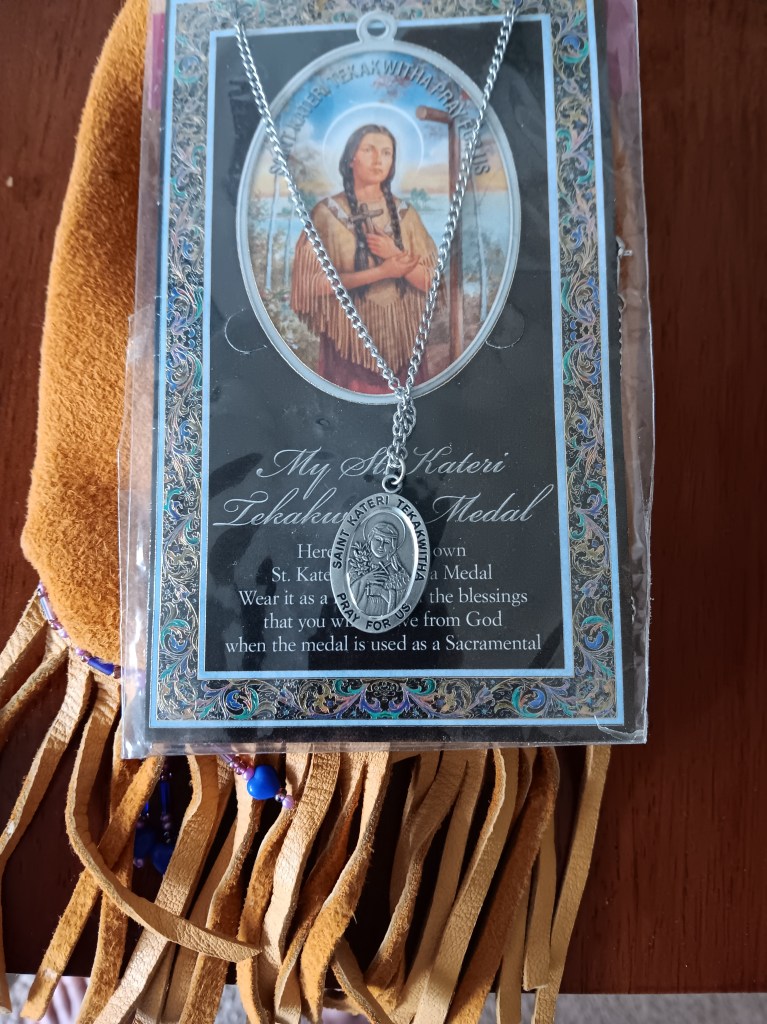
While studying with Sundance, she introduced me to her Catholic faith through the life of Blessed Kateri who subsequently became Saint Kateri Tekakwitha. Kateri was known as the Lily of the Mohawks. I learned to pray the Rosary and made an altar in my bedroom. When I joined the Kateri Society based in Fonda, N.Y. they sent me several Kateri objects such as a necklace, a history and prayer card. I added these to my altar along with a small statue of her. She is beloved among Catholics and native peoples. This may seem like a profound contradiction, but you’ll understand why when I post the next insights I made about the fluidity of Spirit.

To be continued …
Resources:

National Constitution Center

Hudson’s Bay Company

Mohawk History

The River People – Chapter 10

Continued …

Photo by Oleksandr P on Pexels.com

July 6, 1865

His son opened the letter from Col. Boatright and began to read.

“Wait” Chief Joe said, gesturing for his son to hand over the envelope and letter. Joe held both between his palms and closed his eyes. Breathing deeply he opened his eyes and examined the writing, finger following the looped symbols 0f an even hand. Last, he studied the signature.

“Okay, you read now,” he said, handing them back to his son. It was the first letter Joe had ever received, sent in care of the Fort Yuma Commander.

~~~

The Lieutenant had penned a copy of the original letter, written with a bit of flourish at the end as if he had considered it the official closing of a chapter in his life. It was later reprinted in the small book Vicky found in the dusty bookshop overlooking the reservation.

A letter from the Office of Indian Affairs was reprinted – a prophetic answer to the retired Colonel’s inquiry.

August 12, 1865

Noting receipt of a letter from the Office of Indian Affairs, U.S. Department of the Interior

Re: Correspondence from Benjamin Boatright, Colonel, U.S. Army, Ret. Regarding the current and official status of Indians in the United States of America.

Dear Sir:

Tribal members are not considered citizens of the U.S. and by that are not protected by the 13th or 14th Amendments. The Office of Indian Affairs has established its own set of regulations regarding Indian tribes as negotiated in treaties between said tribes and the U.S. Federal Government.

If the River People refuse to live on the Colorado River Indian Reservation, they will be acting outside of the federal laws established in the Treaties. While we do not have sufficient means to force them onto that reservation at present, should they resist the U.S. Army, they will not have access to food or any other kind of service the U.S. Army normally provides to tribes during removal. It is the opinion based on reports from Ft. Yuma that the reservation lands set aside for the Colorado Indian tribes are sufficient to provide them with their traditional ways of living.

Efforts are underway to establish a process by which native children can be boarded and educated in the ways of our civilization, and for assimilation to our country’s laws and principles. The legal basis for these matters can be found in the Doctrine of Discovery and Manifest Destiny policies of our nation. It is the wish and fervid desire of our leaders and citizens that this country’s Indian tribes assimilate into our civilized and democratic ways of life and governance. Having done this, their families can benefit from the fruits of a democratic society where every man is considered equal and deserving of the freedoms inherent in that status.”

In your service,

Capt. Larry Haskell

Assistant Secretary

1870

Chief Joe dictates to his son who records his father’s thoughts in a diary he is preparing for the People.

“More settlers establish themselves near Ft. Yuma. The white flood never ceases. Our people’s existence is threatened.

“Col. Boatright is unable to help us. We have not received another letter from him since he last wrote stating that he would try to learn more on our behalf.

“Among our steamboat pilots and the men who supply the wood to fire them, I’ve noticed some buy alcohol in town after they are paid. Despair is high among us and I confess that I feel a kind of deep fear and grieving as I realize there will be no cease in the white man’s efforts to herd us to some place far from our homes and without the bounteous river and forests that have been our source of life for so long.

“There is no regard for original land rights, nor respect for the traditions of our nation. We are looked upon as lesser than the whites, ignorant because most of us do not read or write. At least our sons can do that, but now I wonder what good it might do for them if they are hated for being Indian, as the whites have named us. But something in me will not give up; I still hold that there must be a way to survive as a people, to preserve our ways even while we try to live among these strange human beings. Our people have never shied from a challenge, and we have embedded within our ways, our stories, and practices a certain resilience and adaptability that will sustain us—I just know it—but I cannot seem to see the way forward in this white onslaught.

“Col. Boatright is different I believe. Yet few among his people share his vision – or possess his courage.”

Read more about the Doctrine of Discovery.

Photo by Isaque Pereira on Pexels.com