
Religion’s Role in Caring for the Earth

Religious groups are exploring their role in curbing climate change. One of the Land Ethic Books Clubs that I am facilitating in my community, the Lathram Chapel United Methodist Church in Barrineau Park, FL, is looking deeply into the scriptural directions for caring for the earth.

The Guardian the British news publication and winner of the 2014 Pulitzer Prize for public service is focusing on climate change. The Greatest Story in the World, a podcast on climate change is part of the current efforts to start deeper discussions about institutional and individual roles in solving climate change. This is Episode 9, Religion. Here is the link. 

Faith groups have huge followings and have adopted climate change as a cause for decades. What can the Guardian learn from religion? Can the paper use the language of sacrifice when it doesn’t have the same offer of salvation?

We strongly recommend that you listen to the series from the beginning.

Related resources
Neil Thorns – How will the world react to the Pope’s encyclical on climate change

Suzanne Goldenberg – Climate change denial is immoral says the head of the episcopal church

Damian Carrington – Church of England wields its influence in fight against climate change

~ Guardian Podcast, Episode 9
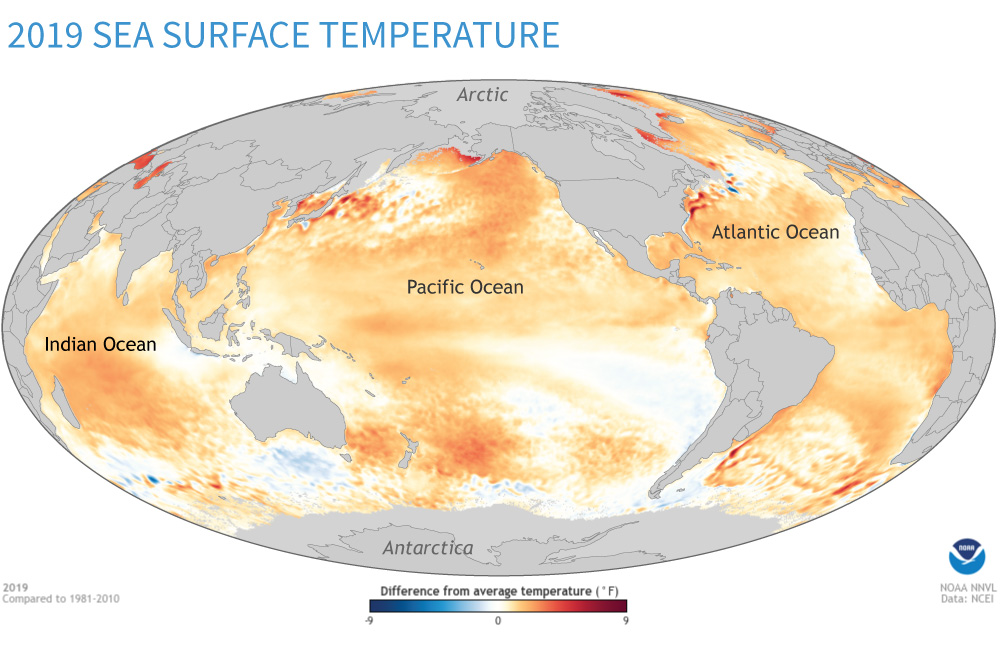
Warming Ocean Surface Temps…

Comparing today’s temps to the temperature I blogged about in 2009 – a quarter century ago.

Ocean heat content has increased from 1971 to 2018 by 0.396 [0.329 to 0.463, likely range] yottajoules and will likely increase until 2100 by two to four times that amount under SSP1-2.6 and four to eight times that amount under SSP5-8.5. The long time scale also implies that the amount of deep-ocean warming will only become scenario-dependent after about 2040 (medium confidence), and that the warming is irreversible over centuries to millennia (very high confidence). 

IPCC

A yottajoule is 1024 joules. A joule is “the heat required to raise the temperature of water from 0 degrees Celsius to 1 degree, or from 32 degrees Fahrenheit to 33.8.”

From the Environmental News Service

ASHEVILLE, North Carolina, July 21, 2009 (ENS) – The world’s ocean surface temperature in June rose to its warmest since 1880, breaking the previous high mark set in 2005, according to a preliminary analysis by NOAA’s National Climatic Data Center in Asheville.

The combined average global land and ocean surface temperature for June was second-warmest since global recordkeeping began.

The combined global land and ocean surface temperature for June 2009 was the second warmest on record, behind 2005, 1.12 degrees Fahrenheit (0.62 degree C) above the 20th century average of 59.9 degrees F (15.5 degrees C).

Read More