Humanity is on track to reach and surpass the 1.5° C planetary heating.
The latest UN Climate Report from the UN Environmental Program reports that the world may exceed the 1.5° C global heating limit on degrees of heating and goal of the UN Climate countries which had projected that that temperature could occur by 2100. It’s likely we will exceed the 1.5° C in the next few years. The UN is declaring an emergency.
Cooling Down Will Not Happen on a Timescale Meaningful to Humans
Global heating will not lessen but continue to rise as long as the atmospheric concentration of carbon dioxide [CO2] continues to rise. Once the ocean begins to heat up it does not release the heat in any time period meaningful to human beings. What that means is that the world is heating and will not cool down even after we have stopped contributing more CO2 to the atmosphere.
The largest contributors of [CO2] historically are the early industrializing countries with the U.S.A. leading. While today we have reduced our [CO2] contributions according to commitments made as part of the various international agreements, we must continue to dramatically reduce our current contributions to greenhouse gas emissions (GHG). Efforts around the world to increase the production of clean energy sources are showing outstanding success. China has so much clean energy production they have a problem with how to store the excess. Africa is building out grids with clean energy. Australia has enough clean energy generation that anyone can use energy from the grid at noon for a couple of hours of FREE energy. Even in the USA where the current administration has stopped the momentum for clean energy production while declaring there is no such thing as climate change and increased fossil fuel development, the U.S.A. has continued to build out clean energy infrastructure. The momentum cannot be totally blocked because clean energy is cheaper keeping economic advantages that drive ongoing development. The U.S. public has also continued pressure for cleaner, cheaper power and infrastructure.
Resources for Readers
On Substack
What If We Get It Right? Ayana Elizabeth Johnson – Ayana read the UN Report on Limiting Overshoot of the 1.5° C
The Crucial Years – Bill McKibben updates on election and climate (September 7)
The Weekly Anthropocene – Sam Matey-Coste Interview with Professor Jeremy Ney: Professor Ney and Sam discuss many of America’s climate related challenges with positive gains on development of clean energy updates by Sam
I recommend all three Substack accounts for reliable updates, with Sam keeping track of positive energy developments across the world. I read Sam as I would a hope serum.
When despair for the world grows in me and I wake in the night at the least sound in fear of what my life and my children’s lives may be, I go and lie down where the wood drake rests in his beauty on the water, and the great heron feeds. I come into the peace of wild things who do not tax their lives with forethought of grief. I come into the presence of still water. And I feel above me the day-blind stars waiting with their light. For a time I rest in the grace of the world, and am free. ~ The Poetry Foundation
My spiritual center, i.e. the physical and psychological tether of my soul on this planet is the ancestral home of my grandparents in Watauga, Tennessee. The Hilltop Farm they inhabited and farmed, and welcomed their children and grandchildren is the place where I felt Mother Earth’s presence as a child. I have written that I’m tethered there, grounded there psychologically and spiritually. For my entire life it hovers in my imagination and pulls me toward it.
America was first an agrarian nation with millions of family farms by the time I was born in 1945. But during my life up to now (81 years and counting) we have lost millions of small family farmers and their lands to industrial scale one crop operations owned by corporations with no human face. With that theft the soil of our geographical home has been robbed of its biological wealth and resilience. Young farmers today – our pioneering youth – face insurmountable barriers to small farm, biodiverse farming. The American Farmland Trust reports that we lose 2,000 acres of farmland every year. Most of these are farms where the farmer ages out. Sons and daughters do not carry on the farming business because its almost impossible to make a living growing wholesome food for Americans in their local communities. The farm is sold. American is sold out for some corporatized replacement that drains the community of its wealth.
Wendell Berry, whose poem has always resonated with me as a fellow guardian of the sacred nature of the Earth. If we cannot learn to live on Earth without ruining it, we are doomed. This is everywhere apparent across the planet.
Why have corporations come to rule over us? Why is capitalism a no-win system? Get a tea or coffee, or a clear glass of that sacred beverage – agua pura – and listen to Wendell Berry discuss America’s un-settling by greed.
I promise you this interview with the late great Kentucky farmer-poet, writer and philosopher – at a Sustainable Agriculture conference – will settle you with his eagle vision of a way forward in an uncertain time.
that the world should become so immune to its own losses seemed inconceivable 25 years ago. Now that we have re-learned how remarkably obtuse humankind can be when dazzled by monetary and material gain, we must shine the light all the brighter on the singularity and prescience of Schumacher’s work and vision.
When I first read Small is Beautiful by E.F. Schumacher, it was 1981. I was concerned then by food security and exploring why hunger and poverty persist. At that time, I was leading a community effort to raise funding for hunger relief with the goal that at least some of it would be invested in longer term solutions. That project is the Harry Chapin Run Against Hunger, now in its 46th year.
Schumacher called his understanding of sustaining economics as “economics as if people mattered.” He was a British Economist who had identified the most effective size and orientation for production to address the needs of the community where it operates.
He showed in real time examples that the ideal size for a company was no more than 500 employees. A company that size can achieve economic wealth while improving the lives of employees and contributing to the community it impacts.
As time progressed, and I studied to become an environmental educator, his research and understanding about “economics as if people mattered,” I saw these principles at work in nature Herself.
On Earth five principles of sustainability are followed. 1. a limitless, nonpolluting energy source; 2. avoidance of over drafting the carrying capacity of an ecosystem;3. maintenance of biodiversity generation to generation; 4. recycling of waste; and 5. adaptation to change.
We are operating at a deficit.
The World Meteorological Organization (WMO) has released its 2026 report on the state of heating of the Earth and contributing factors. Here is the Press Release.
The Global Annual-to-Decadal Update also takes a look at the observed climate over the past five years and gives regional predictions for temperatures and precipitation over the next five years.
Annual global mean near-surface temperatures during 2026–2030 are predicted to range between 1.3°C and 1.9°C above the 1850-1900 average. It is likely (86% chance) that one year between 2026 and 2030 will surpass 2024 as the warmest year on record, according to the update.
It is very likely (91% chance) that the global mean near-surface temperature will temporarily exceed 1.5°C above the 1850-1900 average levels for at least one year between 2026 and 2030. This level was also temporarily exceeded in 2024, when the global average surface temperature was about 1.55 °C above the pre-industrial baseline.
It is likely (75% chance) that the 2026-2030 five-year mean will exceed 1.5°C above the 1850-1900 average. It is considered exceptionally unlikely (less than 1%) that any single year will exceed 2°C above the 1850-1900 average in the next five years.
Everybody and everyone will be impacted due to this global heating mostly from fossil fuel burning which through the industrial age to the tech age has exceeded the carrying capacity of the Earth’s ecosystems. We are seriously overdrawn on all measures of sustainable living.
The operational principles of Mother Earth’s body from which we all derive our lives, give us the signs to follow now. While we as yet cannot remove the greenhouse gases already in excess, we can at least stabilize our climate by countries switching as quick as possible away from burning fossil fuels.
Meantime, its all about adaptation. How we live, what we eat, how well we care for our families and others, and having the right kind of leaders in place.
America is in a world of hurt from an ignorant and ideologically driven autocracy forced on its citizens by traitors to our government and people. So here we must work at all levels to adapt. Innovative ideas for reducing our impact on nature (i.e. fresh and ocean water; soil quality; affordability; homes that make their own energy; grid development for clean electrical sources; moratoria on any technology that threatens the well-being of all life on earth; thinking outside the box of conventional thinking…these all can generate exciting new jobs for upcoming generations. Lets get to that.
To be continued …
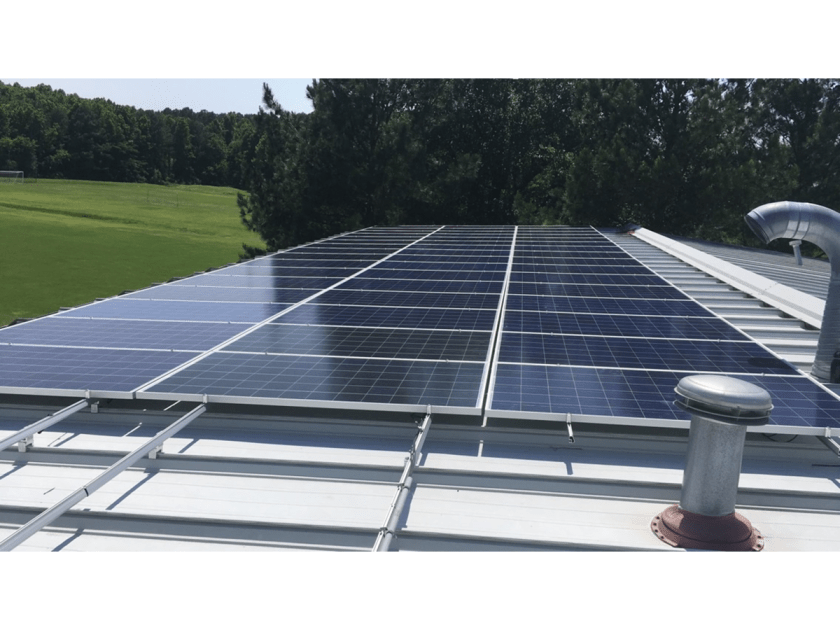
Photo above from Norfolk Academy in Norfolk, Virginia. All new public schools should install roof top solar and existing schools can install on schools when they replace the roofing. Just put into policy.
There are two spiritual dangers in not owning a farm. One is the danger of supposing that breakfast comes from a grocery, and the other that heat comes from the furnace.
Food Security is threatened all across the Earth as climate change is ramping up in extreme heat, consequent drought, fires and flooding, and in rising costs to farmers. In some parts of the world, new crops may need to be considered. For decades now, groups across the world have been working to create new genetic seed varieties that can thrive under adverse conditions.
In the eastern United States, once the breadbasket of a new democracy, farmers are facing daily threats to crops. Changing seasonal patterns, drought, loss of pollinators and other synergistic insects; rising costs of diesel fuel and fertilizer, and saltwater inundation from sea level rise challenge crop production.
Out west in the breadbaskets of America where water is the limiting factor, a historic long-term drought has resulted in Federal oversight of the states sharing the Colorado River system to stem a catastrophe where 40 million people live in major cities of our nation: Phoenix, Los Angeles, and Las Vegas.
This is an impending health crisis. Water is the limiting factor of human life. Water is first and a healthy, stable food supply is second. These major growing areas (the Imperial Valley in California, Arizona farms and orchards, and to some extent the northern Mexico food production supported by the Colorado River valley are all threatened by the drought on the once mighty Colorado River – caused by historic overuse of the river.
When the Colorado River Pact formed in 1922 among seven states (Upper Basin and Lower Basin states), the allocations were made using average annual flow data that was based on historic high volume. Later, after the Colorado River system was dammed and redirected to flow to agriculture and cities, scientists discovered that 100-year droughts were common in the geological record. In spite of John Wesley Powell’s historic expedition to the West and navigation of the wild Colorado River (paid for by Congress) to assess whether America’s western lands could be developed by harnessing the Colorado, he reported back to Congress that the lands were water restricted to 1-10” of rainfall per year. He cautioned Congress that big construction schemes should not be developed in deserts. Congress ignored his report. And here we are.
America’s Once Historic Breadbasket of the World is in Crisis
Let us be sober for once and look with a clear eye at our country’s situation. Farmers are sending signals that weather and climate are making it harder to bring their crops to harvest and economics are hindering it, too. Also, our long-held pride in small farmers at the center of production is giving away to corporate farms. Those small family farms that grace so much of the Southeast may soon be a relic of the past.
Our country is focused internationally, spending our wealth on unwarranted wars when we have a catastrophe brewing at home: loss of food security.
We see it now as millions of American families are priced out of the healthier foods due to rising costs caused by worldwide tariffs and consequent downstream price forcing. (I’ve watched the price of even the humble sweet potato rise from $0.69 to $1.29 per pound in just a year.)
Access to fertilizer and affordable diesel and climate impacts are chasing each other for front runner position with threats to water supply leading the race. Another runner nipping at their heels is saltwater inundation and drought-caused salination of soils from rapid evaporation. All these factors are combining to potentially reduce food security.
What do we mean by food security?
While there are a variety of ways to understand food security, it contains systems that intersect and combine to create access to a stable healthy food supply. American Agriculture and food industry have striven a century to create what we enjoy today.
access to healthy food (affordability, quality and reasonable proximity);
stable agricultural production season to season (predictable costs to farmers for production both nationally and internationally with oversight to assure farmers are supported in creating market demand for high quality food production);
predictable seasons and growth conditions);
land use (should water-loving crops like cotton or corn for ethanol be grown or crops grown for meat production be carved back when water supply is limited?)
land management for stable freshwater supply and healthy soil;
scientific innovations for seed production, pest control, deep soil health;
fair and stable markets and
nonpolluting, affordable sources of power for food production/transportation..
For centuries, American farmers and international partners have created a robust and dependable food supply for the nation and many other countries around the world. For a century at least, the U.S.A. has supplied emergency food wherever famine develops.
Our national supermarkets are a wonder to international visitors. At least up to now. Dangers lurk that currently threaten our national and international food security.
Stay tuned for the next post on food production from our oceans, lakes and rivers. Please comment on this post so that we can all benefit from our collective wisdom on this critical matter.
Reaching the Poorest: More than half of all benefits go to households living at or below half of the federal poverty line. [Ibid]
Protecting Children: The program has a strong positive effect on kids, lowering both the count and the hardship levels of child poverty. [usda.gov/about-usda/news/bl]
“Any fool can destroy trees.” ~ John Muir, from “Save the Redwoods” essay in John Muir, Nature Writings, The Library of America, p. 830, 1997, N.Y., N.Y.
Study the maps from the Berkeley Climate Monthly Report (previous post on this blog). Study Europe, especially France and Spain. This heat pattern was long predicted by climate scientists yet with all we know, and without any hope of a global effort to reduce heat producing carbon emissions, it may yet all come true and then some.
Heating on land takes human lives, destroys forests whose carbon sequestration is fundamental to the gentle climate we have known for at least the last 10,000 years. We have depended on weather patterns known to us as seasons of the year. Farmers have known these patterns and have planned accordingly.
As agriculture varies over the centuries and location, humans have learned how to extract the most food out of a given piece of land. Extraction from tilling the land we have recently observed destroys the underlying networks of mycelia that are the conduits of water and minerals and the central hub of the lives of millions of microbes and invertebrates whose lives make our abundant foodshed possible.
We are entering a new era of life on Earth. Across the world people and organizations labor to restore ecosystems and to protect species. Notable too are the family by family efforts to plant natives to support insects and birds and other of our kin at risk from climate change, pesticides, and general disruption of their life cycles in their habitats.
In spite of these local or regional efforts, we have passed a point where Earth’s biological systems are irrevocably disrupted by climate forcing that has caused drought, floods, fire, mega-storms and now, these play back on each other for a forcing effect. The fires in the NE USA, Canada, and Europe are illustrative. The fires are so intense now that they are creating their own weather. When this happens, no human intervention can stop them. More people are displaced.
We have passed tipping points now. No going back. This could have been stopped or slowed down had we stuck together across political and social divides but we did not. We know Mother Earth’s creatures are malleable and ultimately able to adapt under favorable conditions. Its still possible that there are things we can do now but they are hard and will need big collaborations to achieve.
This fact has been hard for me personally to acknowledge. Generally, I am an optimist believing there is hope to make change happen soon enough. But those changes, at least in America, have been stymied and denigrated by leaders and some of the public alike. All that fossil fuel lobbying paid off? No one will be unscathed by the coming Earth changes. Nature will endure but in some form we cannot predict nor whether we’ll survive to be part of it. Nature is responsive and ultimately able to change under different conditions.
America embraces capitalism as its economic religion and oath. The vagaries of the system have boomeranged over the decades between the forces of greed and the forces of prudence and justice. In America the forces of avarice and greed are in the White House at present, half the Congress unwilling to stop it, and the other half powerless. Citizens and representatives still in touch with reality are forming coalitions and I feel a groundswell forming to stop them. But when? The world is burning around us. How much longer can rich and powerful people live in altered realities with all their power and wealth? Don’t hold your breath. Better to join with friends and people who DO possess reason and power through the Constitution.
I am not giving up nor are you. There is a growing coalescence among neighbors and communities across the U.S. We can do amazing things together; we can’t stop climate change but we can adapt to it using not only our wits, but also by cultivating a reverence for the Earth we forgot somewhere on the way to “get the gold”.
The reason our culture has not embraced an intelligent relationship with our planet is the way we consider humans separate from other species and the land and waters of Mother Earth. Yet nothing could be further from the truth no matter what some religions may teach. We are a biological species. Our contribution to the whole biota is that we are reasoning creatures and we have an opposable thumb and we make stuff. We could be very useful to Mother Earth by understanding how the natural world works and that we are one among millions of species. I am no fool that that change of worldview could happen in America soon enough, but a great deal of our people are coming to this understanding. So, a major action we can take is to be in a spiritual posture of humility and take actions to undo the conditions that are causing climate change.
We can’t stop it now, but we can mute the impacts and then learn what the new realities will mean for ALL life on Earth and adjust how we live. That is, we embrace and recall reverence for life which our species once embraced. We should turn to the original keepers of North America, the Tribal Nations across this land. We can learn from their understanding of our place in the great panoply of life on this land.
Watch a video from Democracy Now about Data Center development on Tribal Lands. Many governing bodies like Tribal Councils or City Councils sign nondisclosure agreements (NDA) with developers of data centers that prevent citizens from knowing what kinds of deals their governing body makes. Link below to segment.
Krystal Two Bulls, Executive Director of Honor the Earth is interviewed by Amy Goodman about tribal nations pushing back on data centers on their lands, many in water stressed regions such as Utah.
“A thing is right when it tends to preserve the integrity, stability, and beauty of the biotic community. It is wrong when it tends otherwise.” ~ Aldo Leopold
We see this phenomenon in the seven states who have been drawing down the Colorado River Basin water resources to the point of an emergency, and now in the proliferation of data centers in support of AI. In both cases large scale industrial projects drive decisions rather than prudent decision making with a land ethic (meaning the best decision making by a thinking community).
Citizens are finding themselves in a water crisis across seven states who utilize Colorado River Water, or in the fact that citizens in U.S. states are in a quandary as data center developers pressure them to either sell their homes or face the whine, pollution, grid and water overuse of mega data centers built in their backyards.
These kinds of abuses and overuses of the planet’s generosity occur without an ethic that all agree upon. Aldo Leopold made the greatest contribution to this discussion in his landmark essay, The Land Ethic. Leopold considered a land ethic as a dynamic outcome of a thinking community working together for the best outcomes for both the biotic health of the land and for people. The quote above sums up the concept.
When the Colorado River Compact, which includes seven states that utilize its waters, discussed how they could work together to share this great river’s resources, they did so in spite of a basic fact: the river experiences periodic one-hundred year droughts as shown in fossil records and tree rings.
Americans living in these states have witnessed a long-term drought that has all but emptied the two giant reservoirs, Lake Mead (lower basin states) and Lake Powell (upper basin states).
Desert states like Arizona and California, have sucked the regions dry to support enormous growth in cities and agriculture. Before building the Hoover Dam to create Lake Mead, Congressmen in 1878 sent John Wesley Powell to assess the southwest region for its potential for development of the western states. He returned after 18 months to deliver a sobering conclusion: the arid region is unsuitable for large scale development based on available water supply and geological aspects of the west. Read a summary of his report here.
Today, nearly a century later, mega-wealthy oligarchs who developed artificial intelligence (AI) want to build huge (thousands of acres) data centers to power AI. The horses are ahead of the cart again as the public isn’t sure they want AI to be developed without careful discussion and oversight. Virginia, a drought-stressed state, has hundreds of data centers clustered in the northern part of the state and are salivating for land in rural area. They bully landowners, promise huge tax income while drawing large amounts of fresh water from aquifers. The trend is to push out home owners, farmers, and even small townships, by offering as much as $12M an acre. Some owners are pressured when neighbors sell and leave other land owners whose homes, farms and enterprises are their treasures. Emissions from gas-powered turbines, noise pollution, and hidden impacts such as the water required to produce the power to run the data center are unsustainable and undemocratic. Read this recent executive summary of data centers pros and cons from CERES, a nonprofit that supports sustainable business solutions.
What is missing is the values-discussion that Aldo Leopold described that is a dynamic process within a thinking community. It is an ongoing discussion that considers the health of the land when making decisions that could decrease its well-functioning. Read The Land Ethic Below. **This is one of the most downloaded files on my blog. People from all over the world read it. My own view is that no one from the scientific community has analyzed “how to live on a piece of land without ruining it” better than Aldo Leopold. See the Aldo Leopold Foundation located in Baraboo, Wisconsin for more about his legacy.
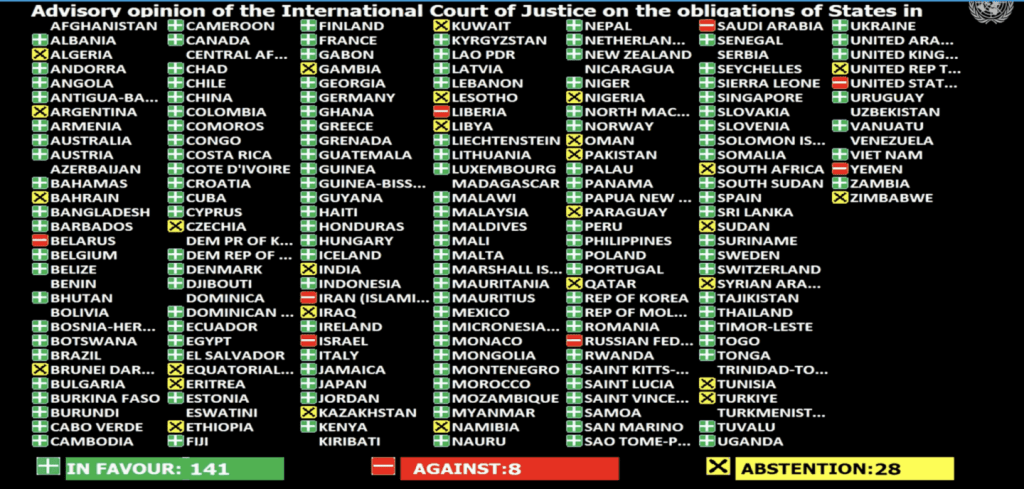
Today on the Sam Matey-Coste Substack account – The Weekly Anthropocene – news and a record of how countries voted to uphold the right of people across the world to a stable environment is presented. The vote responded to a ruling by the International Court of Justice. Note below, the U.S. now joins Russia, Saudi Arabia, Iran, Israel, Liberia, and others, to deny that right.
A U.S.A. nonprofit supporting youth is working in state and federal courts toward a declaration of the rights of children and youth to a healthy, sustainable climate. Our Children’s Trust is a nonprofit worth following.
Listening to youth speak to their futures requires all of us to understand our inaction acts to decrease their life’s potential. No one would deny that to children, right? The children and youth are given top notch legal education and representation at no cost. Explore the website by state to learn where youth are applying pressure to achieve a sustainable environment for their generation.
I highly recommend the book, The Ecology of Childhood, How Our Changing World Threatens Children published in 2020. Barbara Bennett Woodhouse devoted her law career to the rights of children. (See Google Scholar for her published works.) Bennett demonstrates how the U.S. ranks low compared to other developed nations in the social safety net provided for our children. We talk a good game about how we love our children in the U.S. but, when studied, that proves to be false. Now, we deny them a stable climate as well?
Readers, it is my firm belief that Americans are misrepresented by the current administration which denies climate change and has turned our country back to increasing fossil fuel production and use. The momentum toward clean energy that just got started in the Biden administration has slowed as a result.
In Sam Matey-Coste’s Substack account you can learn about advancement in clean energy and environmental victories in countries around the world. I highly recommend him to all of you who need a daily dose of climate hope.
In the U.S. there is progress in clean energy development such as in Texas and California, but it is much slower than it could be – especially in the automobile industry where sales of electric cars have plummeted. And now that Trump has illustrated how vulnerable the fossil fuel industry can be, the U.S. is losing out and our children’s futures are even more imperiled as the Earth warms. Emissions from fossil fuels are the primary driver of climate anomalies and storms like we’ve recently experienced — fires like we’ve never seen, droughts across whole regions of the continent.
But, it is not just our children whom we imperil. We imperil the world’s children. Emissions do not stay in place but circulate around the globe. We are all responsible and must get back to representatives in government who are responsible, serious adults. The window of opportunity for Americans to gain access to free or cheap clean energy is attenuating.
How can this be true? We have historically been a nation of innovators. But here, oligarchs in tech have taken away our agency and made us prisoners of their outsized influence over our politics and thus our government. Data centers to support AI development are being shoved down communities throats. Who profits? Oligarchs.
Step Up!
Step into this path we are on to take back our country and get back on a path to innovation, clean cheap energy for All, and working alongside our allies across the world to obtain for youth and coming generations a safe, stable environment, a world of innovators and well cared for people. War is obsolete, and our people must have a say through our representatives as to whether we go on defense of liberty. DEFENSE. The Speaker of the House refused to bring a vote to the floor of the House of Representatives to end the Iran War.
This administration must be held accountable. We must stand for truth and for our children’s future.
This time in U.S. history will either be recorded as our undoing and defeat, or our finest hour. Which will history record?
When I was a teenager, I would ride my horse deep into the Northern California wilderness. I came of age living in big nature. Given California’s growth and development, that ride would now be impossible. Yet phylogenetically, big nature is deep in all of our psyches. So I began to wonder why we were so rapidly destroying it. Years later at my first job at the University of Houston, I was studying children and parents’ environmental views and values. I found the children knew what air pollution was; but when we asked them if Houston had a problem with air pollution, they said, “No, we don’t have pollution here.” At the time, Houston was the most polluted city in the United States. – Peter Kahn, Environmental Psychologist
Environmental Generational Amnesia (EGA) was identified by Peter Kahn when I was working as an environmental educator. It began to answer my puzzlement about why people could not see the degradation of nature over time.
Kahn explained this phenomenon occurs as each generation takes the environment in their time as the norm.
Now, in America, I am wondering if this phenomenon works with memory of a democracy. We take what is before us as what it has always been.
In Kahn’s recommendations to counter environmental generational amnesia he worked with urban planners, for example, to build in features that allow local residents to experience more robust nature in a built environment.
Could we do the same for each generation to remember and know the origins of our Republic by experiencing aspects of a democratic society through out our lives as The People. Our form of governance is dependent on robust citizen and representative action and participation.
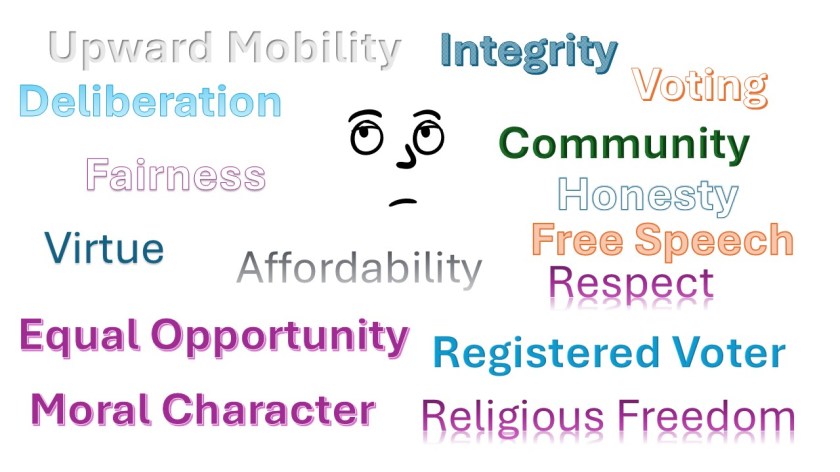
We could start by considering how to identify fairness, developing respectful listening; teaching check and balance by designing situations where kids can participate in situations demonstrate how it works to protect representation, free speech, and other key characteristics of a democratic society.
I recall a teacher in high school who designed his homeroom to function in this manner. He did something else: he taught us the Latin and Greek derivation of many words in our language so that we could derive meaning from root words
Do you agree that a type of democratic generational amnesia may be a force that works to undermine democratic governance which is dependent on individuals possessing more than rudimentary knowledge (i.e. memorizing definitions).
For too long, the dominant culture has cleaved humans from the web of life, insisting upon human separation from and superiority to the larger living world. That assumption has been translated into law, governance, and other realms of practice, justifying the treatment of nonhumans and nature as treasure troves for endless exploitation. However, the grip of this mode of thinking is beginning to ease, leaving space for new ideas and actions to sprout through. MOTH – More Than Human Life Program, https://mothrights.org/about/
Among thoughtful people across disciplines, the understanding that human beings are woven into the fabric of Nature – animal, plant, river, ocean – all is part of a whole that is interconnected beyond the human imagination. Recent research on trees, for example, demonstrate how certain trees “mother” others and pass on their knowledge to new generations. We’ve learned how fungi are a living glue and generative structure that is ubiquitous in nature and microbes in human beings are a living brain in the gut lining. The more we learn, the more we are humbled before the whole of life on earth.
Now, as great harm is evident through the combined activities of human beings which weakens and disappears species, robs whole forests or rivers of its life sustaining powers, we are called to reconsider whether the Earth is for human taking. What of the rights of all beings who make human life possible?
Emergence Magazine Podcast my readers will note is a well I return to frequently to gain new perspectives on the nature of our relationship to the whole of life. Western philosophy separates humans from nature, thereby providing rationale for extraction and overharvesting for economic gain and for power over others. Ironically for America, present at the time of exploration were millions of Americans with intricate knowledge of how to live on a piece of land without ruining it (Aldo Leopold) and a conceptual understanding of the web of life and its spiritual nature. To me this is one of our nation’s greatest sins. Yes, I consider it a sin because a thinking person through observation alone can observe how life is wildly interconnected and sacred.
In Song of the Cedars listeners experience the oneness of life with an exceptional group of humans interwoven in the panoply of a healthy rain forest.
Consider whether the exploitation of a mineral from the earth should come with a cost paid back to that mountain based on the legal rights of nature. While listening to this podcast, I thought, “Wow. to think there are people who are engaged in integration in the web of life. I thought these are our most important people, guides and wisdom keepers.”
Let me know what you think about this movement. What is your experience with the rights of nature if any.

 Susan Feathers