Overdrawn

that the world should become so immune to its own losses seemed inconceivable 25 years ago. Now that we have re-learned how remarkably obtuse humankind can be when dazzled by monetary and material gain, we must shine the light all the brighter on the singularity and prescience of Schumacher’s work and vision.

Paul Hawken in “Small is Beautiful: Economics as if People Mattered: 25 Years Later… 

When I first read Small is Beautiful by E.F. Schumacher, it was 1981. I was concerned then by food security and exploring why hunger and poverty persist. At that time, I was leading a community effort to raise funding for hunger relief with the goal that at least some of it would be invested in longer term solutions. That project is the Harry Chapin Run Against Hunger, now in its 46th year.

Schumacher called his understanding of sustaining economics as “economics as if people mattered.” He was a British Economist who had identified the most effective size and orientation for production to address the needs of the community where it operates.

He showed in real time examples that the ideal size for a company was no more than 500 employees. A company that size can achieve economic wealth while improving the lives of employees and contributing to the community it impacts.

As time progressed, and I studied to become an environmental educator, his research and understanding about “economics as if people mattered,” I saw these principles at work in nature Herself.

On Earth five principles of sustainability are followed. 1. a limitless, nonpolluting energy source; 2. avoidance of over drafting the carrying capacity of an ecosystem;3. maintenance of biodiversity generation to generation; 4. recycling of waste; and 5. adaptation to change.

We are operating at a deficit.

The World Meteorological Organization (WMO) has released its 2026 report on the state of heating of the Earth and contributing factors. Here is the Press Release.

The Global Annual-to-Decadal Update also takes a look at the observed climate over the past five years and gives regional predictions for temperatures and precipitation over the next five years.  

Annual global mean near-surface temperatures during 2026–2030 are predicted to range between 1.3°C and 1.9°C above the 1850-1900 average. It is likely (86% chance) that one year between 2026 and 2030 will surpass 2024 as the warmest year on record, according to the update.

It is very likely (91% chance) that the global mean near-surface temperature will temporarily exceed 1.5°C above the 1850-1900 average levels for at least one year between 2026 and 2030. This level was also temporarily exceeded in 2024, when the global average surface temperature was about 1.55 °C above the pre-industrial baseline.

It is likely (75% chance) that the 2026-2030 five-year mean will exceed 1.5°C above the 1850-1900 average. It is considered exceptionally unlikely (less than 1%) that any single year will exceed 2°C above the 1850-1900 average in the next five years.

Everybody and everyone will be impacted due to this global heating mostly from fossil fuel burning which through the industrial age to the tech age has exceeded the carrying capacity of the Earth’s ecosystems. We are seriously overdrawn on all measures of sustainable living.

The operational principles of Mother Earth’s body from which we all derive our lives, give us the signs to follow now. While we as yet cannot remove the greenhouse gases already in excess, we can at least stabilize our climate by countries switching as quick as possible away from burning fossil fuels.

Meantime, its all about adaptation. How we live, what we eat, how well we care for our families and others, and having the right kind of leaders in place.

America is in a world of hurt from an ignorant and ideologically driven autocracy forced on its citizens by traitors to our government and people. So here we must work at all levels to adapt. Innovative ideas for reducing our impact on nature (i.e. fresh and ocean water; soil quality; affordability; homes that make their own energy; grid development for clean electrical sources; moratoria on any technology that threatens the well-being of all life on earth; thinking outside the box of conventional thinking…these all can generate exciting new jobs for upcoming generations. Lets get to that.

To be continued …

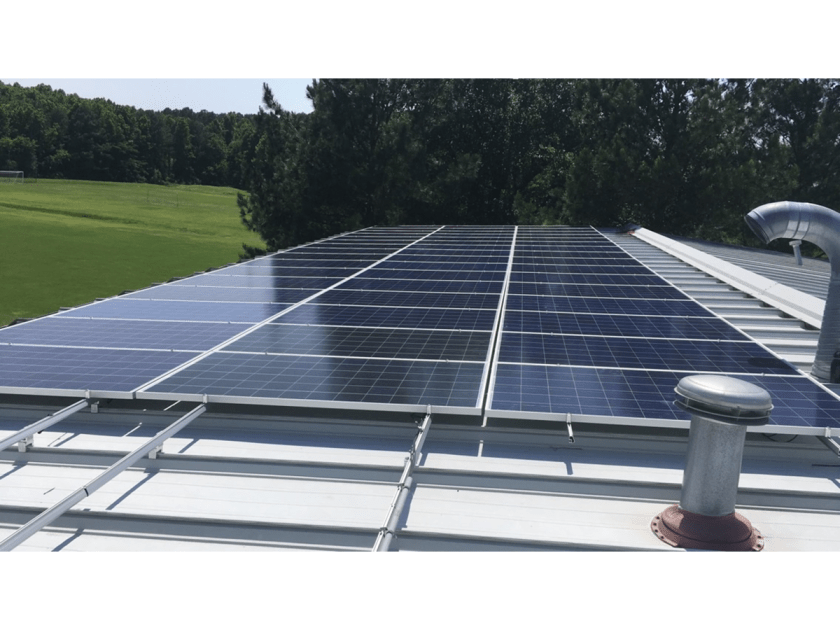
Photo above from Norfolk Academy in Norfolk, Virginia. All new public schools should install roof top solar and existing schools can install on schools when they replace the roofing. Just put into policy.

Earth’s Operational Plan

When we try to pick out anything by itself, we find it hitched to everything else in the universe. ~ John Muir, My First Summer in the Sierra, 1911.

On Christmas Eve in 2025, Iceland recorded a temperature of 19.8 degrees Celsius. The usual temperature average in Iceland on Christmas Eve is ~0 – 4 degrees Centigrade. Of Earth’s two poles, the Arctic Pole is warming faster.

Gradually, over the last 200 years, humans have sent carbon dioxide into the atmosphere at greater and greater rates until causing verifiable climate change. About 75 years ago, climate scientists warned the public of the relationship of carbon dioxide concentration and atmospheric temperature. [Technically, Alexander von Humboldt first described human induced climate change in 1800.]

Jim Hanson in the U.S.A. is the climate scientist who has been sounding the alarm for decades and enduring a concomitant response from the fossil fuel industry of being an idiot or insane (even when the industry was later revealed to have discovered that connection over half a century ago and chose to cover it up and even deny it when challenged, all for profit.).

Hansen first wrote about hidden tipping points in Earth’s complex biological and physical systems: thresholds that exist which once breached throw the system into permanent changes after which a new equilibrium is reached. As mosquitos have reached Iceland for the first time in its geological history, my guess is that the region’s ecosystems have blown by several tipping points. Iceland may be on its way to becoming an entirely other bioregion.

What does it matter? Referring back to what John Muir observed that everything in the world is hitched to everything else, humans cannot predict the outcomes and not just for humans. This amazing planet and the biomes we have all learned about and experienced, have operating systems as yet fully understood by humans. The more we play around as we seek greater riches, the more we play a dangerous game. It’s akin to Russian Roulette with our loved ones and future generations in the cross hairs.

Thanks to the persistence of scientists and environmentalists and other society leaders, we are letting fossil fuel production decrease and developing clean energy sources worldwide. This is a good direction that puts humanity on solid ground, at least for atmospheric forcing of a hot planet.

The precautionary principle

In the 1970s the German scientific community developed the principle of Vorsorge or, foresight. They developed the concept and practice while addressing the environmental impacts of deforestation.

An important and influential statement of the PP is the principle 15 of the Rio Declaration on Environment and Development in 1992. It states “where there are threats of serious or irreversible damage, lack of full scientific certainty shall not be used as a reason for postponing cost-effective measures to prevent environmental degradation.” Scientific Direct

I am including this principle for readers as we begin to address climate change around the world, especially in your home region. We should proceed, but with caution, to try various solutions guided by science and technology first. Economics will follow as we secure the very source of our wealth: the ground under our feet, the sky over our heads, the water we drink, etc.

People across the planet are experiencing climate change through storms, floods, heat waves and loss of biodiversity. So this is no longer a trumped up hoax. We experience in myriad ways. But what we may not realize is that it is changing the planet’s operating systems and we don’t know where that is going to end up. Will it continue to support life as we know it? Don’t know.

Every person must be involved in making sure the way we live is harmonious with what we DO KNOW about how the Earth systems operate:

  1. Earth systems operate on an inexhaustible source of clean energy (the sun);
  2. Earth manages ecosystem relationships so it does not overharvest a population;
  3. Earth recycles matter to reuse;
  4. Earth maintains genetic diversity.

To be an educated citizen of this planet, a child to an adult needs to know how the land under her feet, the sky over her head, and the living kin around her operate to stay healthy, reproduce, and live to the fullest. An educated citizen must understand her role in maintaining that system for the benefit of All.

References

Iceland Temperature at Christmas: Guardian, Dec. 20, 2025

von Humboldt the first environmentalist: nature ecology & evolution

°F = °C * 9/5 + 32

For interest and for an excellent recent book about Alexander von Humboldt and just a generally great read, I recommend Andrea Wulf’s recent biography of Alexander von Humboldt, The Invention of Nature.

Where Climate and Politics Meet

 If the last year has been about a phase change in our planet’s climate, the next year has to be about a phase change in our planet’s politics. ~ Bill McKibben on Substack, August 22, 2023

Kamala Harris and Tim Walz are the only candidates who are engaged at the national and state levels to manage climate adaptation and the clean energy transition – both of which lead to reduction of carbon dioxide and carbon monoxide that are drivers of heating the atmosphere and thus the oceans.

Joe Biden and his Cabinet of experts formulated the Inflation Reduction Act, a historic commitment to funding business, communities and families to make the transition to a clean energy economy. This is an historic achievement.

Oceans have been a sink for heat in the atmosphere throughout the Earth’s history. The ice sheets at the polar caps also reflect incoming sunlight, another of Earth’s modifying functions. Both of these processes have managed to keep the Earth’s temperature at a temperature that supports life. It had been so for 4.3 million years. Humans have long benefitted from the planet’s incredible renewing forces that have made life so abundant and predictable.

Then came the industrial age and with it the burning of fossil fuels. Hundreds of years of wanton deforestation has also removed another natural carbon dioxide “sink” that once kept the Earth cool. The Earth’s temperature has been rising since the industrialization of farming and later industries that burn coal, gas, and other fuels put too much carbon dioxide in the atmosphere.

We have been made aware of this for a century. (Actually, Alexander Humbolt, in the 1799, warned people that the Earth was heating up from human induced causes.) But, I’ve learned something about humans. We are short term thinkers on the whole. When it shows up at our door, we might act but that is not even a guarantee. The problem with that kind of thinking is that once the heat is in the oceans and the atmosphere, it stays there for centuries.

I watch as so much of our heartland is being destroyed by floods and fires, and hurricanes with massive flooding events. Iconic cities and natural areas are disappearing before our eyes. And with them, our livlihoods and lives.

With the other party denying climate change, heads in the sand, while extolling how brilliant they are, please vote for the team already leading on climate mitigation and solutions for our children and all the children to come.

For two centuries the USA has been the biggest emitter and so we have contributed most to the warming of the atmosphere and oceans. Cry babies, some who hold Congressional offices, cry out that China is the biggest emitter today, ignoring our much longer contributions. We have to become adults!

Its about our generation standing up for future generations. Our Children’s Trust recently put it very succintly.

Vote for Harris and Walz as if your life depends on it, because it does.

The care of the Earth is our most ancient and most worthy, and after all our most pleasing responsibility. To cherish what remains of it and to foster its renewal is our only hope.

Wendell Berry

Photo by Susan Feathers. Pensacola Beach on Santa Rosa Island, Florida