
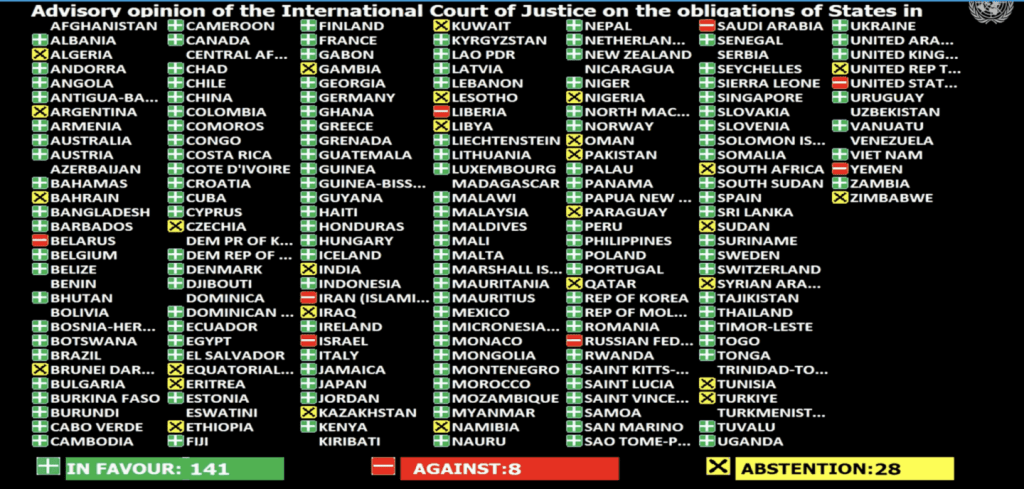
Today on the Sam Matey-Coste Substack account – The Weekly Anthropocene – news and a record of how countries voted to uphold the right of people across the world to a stable environment is presented. The vote responded to a ruling by the International Court of Justice. Note below, the U.S. now joins Russia, Saudi Arabia, Iran, Israel, Liberia, and others, to deny that right.
A U.S.A. nonprofit supporting youth is working in state and federal courts toward a declaration of the rights of children and youth to a healthy, sustainable climate. Our Children’s Trust is a nonprofit worth following.
Listening to youth speak to their futures requires all of us to understand our inaction acts to decrease their life’s potential. No one would deny that to children, right? The children and youth are given top notch legal education and representation at no cost. Explore the website by state to learn where youth are applying pressure to achieve a sustainable environment for their generation.
I highly recommend the book, The Ecology of Childhood, How Our Changing World Threatens Children published in 2020. Barbara Bennett Woodhouse devoted her law career to the rights of children. (See Google Scholar for her published works.) Bennett demonstrates how the U.S. ranks low compared to other developed nations in the social safety net provided for our children. We talk a good game about how we love our children in the U.S. but, when studied, that proves to be false. Now, we deny them a stable climate as well?
Readers, it is my firm belief that Americans are misrepresented by the current administration which denies climate change and has turned our country back to increasing fossil fuel production and use. The momentum toward clean energy that just got started in the Biden administration has slowed as a result.
In Sam Matey-Coste’s Substack account you can learn about advancement in clean energy and environmental victories in countries around the world. I highly recommend him to all of you who need a daily dose of climate hope.
In the U.S. there is progress in clean energy development such as in Texas and California, but it is much slower than it could be – especially in the automobile industry where sales of electric cars have plummeted. And now that Trump has illustrated how vulnerable the fossil fuel industry can be, the U.S. is losing out and our children’s futures are even more imperiled as the Earth warms. Emissions from fossil fuels are the primary driver of climate anomalies and storms like we’ve recently experienced — fires like we’ve never seen, droughts across whole regions of the continent.
But, it is not just our children whom we imperil. We imperil the world’s children. Emissions do not stay in place but circulate around the globe. We are all responsible and must get back to representatives in government who are responsible, serious adults. The window of opportunity for Americans to gain access to free or cheap clean energy is attenuating.
How can this be true? We have historically been a nation of innovators. But here, oligarchs in tech have taken away our agency and made us prisoners of their outsized influence over our politics and thus our government. Data centers to support AI development are being shoved down communities throats. Who profits? Oligarchs.
Step Up!
Step into this path we are on to take back our country and get back on a path to innovation, clean cheap energy for All, and working alongside our allies across the world to obtain for youth and coming generations a safe, stable environment, a world of innovators and well cared for people. War is obsolete, and our people must have a say through our representatives as to whether we go on defense of liberty. DEFENSE. The Speaker of the House refused to bring a vote to the floor of the House of Representatives to end the Iran War.
This administration must be held accountable. We must stand for truth and for our children’s future.
This time in U.S. history will either be recorded as our undoing and defeat, or our finest hour. Which will history record?
Update: A Related Post – New Book for Hotter Times




 Susan Feathers