I am continuing to read Round River—a meditation of immense wisdom in journal form. What am I learning?
That land is different than country
That the hobbies of common people following their own curiosity can be more powerful than the most sophisticated science because these humans are puzzling-together the life story of a plant or an animal, its natural history
That trying to change a person’s mind or behavior by threatening them with calamity does not work
That we are diminished in direct proportion to the incremental loss of wilderness
With Aldo Leopold I enjoy easy company with a man who understood what it means to be human.
Aldo Leopold has been a lifelong inspiration for me and someone whose writings I turn to often. For the first time, however, I am reading Round River, published in 1953 by Oxford University Press. {Powell’s Used Books and Thrift Books both have copies but they are expensive today in 2026].The second chapter, The Delta Colorado, chronicles his trip with Carl Leopold on the Colorado Delta region below the U.S. border starting in San Luis and going deep into a wetland wonder before the Hoover Dam caused its long slow death.
What struck me were two things: 1) the amount and variety of wildlife that dwelt therein (now vanished or reduced to small numbers), and 2) the amount of game it took to keep two grown men from hunger. Leopold’s daily journal entries are fun, informative and definitely from a “guy’s” point of view. He’s getting to know the land by hunting, canoeing, hiking, and exploring its contours. They meet and try to talk with a Cocopah youth on horseback – unheard of today in that region. The record is point-in-time, when that region and all its communities were at the brink of massive environmental and cultural change that most did not fathom. Up stream three hundred miles near Parker, Arizona the realization of other men’s dreams would radically change the lives and fortunes of many by siphoning off water for development in the seven states of the Colorado River Compact. Ironically this agreement was signed the very same year Leopold made his now famous trek (1922).
Round River is a collection of lyrical prose. Leopold is one of our best writers in this genre. Sometimes I just read his works for the sheer joy of its language and easy style. This little book of essays includes many gems including one about the nature of hobbies (A Man’s Leisure Time) that is still instructive today:
A good hobby may be a solitary revolt against the common-place, or it may be the joint conspiracy of a congenial group. That group might be the family. In either event it is a rebellion, and if a hopeless one, all the better. ~ p. 8, Round River, 1953, first edition.
Today I placed a Social Vibe charity widget on my blog to support the work of The Surfrider Foundation. My goal is to bring attention and resources to a citizen’s advocacy network that is making an impact worldwide, but that is also represented here in the Emerald Coast’s chapter by surfer and nature advocates.
Today I placed a Social Vibe charity widget on my blog to support the work of The Surfrider Foundation. My goal is to bring attention and resources to a citizen’s advocacy network that is making an impact worldwide, but that is also represented here in the Emerald Coast’s chapter by surfer and nature advocates. We each have a natural interest in sustaining the foundation of life on Earth: water.
Whether saline, brackish or fresh – bodies of water create oxygen, absorb carbon dioxide, clean toxins, and spawn untold generations of life at the base of numerous human food and economic resources. The awe-inspiring beauty, complexity, and biodiversity in the world’s oceans can still be found across our planet, though diminished. Science is uncovering that ocean acidification and warming are causing changes in basic processes such as shell formation in marine invertebrates at the base of food chains. Changes from more localized impacts like the British Petroleum Deepwater Horizon Oil Spill, are harder to follow but observed by many local beachcombers and surfers including moi.
Our coastal communities with the state and federal governments are engaged in major economic diversification efforts for the reason that remaining a tourism-dependent community leaves us vulnerable (Restore the Gulf). Human error robs us of the certainty that our oceans and watersheds can provide us the beauty, food, recreation and inspiration that humans have relished for all time.
Rachel Carson’s assertion that a child must first form an emotional attachment with nature before he is willing to protect nature is an assumption in the sense of place movement.
When the education community was “atwitter” with the concept of a sense of place (1990s), I was an environmental educator in Arizona. Much of the theoretical basis for this movement derived from studies that showed increased learning from experiential education (out in nature, hands-on, etc.) Rachel Carson’s assertion that a child must first form an emotional attachment with nature before he is willing to protect nature is an assumption in the sense of place movement. A National Endowment for the Humanities article by William R. Ferris (1996) is an excellent statement of the importance of place in human development:
Each of you carries within yourself a “postage stamp of native soil,” a “sense of place” that defines you. It is the memory of this place that nurtures you with identity and special strength, that provides what the Bible terms “the peace that passeth understanding.” And it is to this place that each of us goes to find the clearest, deepest identity of ourselves.
As Ferris explores the critical importance of the arts and humanities in education he offers a ten point plan that addresses the problems we face even now in 2012 (16 years later):
Those in politics have voiced their concern over the impoverishment of American life and values, but no one has found an answer to our problems. I suggest that the solution lies in the indigenous culture about which Alice Walker wrote, the familiar worlds into which we each are born. We must study and understand the worlds that make each of us American and through that journey we will renew American culture.
“The future is a construct that is shaped in the present, and that is why to be responsible in the present is the only way of taking serious responsibility for the future. What is important is not the fulfillment of all one’s dreams, but the stubborn determination to continue dreaming.”
~ Gioconda Belli, The Country Under My Skin
Nothing can replace the act of seeking knowledge for oneself. I can read about it, have it explained, or live it through another person’s experience, but in each case I see it incompletely, like the blind man holding the elephant’s tail.
For Americans eighteen and older this has never been more relevant.
In 1990 I sought to learn about our nation’s first people by going to them. I left a high profile position at a well known institution, sold or gave away most of my possessions, packed up my pick up, and traveled to a dusty border town trusting my inner compass. There was a man and woman who agreed to take me on as an apprentice and student to help me understand American culture and my own life’s course through an examination of my country’s historical relationship with the First Americans and with the land, water, air, and wildlife of the North American continent.
Why did I do that, you may wonder. I had come to the realization that instead of my nation being a beacon of light in the world, it was in fact an empire to many other nations and peoples whose cultural beliefs and lands were at odds with ours. How could there be hunger in a land of plenty? Why were democratic rights applied conditionally to members of our own society and in the world – and my culture accept that? How could we destroy the great natural beauty and abundance of our lands even while extolling how much we love it?
It made no sense to me and created a pervading sense of living a lie. I remember the unreality of my life then as I drove to work where architecturally beautiful buildings and the expansive green of a golf course tumbled down to the deep blue of the Pacific ocean. My day was stressful administering programs at a world renown health care facility where patients—banged up in the American market wars and social striving—suffered from heart problems, addiction, or complications from obesity.
One day I sat looking out the picture windows of my corporate office on a singing blue-sky day in southern California. Internally I felt lost and weak. My eyes settled on a book that had lain unread on my shelves for many years: Touch the Earth (T.C. McLuhan.) It is a book of Indian values from Indian voices.
At the first reading I experienced a profound sense of sanity return to me. In them I found a direction to pursue the answers to my deepest questions. I became aware of a pulsing hunger at my core for this knowledge, like something precious lost and then vaguely rememberd. Could it be that we have within us the knowledge of past human wisdom buried in our brains at birth? Looking back now, I realize that I had no choice but to make the decisions that led me to seek guidance and leave all I had known before – to clear the decks and make way for something new.
The next three years of living in the daily presence of two American Indian educators (one a Mojave elder, college professor, Korean veteran and social worker; the other an Iroquois artist and musician.) Their guidance changed the way I see myself and the world around me. I still believe the experience made me a better person. But the story of how that evolved is a hard one and definitely not what I had expected. The path to self-understanding is a crucible where falseness is burned away and a tender new skin grown. It requires humility, determination, and humor. It is anything but glamorous.
I hope you will return to my blog for journal entries about my experiences. Until then, here are some links to explore:
I know that my discovery of “On Being” at 6 am on my local public radio station, WUWF.org, reveals just how out of it a person can be in a world with a cornucopia of media sources. Apparently the program has been broadcasting since 2008! However, humbly, I submit this link to this interview with Terry Tempest Williams.
The recorded podcasts on their main page are a treasure trove of some of our greatest spiritual voices and cultural innovators. This might be a very good way to “reset” your moral compass after a day or week out on Main Street.
Krista Tippett is the moderator. The link above to the unedited discussion with Terry includes many personal statements by both Terry and Krista that give additional insights into their focus and personalities.
I’ve been reading Terry’s books, blogs, and following her activities for the last 15 years. I am convinced that she is on the forward edge of an emerging sensibility that seeks to bring together divergent perspectives in American culture for open dialogue and understanding. She gives numerous examples of how she personally is able to sit with people who hold opposite points of view and learn from them and stay in the dialogue….
If you read one book by Williams, read Refuge. You will understand then how Terry weaves the deeply personal, landscape, religion, spirituality, politics and the art of dialogue. This perspective might be similar to present and previous Earth – focused cultures (e.g. native cultures worldwide; ancient earth-based cultures.) However, what is evident in this interview and many others on the site, is an emergent blend of our best past and present thought. There is a heightened awareness of something much greater than ourselves, the issues at hand, and what we can perceive.
Listen and learn from a person who has learned to stay in the crucible of conflict and transform it into something of beauty….
The EPA is under scrutiny about its estimates of oil inundation from the BP Deepwater Horizon Oil Spill. At issue is direct access to scientists at the EPA without oversight from the EPA administration. Congressman Raul Grijalva has been critical of the EPA policy that scientists cannot respond directly to journalists or government officials questions. Read below from the Public Employees for Environmental Responsibility (PEER).
WILL EPA SIT OUT SCIENTIFIC INTEGRITY RULE-MAKING? — Memo Implies EPA Will Not Clarify Scientists’ Right to Publish or Speak with Media
Washington, DC — Despite a White House directive that federal agencies strengthen their procedures for ensuring scientific integrity and transparency, the U.S. Environmental Protection Agency is apparently planning no changes, according to an internal EPA e-mail released today by Public Employees for Environmental Responsibility (PEER). As a result, EPA scientists will continue to lack consistent rules for publishing studies, speaking at scientific conferences or answering questions from the media.
Hope Beneath Our Feet, Restoring Our Place in the Natural World is a new anthology of essays by authors who responded to this question: In the midst of environmental crisis, how can we live NOW?
I am unabashedly promoting the book because I am one of the authors. To be published along with the writers and thinkers to whom I have turned for inspiration over the last twenty years, is a huge honor for me. Some of these mentors are: Frances Moore Lappé, Bill McKibben, Wendell Berry, Barry Lopez and Howard Zinn.
The book’s genesis is the work of Martin Keogh, its Editor. In the forward, Martin describes how his children expressed a sense of hopelessness about the future as they considered climate change or nuclear war—challenges that dwarf our sense of being able to make a difference. He wondered how human beings can keep hope and live well in very uncertain times. In 2006 Martin issued a call to writers to submit an essay answering the question above.
The book is published by North Atlantic Press and is now in its third printing – barely a month after its release.
Turtle Island churns under the soles of my feet on this fair-weather day on the Gulf
NOAA Photo
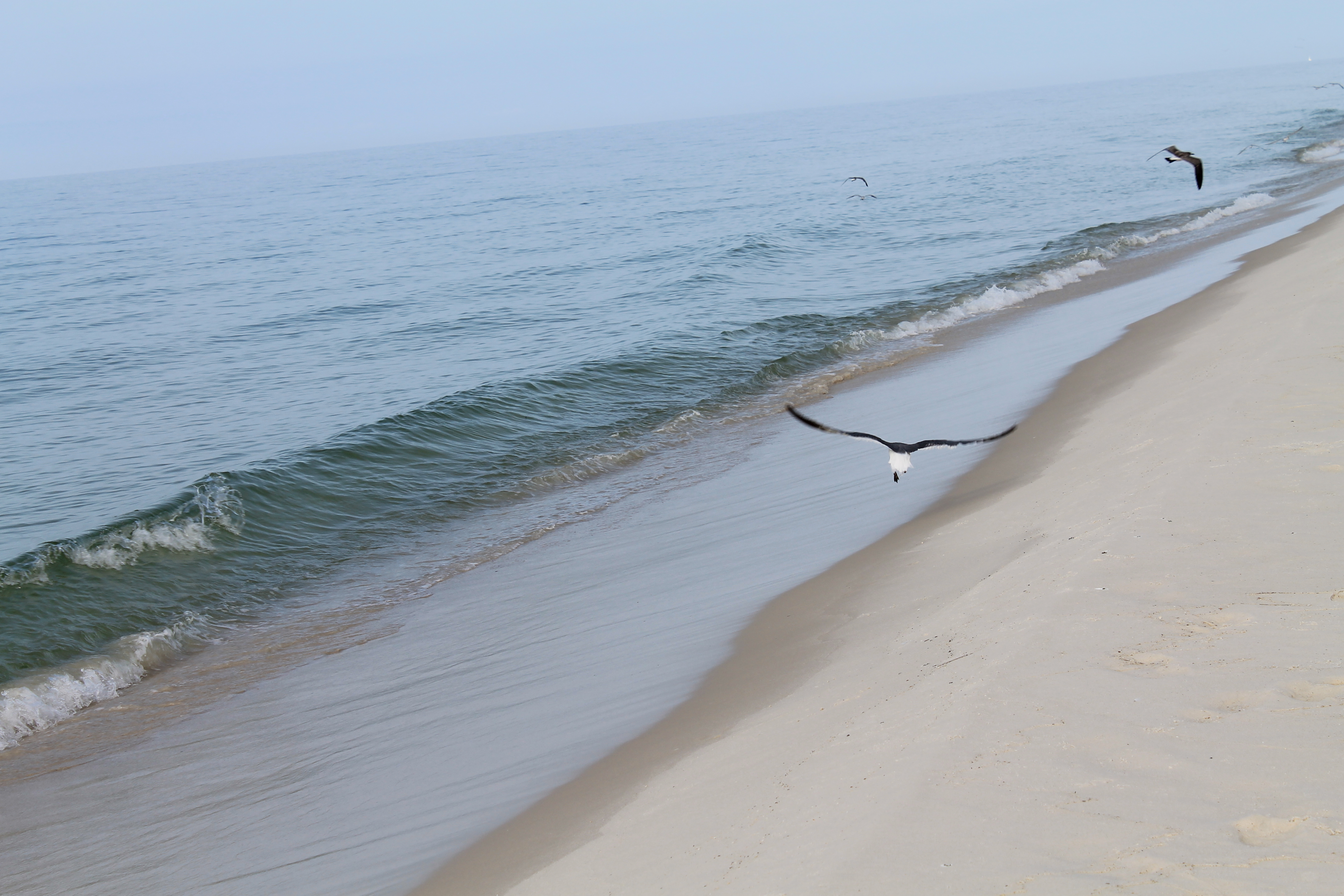
Turtle Island churns under the soles of my feet on this fair-weather day on the Gulf. The ocean is green near the shoreline—pea green. I’ve never seen that before. I wonder if an algal bloom is forming in warmer seas. A battalion of brown pelicans coasts on dark arched wings over the waves.
Children build sand castles and bob in the surf while far out at sea large fishing vessels ply the waters for bigger catch. I can see one person atop a scaffold with a line trawling behind. I wonder about toppling into the cold, thick waves so far from shore.
There are few shorebirds but it is late in the day. They are probably on the bay side of the island resting in warm dunes. A moveable feast of beauty and abundance, we call this Santa Rosa Island named to honor a young woman from Lima, Peru who lived 500 years ago.
How arbitrary our histories.
Take the story of Caretta caretta. She doesn’t even know we’ve tagged her with a dichotomous term to set her species apart from others. Her only inclination is to find a darkened shoreline and lay her burden down.
Buoyed by the salty water she paddles with strong legs through the currents.
Through heavy lid, she looks toward shore and vaguely remembers its smell and warm, gritty touch. Suddenly she recalls the hovering gulls with their piercing eyes and angular beaks. She quickens her advance in hopes she might outpace the probabilities.
The moonlit shore is quiet as she takes purchase on the shifting sand below her. She looks from just under the water. Bright lights might turn her away to find a place where pale moonlight guides the way instead. It is instinctual.
And should she come ashore and dodge the beach chairs and plastic bottles, to lay a hatch of eggs, and later when they emerge, so tiny and vulnerable, will her young head toward the sea with its shimmering moonlight, or will they head for the Holiday Inn instead?
Countless volunteers tend turtle nests all along these Gulf shores to redirect hatchlings toward the ocean. Does it mean they are no longer self-sustaining?
Caretta caretta, loggerhead turtle mom, come back! Come back!
Will she find a place to lay her eggs? If she doesn’t, will she release them into the water and watch as a devouring host of predators gobbles them up as fast as they emerge?
And, what of it…what if all the Caretta caretta’s disappear? Will it change my walk on the beach?
To answer that question we would have to observe this beach over the long arc of time—not the brief period of a human lifetime.
If we could go back even a thousand years (a bleep on the screen of geologic, Earth time) we’d see an abundance of birds, perhaps many we’ve never seen here before. And the waters would team with crustaceans; you could just scoop up dinner with your hands.
We’d be looking at an ocean web of life that compares to today’s web like intricate lace to an old net. But if we do not know that, the old frayed net looks pretty good.
A Yale psychologist gave this phenomenon a name: intergenerational, environmental amnesia. Basically, we’ve failed to remember our origins; we’ve forgotten to tell the human story.
That story tells us how we evolved with a host of other species, interdependent on each other. In a far distant land, in a far different world, our kind began humbly dependent on the whole.
We were part of something that worked, found its rhythms in a sort of give and take that leveled the playing field for all. Some little guys had the gift of a poisonous bite that made the big guys shy away and so on.
Then we evolved an opposable thumb and a frontal cortex. We were powerful beings by virtue of our new intelligence. We learned to cooperate and bring down beasts that towered over us. We covered our bodies with their hides and set out to explore the world at large.
We got caught up in our own ingenuity; we forgot our origins, intent on harnessing nature to our collective dreams. This was our infant sensibility.
Today our task as a species is a difficult one: we need a dose of emotional honesty to accept that we aren’t as great as we’d thought. What’s superior about spoiling paradise, about circumscribing the futures of our children?
Well, we can chalk it all up to immaturity, for our species’ evolution is new and our learning curve is a sharp one. We’ve got to use our talent for the good of all. We can’t repair nature’s living webs, but we can give her a chance to do it herself.
For Caretta caretta we can turn down or turn off our lights, sit out on the decks of our homes and watch the waves glisten in the moonlight, listen to the oncoming waves. Is that so bad?
Native American wisdom recognizes the Earth as Turtle Island, the continents forming plates on her back. In this era of human pervasiveness, we are changing the body of the Earth in which every living thing finds a source of life.
For most of our species’ history we did not know that. But now we do recognize our impacts on the ecosystems that created the biosphere.
Caretta caretta’s plight to find a darkened beach points us toward a path we could take. If we turn off our lights, she might find a place to lay her eggs, her hatchlings a way back to the ocean, and for us a reduction in energy consumption and carbon emissions.
It is rare for us to make these connections. Small though they seem, it is myriad of these that need correcting.
Global warming threatens our very existence. Since we are the cause of it, we can stop it. Doing so will correct our species’ relationship with so many others and begin to set things right again.
Caretta caretta’s story is mirrored in the stories of countless species feeling our footprint.
We must take up the cause for each of them where we live with the firm conviction that enhancement of life anywhere enhances life’s chance of survival everywhere.
Identify a small area of land or a nearby river and defend its integrity with your life.
Caretta caretta…no, it’s not a song. It’s a symphony.


 Susan Feathers