Once Upon a Time on the Gulf of Mexico

Turtle Island churns under the soles of my feet on this fair-weather day on the Gulf

NOAA Photo
NOAA Photo

Turtle Island churns under the soles of my feet on this fair-weather day on the Gulf.  The ocean is green near the shoreline—pea green. I’ve never seen that before. I wonder if an algal bloom is forming in warmer seas. A battalion of brown pelicans coasts on dark arched wings over the waves.

Children build sand castles and bob in the surf while far out at sea large fishing vessels ply the waters for bigger catch. I can see one person atop a scaffold with a line trawling behind. I wonder about toppling into the cold, thick waves so far from shore.

There are few shorebirds but it is late in the day. They are probably on the bay side of the island resting in warm dunes. A moveable feast of beauty and abundance, we call this Santa Rosa Island named to honor a young woman from Lima, Peru who lived 500 years ago.

How arbitrary our histories.

Take the story of Caretta caretta. She doesn’t even know we’ve tagged her with a dichotomous term to set her species apart from others. Her only inclination is to find a darkened shoreline and lay her burden down.

Buoyed by the salty water she paddles with strong legs through the currents.

Through heavy lid, she looks toward shore and vaguely remembers its smell and warm, gritty touch. Suddenly she recalls the hovering gulls with their piercing eyes and angular beaks. She quickens her advance in hopes she might outpace the probabilities.

The moonlit shore is quiet as she takes purchase on the shifting sand below her. She looks from just under the water. Bright lights might turn her away to find a place where pale moonlight guides the way instead. It is instinctual.

And should she come ashore and dodge the beach chairs and plastic bottles, to lay a hatch of eggs, and later when they emerge, so tiny and vulnerable, will her young head toward the sea with its shimmering moonlight, or will they head for the Holiday Inn instead?

Countless volunteers tend turtle nests all along these Gulf shores to redirect hatchlings toward the ocean. Does it mean they are no longer self-sustaining?

Caretta caretta, loggerhead turtle mom, come back! Come back!

Will she find a place to lay her eggs? If she doesn’t, will she release them into the water and watch as a devouring host of predators gobbles them up as fast as they emerge?

And, what of it…what if all the Caretta caretta’s disappear? Will it change my walk on the beach?

To answer that question we would have to observe this beach over the long arc of time—not the brief period of a human lifetime.

If we could go back even a thousand years (a bleep on the screen of geologic, Earth time) we’d see an abundance of birds, perhaps many we’ve never seen here before. And the waters would team with crustaceans; you could just scoop up dinner with your hands.

We’d be looking at an ocean web of life that compares to today’s web like intricate lace to an old net. But if we do not know that, the old frayed net looks pretty good.

A Yale psychologist gave this phenomenon a name: intergenerational, environmental amnesia. Basically, we’ve failed to remember our origins; we’ve forgotten to tell the human story.

That story tells us how we evolved with a host of other species, interdependent on each other. In a far distant land, in a far different world, our kind began humbly dependent on the whole.

We were part of something that worked, found its rhythms in a sort of give and take that leveled the playing field for all. Some little guys had the gift of a poisonous bite that made the big guys shy away and so on.

Then we evolved an opposable thumb and a frontal cortex. We were powerful beings by virtue of our new intelligence. We learned to cooperate and bring down beasts that towered over us. We covered our bodies with their hides and set out to explore the world at large.

We got caught up in our own ingenuity; we forgot our origins, intent on harnessing nature to our collective dreams. This was our infant sensibility.

Today our task as a species is a difficult one: we need a dose of emotional honesty to accept that we aren’t as great as we’d thought. What’s superior about spoiling paradise, about circumscribing the futures of our children?

Well, we can chalk it all up to immaturity, for our species’ evolution is new and our learning curve is a sharp one. We’ve got to use our talent for the good of all. We can’t repair nature’s living webs, but we can give her a chance to do it herself.

For Caretta caretta we can turn down or turn off our lights, sit out on the decks of our homes and watch the waves glisten in the moonlight, listen to the oncoming waves. Is that so bad?

Native American wisdom recognizes the Earth as Turtle Island, the continents forming plates on her back. In this era of human pervasiveness, we are changing the body of the Earth in which every living thing finds a source of life.

For most of our species’ history we did not know that. But now we do recognize our impacts on the ecosystems that created the biosphere.

Caretta caretta’s plight to find a darkened beach points us toward a path we could take. If we turn off our lights, she might find a place to lay her eggs, her hatchlings a way back to the ocean, and for us a reduction in energy consumption and carbon emissions.

It is rare for us to make these connections. Small though they seem, it is myriad of these that need correcting.

Global warming threatens our very existence. Since we are the cause of it, we can stop it. Doing so will correct our species’ relationship with so many others and begin to set things right again.

Caretta caretta’s story is mirrored in the stories of countless species feeling our footprint.

We must take up the cause for each of them where we live with the firm conviction that enhancement of life anywhere enhances life’s chance of survival everywhere.

Identify a small area of land or a nearby river and defend its integrity with your life.

Caretta caretta…no, it’s not a song. It’s a symphony.
Risky Business: Oil and Water

A pall hovers over our vibrant city

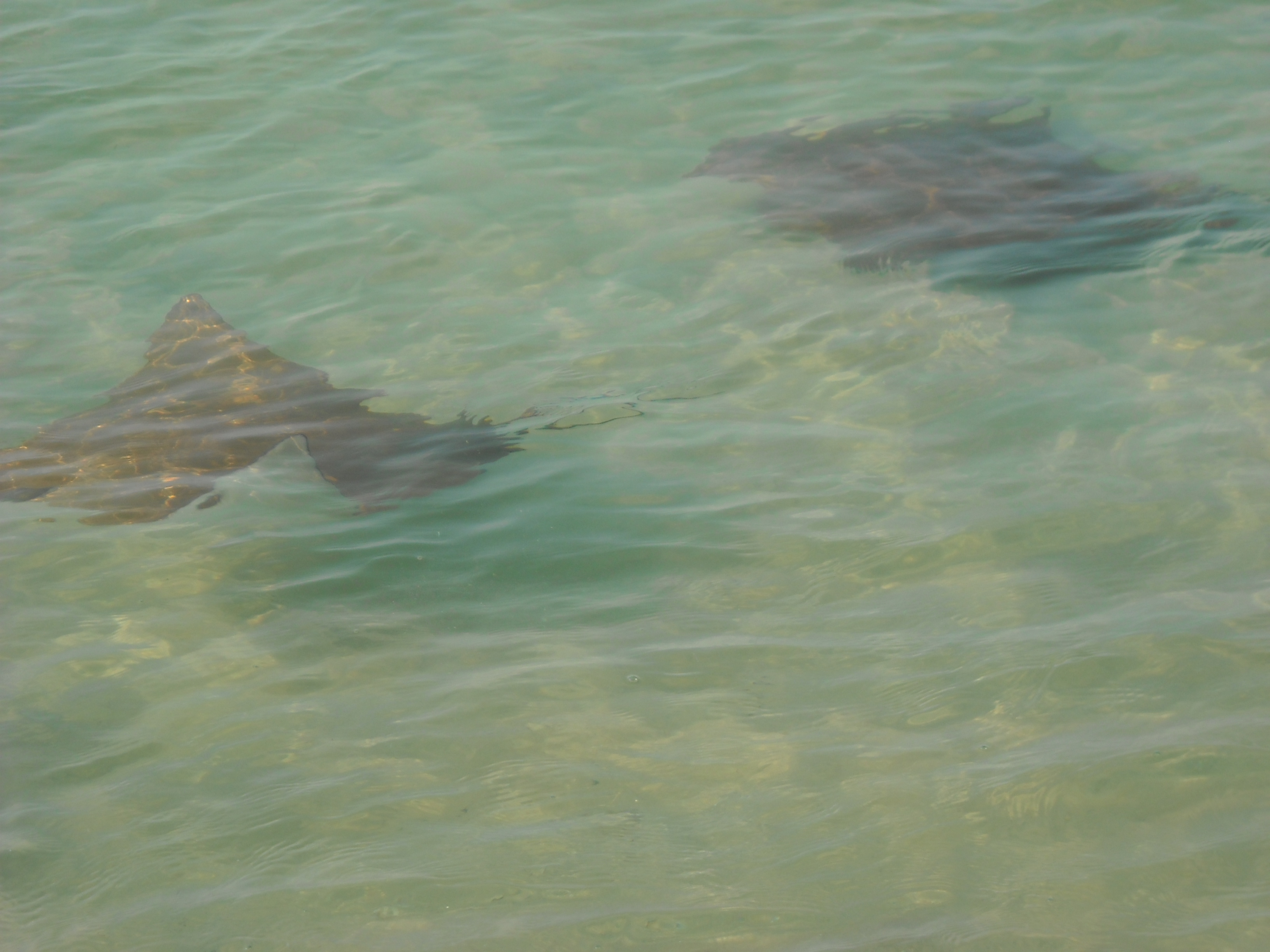
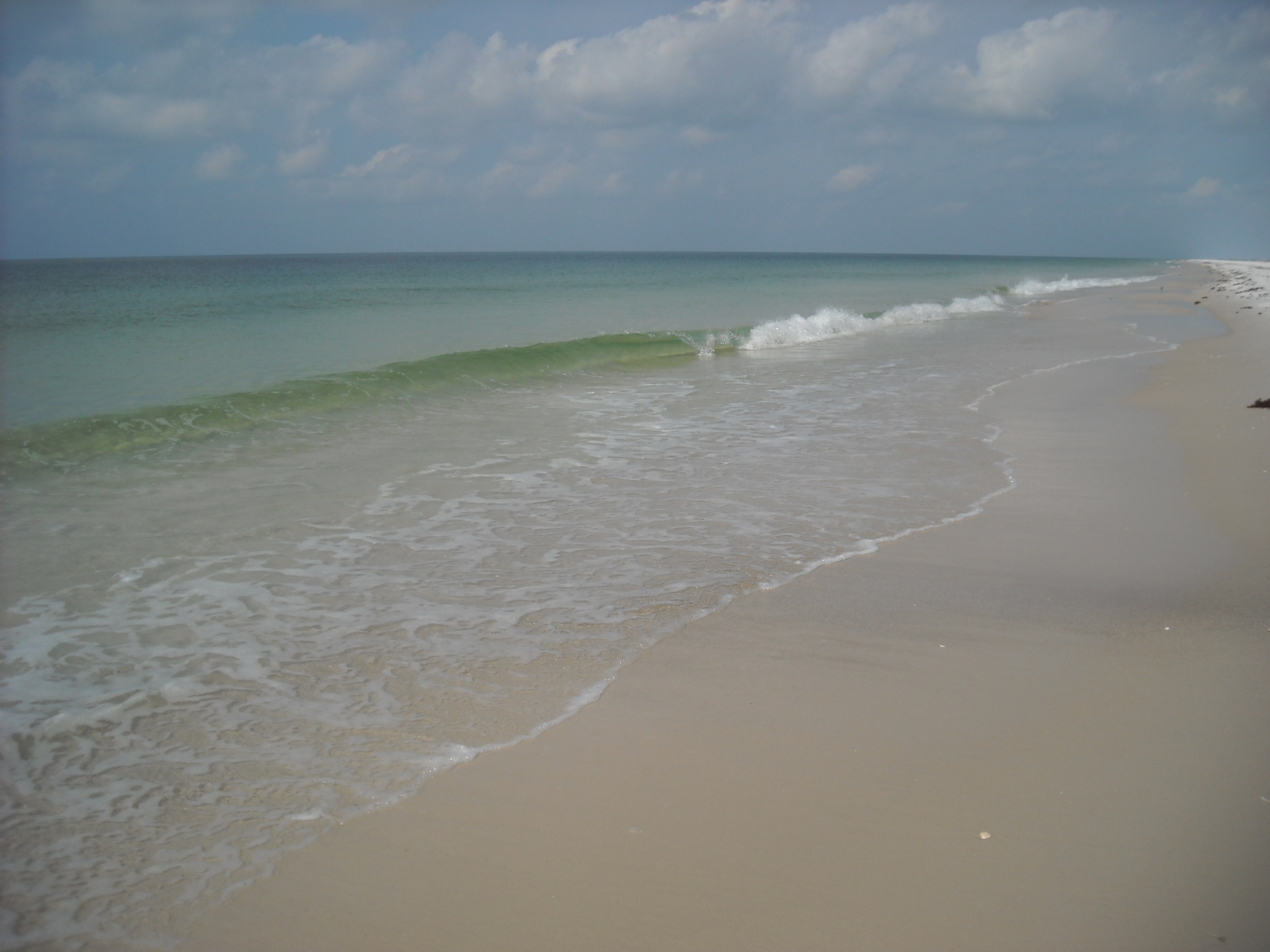
I’d stayed away from Santa Rosa Island, Pensacola Beach because I couldn’t take it…seeing the destruction of a rare, beautiful place and all that inhabit it. Finally, curiosity got to me and I went out on the western end of the island to the Gulf Islands National Seashore, Fort Pickens. At its entrance I began walking with trepidation. It was about 8:45 and there were not many people out. As I walked along the glass green waves all I saw on the shoreline was a lot of kelp blown up by southerlies and the usual beach denizens: ghost crabs on the prowl, sanderling scurrying to snatch a welk from the draining sand and retreating waves; black skimmers trawling a long organge jaw to scoop minnows. A fleet of pelicans above and a squadron of spotted eagle rays below glided over their hunting grounds. A couple of small sharks had ventured into shore after fish and out on the horizon dolphins were feeding. I saw a dozen speicies of shorebirds including a dozen willets and one or two gulls. Least terns were solitary and dove straight down into the calm water then winged sharply upward.  I think I might have seen a large loggerhead pop its big head out of the water.

Talked to two rangers patrolling the beach with bags full of tarballs and other trash left by humans – flipflops, bottles, condoms, and food containers. We chatted. Apparently just a quarter mile away the tar balls were entering Pensacola Pass and washing up on the Escambia Bay shoreline. The beach I walked this morning would be next unless by some miracle the winds and currents keep the advancing oil beds and sheen offshore. But given the size of the oncoming black tide (two miles wide by 30 miles long) there probably isn’t much chance of that.

A pall hovers over our vibrant city, newly recovered from Hurricane Ivan. This city that so many corporations have left lethal legacies and then moved on…this city has seen enough of that.

See below some reminders that all is not well and a couple of last images of ocean system denizens in the path of destruction.

This slideshow requires JavaScript.

Oil Globs on Santa Rosa Island: It’s Here

The People of the Forward Stampede

Late this afternoon I drove to Santa Rosa Island, to the entrance of a seven-mile stretch of undeveloped barrier island, protected by the Gulf Islands National Sea Shore, one of our priceless U.S. National Parks. While there was a long stretch of beautiful beach, as I walked west toward the end of the island, I began to see oil – firsts dime-sized, then bottle-cap, then hand-sized: thick crude oil, pooled and hardened among shells and sea grasses on the high tide line. Adjacent to this pollution, black skimmers sailed by with their long lower jaw skimming in the shallow edge of the surf and Least Terns dive-bombed for small fish not far off shore. Surely they must be tasting and smelling this invasion of foreign substances. We can only guess what is happening to fish, corals, jellies, dolphins, plankton…I am so profoundly sad about this awful time when we are facing our ourselves –  our ways and wants. It is NOT a pretty picture.

Only a few days ago this was the image of this treasured coast at sunrise:

And to think we are risking this and our families health for a culture addicted to speed and consumption and which cannot function without an enormous and uninterrupted supply of oil. Will it be worth it when all this plays out? And, it will continue to playout over months and years and there will be other catastrophes like it where we have taken enormous risks as the People of the Forward Stampede.

They will all be impacted by the oil catastrophe and eventually it will reach to our children and us through our air, food, and spirit.

Santa Rosa Island, Pensacola Oil Spill Update

Interesting proposal to permanently follow oil rigs with satellite surveillance…

Our local NPR station is covering our local conditions. Go to this link for WUWF.org for trajectory maps and fishing limitations. Also go to Skytruth for an interesting proposal to conduct ongoing satellite surveillance of all our oil rigs from now into the future.

After hiking on Santa Rosa Island on Saturday and Sunday I developed a migraine which I have never had in my life. I wonder…that is a symptom of air pollution where oil has evaporated and benzene, toluene, methylbenzene, and xylene compounds are in the air. Pensacola as terrible water and air quality due to an eddying effect, similar to those seen in the Gulf offshore our barrier islands.

A jewel of nature: in the path of the Oil Spill?

For today I thank God for the Gulf – a nursery and a home to creatures big and small and innocent to our machinations.

Pensacola, Florida. Santa Rosa Island. Gulf Shores National Seashore. Observed wildlife: dozens of spotted eagle rays skimming along the shoreline; dolphins pursuing schools of silver mullet offshore; two small loggerhead turtles bobbing along (looking for a place to come ashore tonight under the moonlight – to lay her eggs?). Least terns dive-bombing over white sands under translucent green seas, a small fish for breakfast; 14 brown pelicans, gulls, and two black skimmers with long jaws dropped to scoop up the least terns meal; and one handsome man from Scotland who showed me how to find small, whole sand dollars.

I cannot tolerate the idea that a black tide is on the way here. I pray that it does not so that our shores can provide accommodation for wildlife on the move from the tragedy happening in Louisiana. But I am probably too optimistic. For today I thank God for the Gulf – a nursery and a home to creatures big and small and innocent to our machinations. See links on this site for updates on the spill in our region: Oil Spill Academic Task Force, Skytruth.org.

For now this jewel of nature’s creation persists….

Oil Spill Perspectives

…what if we did something revolutionary and base our decisions on a set of conditions that assures we don’t harm the Earth and thus ourselves since we are one community, interlinked?

Most of us have copious information about the oil spill (I think we can agree that GOBS MORE oil is spilling into the Gulf waters than we have been told by BP and by the EPA. Go to links on this blog for more accurate estimates).

The impacts are starting to show up in Louisiana and threatening Alabama and Florida. Things are not static this time of year with the tropical storm season and strong south easterly winds and thus currents. We can only guess what is happening to plankton and all the vulnerable life underneath the surface, out of site. It has to be devastating.

What has been growing in my mind is much greater than the stats on this spill, though important. What I am thinking about is how we make (or don’t get a chance to make) decisions about our technologies, even at the origin when inventors are “out there” thinking up stuff. Right now the values that underpin most of our biggest industries are based on providing a natural resource or product from it that has been evaluated to make a lot of money for its creators and sellers. Our principle is: if it can be made and make money, make it! Figure out later if it is harmful in which case the American citizen or the natural systems that support us will take the blows, and while down, have to wage a near impossible battle to bring the barons to court. Even then there is no certainty justice will be done.

What if there was much more thought on the front end of the process where we carefully consider the impacts on the health and well being of our people and all the wildlife and natural systems that produce health and wealth? And what if we did something revolutionary and base our decisions on a set of conditions that assures we don’t harm the Earth and thus ourselves since we are one community, interlinked?

Consider what Wendell Berry suggests are bad solutions to problems versus a good solution:

“A bad solution is bad because it acts destructively upon the larger patterns in which it is contained. It acts destructively upon those patterns most likely, because it is formed in ignorance or disregard of them.” ~ p. 137 The Gift of Good Land

“A good solution is good, on the contrary, “because it is in harmony with those larger patterns.”

Good solutions:

  1. Accept given limits
  2. Accept the limits of discipline (i.e. agricultural problems are solved by agriculture not technology, etc.
  3. Improve the balances, symmetries, or harmonies within a pattern
  4. Solve more than one problem
  5. Will satisfy a whole range of criteria
  6. Embody a clear distinction between the biological and the mechanical
  7. Have wide margins
  8. Answer the question, “how much is enough?”
  9. Should be cheap and should not enrich one person by the distress or impoverishment of another
  10. Exist in proof
  11. Imitate the structure of natural systems
  12. Are good for all parts of a system
  13. Preserve the integrity and pattern that contains it
  14. Are in harmony with good character, cultural value, and moral law~ pp 141-145 Ibid

In 1970 during the oil crisis of that day, President Carter was laughed at for his efforts to develop energy independence by switching to alternatives such as wind, solar, and geothermal sources. What stopped all that effort, removed the electric car from the road?

Simply, greed. Could that be why we have an incredible 3500 oil rigs in the Gulf of Mexico and 1500 miles of pipeline criss crossing the ocean floor in a hurricane prone zone. Follow the money and you will discover the reasons why we do most of what we do in America. Our bottom line is STILL profit. Preoccupation with the market and belief in it, which is a metaphysical movement unnamed as such, is driving us to the edge of environmental degradation after which no one can really predict outcomes – exactly where we are with this oil spill.

See the Lindbergh Foundation website. They support innovative research that establishes a healthy balance between technological development and preservation of the Earth’s ecosystems. Click on each of the funded scientists and educators whose work they are supporting to understand the concept that Wendall Berry was getting at. We need a lot more of this kind of thinking!

Read Barry Lopez to understand what it means to live connected to everything around us, our own nature knit tightly into the fabric of all the creation.

For a very thoughtful article by Joshua Reichert of PEW Environmental Group published in the Miami Herald, “The Future of Oil and Water.”

Passages and Oil Spills

While the Deep Water Horizon platform exploded and began to spew oil into the Gulf of Mexico, my loved one lay in the ICU suffering from post heart surgery from which she never recovered. She died on April 27 at 3:43 pm. I know because I was there with her, my other sister and her daughter. We were the ones who would escort my older sister to places beyond our reach. We navigated terrifying medical procedures, tubes, drains, trachs and vents, dialysis machines, and watched my sister’s body swell beyond belief, turn red and raw; we gently kissed the scabs and bruises on her arms and hands that crusted over or oozed with edema. On her last day of life the sheets were soaked from her body fluid oozing out of every pore. The machines peeped and winked; the vent breathed in and out from a taped area around my sweet sister’s neck. I wondered, Does it hurt, Bev? But she could not answer me, rendered speechless for a month, with only mouthing which we could not lipread and which toward the end was not even possible. I kept a piece of computer paper on which my brilliant, accomplished sister struggled to write a message but it is only scribbles that run eventually off the paper…

It has been one week now and she has been cremated and her remains await her family to scatter in her favorite places. We gave her a wonderful memorial at which her friends assembled and many from my family including my son and daughter. While together we held each up somewhat, when we separated I felt the vast pain and sadness that washed up against my chest like a sea pushing against pilings.

Meantime the oil continued to billow into the ocean waters of the Gulf which my sister loved, and it crept toward the crystal white beaches on which we sat watching a green translucent sea lap against the snow-white sand. Langdon Beach with brioche and coffee…our habit….

The Gulf is lying as she did, helpless to an approaching disaster, with concerned people all around whose efforts cannot prevent something set in motion that cannot be undone.  I walk the shores weeping for Bev as I weep for dolphins and schools of silver pompano and the microbial hordes whose haven, the waves, will soon be something like a wrath – innocent to the machinations of a misdirected culture.

Was the medical treatment of my sister also misdirected? Invasive, entirely without humanity, all numbers and organs and technology in the name of life.

Why can’t I help thinking my sister died an early death as the beaches on the Gulf will, too, from events so complex and indirectly applied as to cloud our perception?

Now I know what it is to feel totally helpless.

Failure Is Not An Option

Apollo is the Greek god of reason, morality, and maintenance of society. Perhaps in our cultures these have not always been united.


The Apollo Moon Program took Neil Armstrong and Buzz Aldrin to the moon’s surface in 1969. During the third mission to land men on the moon (1970) an explosion left the Apollo crew in grave danger.

The story of Apollo 13 offers an important message for humankind as we face up to climate change: “Failure is not an option.”

These words were uttered by Gene Kranz, NASA Flight Director, when he addressed the engineers and scientists responsible for returning the three crewmen to Earth under what appeared to be impossible circumstances and limitations.

As we learn more about the daunting task of reducing carbon emissions well below 1990 levels even while the world’s population grows exponentially, the challenge feels every bit as awesome as that faced by Krantz on that fateful mission.

Kranz advised his team to not be emotional but to “work the problem.” It seems to me that is good advice. We have to cut through the arguments and individual beliefs that each of us holds to create a sustainable human enterprise on Earth.

And like Apollo 13, the clock is ticking for us, too. Beyond a certain point we will not be able to reverse the physical adjustments of Earth’s atmosphere and oceans and of living communities most vulnerable to them.

So just how did these scientists and engineers “work the problem?” Well, to begin with they erased the previous flight plans and went back to the drawing board. Then, they looked at what was on hand that could be used in new ways to meet the needs of the moment: “We’ve got to take this square battery pack and make it fit into this round receptacle,” the engineer explained to his team.

And what were they attempting to solve? Chillingly for us, the crew was experiencing a lethal build-up of carbon dioxide on board their small craft, and the engineers were attempting to build a carbon scrubber with the stuff on board the spacecraft.

Cutting through all preconceptions, the team put their heads together and managed to build a new scrubber with a square end that fit into a round hole.

Without being simplistic, much of what we have to do to come together as communities, nations, and international bodies seems just like that: a square peg in a round hole. So far nothing fits very tight.

But here is a simple example of how a great accomplishment was achieved:

  • Work the problem, skip the rhetoric;
  • Gather what is on hand and if necessary use it in new ways that can get us the solutions we seek;
  • Failure is not an option – we do not have the luxury to try this another time, therefore our leaders, social institutions, and citizens must all come to the table with sobriety and willingness to think anew.

Apollo is the Greek god of reason, morality, and maintenance of society. Perhaps in our cultures these have not always been united. Just as the Apollo crew was buoyed by the worldwide prayers and hopes of people and nations, we could look at the human community, and all the living communities that keep us alive and happy, as a crew on an endangered spacecraft that we have got to bring home safely.

Let’s work that problem.

Duma, Ghost Cat, Part III

The big cat’s ghostly form moved through the forests of broccoli, then across the road under a cool moon and into the tall corn tribe growing profusely by the canal.

Border Cat

This story takes place in Yuma, Arizona where the Colorado River meanders south to the Sea of Cortez. In truth, most of the water never gets to the Delta area as it once did. The jaguar in this story followed the river trace toward Yuma’s agricultural canals and farm fields where he inadvertently became tangled up in border problems. He represents species whose ranges traditionally span the arbitrary boundaries of the human species.

Duma bounded from row to row, sure footed in the cover of night. The big cat’s ghostly form moved through the forests of broccoli, then across the road under a cool moon and into the tall corn tribe growing profusely by the canal. His activity was confined solely to night, now that the ranchers and homeowners were on the lookout for the phantom jaguar. This put Duma at a disadvantage. His white coat stood out starkly against the night sky and dark shadows. His large tracks left a trail of fear for the farm hands who worked in the same fields come morning. Duma plodded over the fields in search of prey. It had been many days without meat and he felt weakness entering his heavily muscled body.

Duma’s quivering nostrils caught the scent of something unknown, stopping him in his tracks. It was not exactly like the smell of the two-leggeds. But what? Duma moved closer to the smell’s source in a low crouch now, soundlessly advancing. Another smell—of death—unmistakable…  His nose led him closer to the road than he liked, and at its edge he paused and stretched out his long, white neck to peer through the corn stalks. Every fiber of his being was on alert, his small ears drawn forward to catch the slightest sound, Duma’s glassy eyes opened wide to catch the slightest movement. He held himself completely still, taking in every possible clue as to what this prey might be and calculating what it would take to bring it down.

Finally, the animal came into view. It was small and sitting on its tail in the middle of the road. It smelled strange. Duma’s full-grown jaguar body demanded more and more of the hunter’s skill to satiate the incessant need for flesh and blood, and now he felt the gnawing ache of hunger in his empty belly. So he continued to investigate.  As he looked on in perfect silence, the strange animal stood up and started to walk toward something ahead of it in the road. Duma understood with his nose that whatever it was, it was dead. The smaller animal swayed over it.

Duma sniffed the air again, breathing in the chemical language.  An acrid scent of urine and scat pierced his nostril. This was no self-respecting beast, he decided.  He took a chance and crept slowly out onto the road toward the prey, sensing no eminent danger.  As he skulked closer, the small creature turned. Duma let a low growl roll out onto the warm night’s air from his powerful throat. The animal seemed unafraid! Perhaps it was more of a threat than he realized. Duma paused, bringing himself more upright. He cocked his small, intelligent head as he tried to understand what he had encountered. Remembering other times he had misjudged a threat, Duma was not going to let his ego fool him again.

Duma crouched, waiting to see what this strange beast would do. It started coming toward him, walking in a strange manner, falling down, and then righting itself. Duma thought it must be injured. He stood up, walking forward with more curiosity, yet ready to pounce.

When the moonlight lit up the white panther, the child saw it.

Colectacolecta…. ”

What a strange sound, Duma thought…high pitched like a rabbit. The creature was holding its paws out toward him, and he reflexively swiped them away, knocking the child down. It began to wail.  Its smell was foul.

Duma was deciding just how hungry he was when suddenly a noise grew out of the sky and sunlight shot down the road! The great white panther bounded out of sight. Behind him he heard his prey shrieking.  Duma looked back. It was the sky beast he’d seen many times.  He was filled with terror.

Now it dropped from the sky with wings swirling and fire breathing from its mouth.  Duma had never seen anything like this animal, many times his size.  He soared into the air and leapt over the tall corn, golden tassels brushing against his belly, white flanks streaming through the dark field toward the trees.

Duma stopped for a moment and looked back to see the beast take its prey. But instead of devouring the strange little animal, it turned toward him! Now the deafening roar and giant flapping wings came rushing at a greater speed than the jaguar could maintain, and his great paws lost traction in the muddy soil. Reluctantly, the powerful cat decided to come into the open to gain traction on the solid dirt path between corn rows. That’s when the creature threw light onto him. Duma felt the ripping heat tear through his flank. He crumbled to the ground, pushing up a great cloud of dust as his two-hundred-pound body came to rest in a heap of white hair, muscle, fang, and claw.

The last fading sight in the cat’s blue eyes was that of the great monster coming in for the kill.

Duma, Ghost Cat – Part I

With clear, blue eyes rimmed in red and a ghostly white pelt with telltale rosettes, the pale cat later earned the name “ghost cat.”

Yareen made her way down a jagged escarpment on the Sierra Madre plateau, not far from Luis Munõz’s boyhood home. Her ebony and tan flanks rippled through the pale green of manzanita and scrub oak. Falling pebbles, pushed from their earthen beds by her great paws, scattered noisily down the slope ahead of her.

Her mate was roused from an afternoon nap in a tree above her. They greeted each other with low, rolling hellos as she bounded up the tree. Yareen rubbed her head against her mate’s with her golden eyes wide open. They had been together for many sunrises and sunsets. Soon, he would leave her and she would return to a solitary life to birth their cubs. It would be her second time.

They climbed down the tree and followed a path to a big, rock-lined bowl in the stream for a swim. She caught a trout and they shared it. Later they lingered by the water’s edge, where a nearby deer stood immobilized in the brush, caught unawares by their silent arrival. Its breath was barely discernable until the large cats moved away, saved by being upwind of its natural predator.

Earth changes were indeed affecting the sky islands of the jaguars’ home, but this spring it had brought more frequent rain. The streams ran full and cold, and the oak woodlands were a riot of activity as the oaks produced an abundance of acorns on which a host of creatures feasted.

For Yareen, it meant easy access to plumb deer, and plenty of milk for her young cubs when three months later she gave birth to four kittens.

Among them was a large, white cub who startled his mother each time she looked at him. Following her natural instincts, she gave Duma little access to her teats until the cubs she saw as normal had suckled, and often, there was little nourishment left for the largest baby.

And so the white cub weaned earlier than the others and began foraging to survive. Oblivious to his difference, Duma frolicked in the woods that first season of his life, reveling in the joy of being alive on a great, good planet.

Soon, he learned to imitate their mother’s low whistle and practiced the hissing scream that immobilized trembling quarry, though with his were more a yip and a squeak. The furry ball loped over rocky terrain, following Yareen and his siblings at a distance through the scrubby wooded forests, pouncing on the prey his mother wrestled to the ground in a fury of claws and fangs.

Duma’s markings afforded him little camouflage in a region of emerald, umber, and black. Unknowingly, the young cat developed stealth and discernment beyond even the ability of his kind. He would have to be faster, stronger, and develop cunning beyond that of his siblings and mother to survive.

With clear, blue eyes rimmed in red and a ghostly white pelt with telltale rosettes, the pale cat later earned the name “ghost cat.” And so it happened that as the jaguar went about the business of eating, sleeping, and traveling sightings of Duma would spark many colorful legends among the two-leggeds of his time.