 Florida is still a mysterious place to me. It may be red neck, a senior haven, conservative, environmental disaster, but it is also sophisticated, energized, liberal, and gorgeous country more varied than any state in the union. I have discovered to my surprise that Florida is a haven for great writers. Riding home last night our public radio,WUWF, featured Bob Kealing—an Emmy award-winning journalist and author. Kealing wrote Jack Kerouac in Florida: Where the Road Ends to chronicle events in Kerouac’s life that are little known. Kealing as journalist found people who were close to Kerouac and was able to find manuscripts and letters that fill in blanks in the life of the beat generation’s guru. He also helped establish the Jack Kerouac house and writer’s residence in Orlando where Kerouac lived with his mother. Explore this site and then listen to Bob Kealing’s 25 minute presentation at University of Central Florida where he talks about how he found the Kerouac materials and the establishment of the Jack Kerouac house.
Voting in Little Earth of United Tribes
New Yorker Article by Louise Erdrich about voting “in Little Earth of United Tribes” – a Native-preference housing development within the larger city of Minneapolis. Read this to experience the local democratic spirit among America’s tribal communities where the spirit of democracy thrives. On this granular level Erdrich delivers oh so well—kids standing in long lines in the dark, waiting to vote; Erdrich buying pizzas (“they were low on grease”); brought down to street level, to rural country roads and hamlets. Feel the power of the vote as they are delivered where “little old grandmothers” serve cupcakes and coffee and voting booth drapes match the window curtains…where someone turns on the headlamps of their truck to light up the voting place for the latecomers. Its the real stuff from one of our country’s outstanding writers. Miigwechiwendan
Who We Are
A writing project is filling my free time and thoughts when not working at something else, cleaning or taking care of business: exploring seven works of fiction that each deals with the relationship of Native Americans and European Americans. The works were written between 1940 and 2012. Three are written by Europeans (Iola Fuller, Margaret Craven and Geraldine Brooks), and four by authors whose ancestries include indigenous grandparents or parents (Waters, Silko, Alexie, and Erdrich).
Each story is set in a different area of the United States with historical time ranging from 1808 to 2012. As I have reread them, studied them, learned more about each author (online interviews, family member’s recollection, and formal research) I deepen my understanding of my country, of me, and our historic relationship to people of non-Anglo descent.
Why is this so important to me? It concerns my life-long puzzle over my culture’s exploitation of nature for profit and for power. Until I was 30 I never associated that exploitation with oppression of people whose nature is close to the earth: indigenous societies, women, African-American slave cultures and children. A realization came to me this morning as I considered these relationships in light of the long history of the human culture. Recent mitochondrial DNA research traces modern people back to a common matrilineal line in Africa about 175,000 years ago. Researchers trace migrations of these descendents into a world-wide migration, the formation of ethnic groups across the world. This took place over millennia and there are a lot of uncertainties but the general phenomenon is corroborated by different lines of research, and the more people learn about their individual DNA linkages, this picture will become more accurate. In the meantime the fact that ethnic groups no longer recognize their common origins is tragic and has led to war, oppression, hatred, and ongoing misunderstanding about our common humanity.
The degradation of natural resources arises in the context of these misunderstandings at a deep personal level. I had never made that connection and this is what I hope to write about in my new book, Who We Are.
Put on a pot of coffee…
It is a soft quiet Sunday on the Gulf coast. Downtown the annual arts festival must be a busy, and the time when artists realize in the last few hours that its time for a sale! Out on the barrier island of Santa Rosa the beachcombers are luxuriating in a November day in the 80s. Bet the water is tourmaline emerald. King and Spanish mackerel are being hauled out over the Pensacola Beach Pier and dolphins and reds are teasing the fishermen.
I’m home atop my upstairs condo with a view of old oaks and blue sky filling with white stratus clouds. I feel a change. The last few days of cloudless, warm easy days may be on their way out chased by the Polar Express.
On my mind are friends and family and Americans in the Northeast in devastating circumstances who are trying to heat a cup of coffee, stay warm, and wonder whether they’ll work tomorrow or kids to school. The heavy realizations crowd in on us: we are naked and unprepared for the storms on our horizon.
It’s a bitter pill to swallow, with our sense of being exceptional, to respond to the call to refrain or curtail our fossil-fuel addiction. We’ve had nearly 50 years to seriously think of it and do something but we have not. Now that sinks into the national consciousness with the familiar boardwalk caving into the sea.
Each time a disaster happens there is an opening, because “things as usual” are paused. Into these moments of suffering and confusion are opportunities for insight and action. We’ve experienced this phenomenon personally when sickness or tragedy sweep aside the normal flow of our work and home lives; we may learn something new…or not.
For years I’ve wondered at America’s poor ability to learn from her mistakes. Great wealth and a land of abundance and a hard working people have staved off this fact. Now it sits with us, an unwelcome guest. Time is running out.
We should welcome this uninvited hulking presence, put on a pot of coffee and have a conversation. Let down the guard and fess up. It would do us good and maybe lead to some moderation in our behavior, and maybe even more.
Silenced by Money
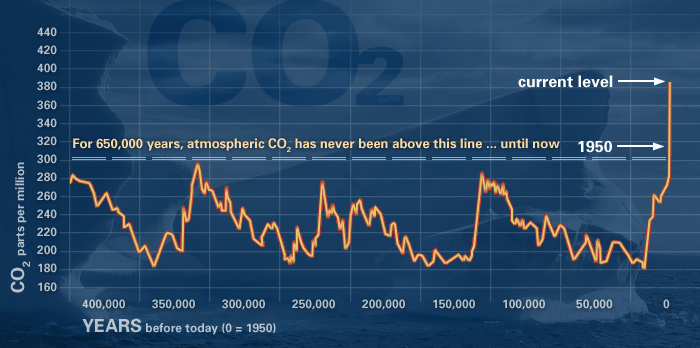
This is a graph from the NOAA Cimate Change website. See the Climate Indicators, an actively ticking measure of many indicators such as total ice shrinkage, sea level rise, etc which you can monitor.
Despite the massive investments of the disinformation conservative movement, a thinking individual – no matter what party, religious orientation or persuasion – cannot easily turn a blind eye to what we are witnessing in nature today. The basic idea is that we are weakening the inherent feedback loops that have kept the biosphere in dynamic balance for at least as long as living creatures have existed on the planet.
What we are witnessing is selective intelligence by a movement of corporations and their investors who deny climate change to be able to continue exploiting the earth’s natural resources unhampered by any state or self-imposed limitations. It is recognized that the Homo sapien has become the dominant species on earth so much so that scientists now label our era as the Anthropocene era.
The conservative think tanks and their investors have created doubt in Americans about the truth of climate change and there is now a chilling silence about it in Congress and in the Presidential debates. In fact if Romney and Ryan are voted into office, we will see unbridled fracking of land, including public lands, to suck out the remaining natural gas deposits to achieve energy independence. Everyone is talking about safe processes for fracking which is laughable. There are also a lot of “safe” processes that led to massive destruction of mountaintops in the Appalachian mountains. Fracking, which releases large amounts of methane – a heat trapping gas many times more powerful than the carbon dioxide molecule – will increase the heating in the atmosphere.
We don’t care. That is the bottom line. The march of capitalism, Big Stick diplomacy, exploitation for profit, and the brainless call for jobs, jobs, jobs at any cost has undermined reason, ethical responsibility, and stewardship of American land, water, air, and food security…at least in the Republican camp and to great extent in the Democratic ranks as well who are silenced for fear of losing votes. All the cries for individualism at all costs and the hatred of government are radically applied as if they were one-or-the-other choices. What ever happened to reason, to discussion and civil debate? That question cannot be heard in the temple.
With the January 2010 Supreme Court decision Citizens United versus Federal Election Commission corporations, and other organized political groups are able to make unlimited donations to a political campaign as long as they make no direct donations to the candidates. Thus the tsumani of advertisements for candidates that now blanket the airways and television and the internet. The court decided that these contributions do not lead to corruption. People can now contribute to silencing concerns about the environment and no one knows their agenda. Debate is not just tamped but eliminated conveniently. Corruption may be developing a new definition: parading as one thing when you are entirely another. I think we used to call it false representation.
All the previous campaign finance law, which attempted to make the playing field level and prevented special interest influences, granting citizens some space in which to seek their own information on candidates and make their own minds up – was wiped out with the Supreme Court decision. Now our citzenry is force-fed what to think and do. If you decide to not listen, you must literally turn off the radio, TV, and not read print news, and stay off your computer.
Corporations now vote. Welcome to the New America brought to you by the Modern Day Tea Party, deluded into thinking they have any semblance at all to the Boston Tea Party that grew in response to British domination of American economic success. The Tea Party, like the climate deniers, have created doubt and distrust in the government that we have all elected and that we are responsible to monitor. It is not something that others own, it is ours and we have added government where our citizenry have not always exerted justice and generosity. When our character fails as individuals and thus our businesses or public services fail, we look to government for justice measures. These have grown in direct relationship to the level or corruption in our society. The corruption is the collective actions or non-actions of citizens who are not living up the the American creed.
We are now on a stampede toward a cliff and fall into ecological catastrophe. Each of us must remember that we each have equal power to change this direction but, we must get rid of the corporotocracy that America has become.
What’s the best way to get started? Arm yourself with a couple of questions and keep them foremost in your mind: 1) Who is speaking? 2) What do I think about that?
As a teacher once instructed me: STOP WAIT CONSIDER!
That is the starting point. Vote your conscience next. Then dig in and ride your representatives to live up to their responsibilities to us. Pick one area of focus and become an absolute expert and guide others in your circle of influence. After that you’ll know what else you can do.
Money cannot define America and Americans. Right now it does. It has to change if we are to last.
On the tranquil Gulf
 I spent a glorious hour on the pier at Pensacola Beach high above the waves where you can see the curvature of the Earth on the horizon. The water was crystal clear to the white bottom. Some people floated, suspended in air it seemed, others walked far out from shore in tourmaline to emerald hues. The whole of it had no time.
  Slender needlefish meandered in small schools pushing a long nose to the surface while occasional dark clouds of spawning babies twirled by under the pier and beyond – the food of the sea.
The fishermen were in dreams, the lovers strolled in silence, and the gulls and terns fell in wide turns on the invisible ocean of air, a tern diving headlong into the green sparkling jewel…
Even the hotels and noise from beachfront bars became artful additions into a masterpiece of such beauty and tranquility all present are lifted into what must be Heaven.
I come home. Was I there really? My camera is here. I download the photos. A tiny sliver of what was there is recorded for the eyes but the heart and soul remains out there, out there!

Ceremony
 Nature’s beauty cannot be dissected nor understood through mere thought or system. What fills your eye and then your heart is understood whole. It’s more like a symphony—there is magic in the melding.
Each morning before I write, I light a candle or two in celebration of the new day. If I have a bundle of white or purple sage, I burn a leaf or two and let the fragrance of its spirit cleanse my soul and body, and I offer a prayer to the Giver of Life. When I lived in the West, I always had this mystical plant at hand. I miss it in the Southeast where I now reside, and have not found a substitute—perhaps pine needles from the great long-leafed pines of this low, coastal landscape.
A writer-friend of mine, Byrd Baylor, wrote The Way to Start a Day which describes the ways that peoples around the globe greet the dawn of a new day. Here’s an excerpt.
The way to start a day is this —
Go outside and face the east and greet the sun with some kind of blessing or chant or song that you made yourself and keep for early morning.
The way to make the song is this —
Don’t try to think what words to use until you’re standing there alone.
When you feel the sun you’ll feel the song, too.
Just sing it.
But don’t think you’re the only one who ever worked that magic.
Your caveman brothers knew what to do.
Your cavewoman sisters knew, too.
They sang to help the sun come up and lifted their hands to its power.
A morning needs to be sung to.
How do you greet the day? No need to do it any particular way, in fact, you may even be unaware of how you are paying attention and feeling gratitude for this one good day. Sometimes we are so wrapped in our individual challenges and tragic circumstances we forget to breathe, to look up and see the beauty all around us. Create a tiny sacred space to recognize the gift of life and the wonder of nature and you.
Seven Gems
These are books and authors that I have read and reread that I am posting today for you and especially your thoughts if you too have read them. These books are dear to me for their wisdom—powerful narratives that explore indigenous and European values through the experiences of characters. Some, like Loon Feather, are of the rarest beauty.
This original meeting of Two Minds began 500 years ago on the North American continent and play-out today as we make decisions regarding wilderness, use of public lands, climate change, and our basic human relationship with each other.
The Seven Gems
Loon Feather by Iola Fuller (1940)
The Man Who Killed the Deer by Frank Waters (1942)
I Heard the Owl Call My Name by Margaret Craven (1973)
The Work of Wolves by Kent Meyers (2004)
The Painted Drum by Louise Erdrich (2006)
The Absolutely True Diary of a Part-Time Indian by Sherman Alexie (2007)
Caleb’s Crossing by Geraldine Brooks (2011)
The Dawn Chorus
Aldo Leopold: “If the land mechanism as a whole is good, then every part of it is good, whether we understand it or not. If the biota in the course of eons has built something we like but do not understand, then who but a fool would discard seemingly useless parts? To keep every cog and wheel is the first precaution of intelligent tinkering.”
Aldo Leopold, the 20th century’s most important conservationist, is brought to life in this recent interview on Living on Earth. Steve Curwood interviews Stanley Temple, Professor Emeritus in Conservation at the University of Wisconsin-Madison who is a Senior Fellow at the Aldo Leopold Foundation. Specifically, Aldo regularly recorded the dawn bird chorus on his farm. This journal increases in value as a baseline record of bird species on a worn out piece of land which he bought to restore to life. Over decades the Leopold family replanted trees and native plants—often a disheartening activity as many perished before some “took.”
In this interview, Temple explains how he found an unpublished manuscript from the Leopold papers, archived at the University of Wisconsin. Leopold used one of the first light meters of his time to coordinate the level of light from night to dawn with the sounds of the first birds—the Dawn Chorus. What got recorded for all time was an invaluable record of the environment against which today’s environmental elements and biodiversity can be compared.
Unlike what is happening in general to habitats, Leopold’s land has increased in biodiversity due to its restoration of native vegetation and watershed.
Enjoy the recording during the interview, and also, a current recording in which the sounds of the birds are nearly drowned by the noise from a nearby freeway.
The Power of Trees
When I consider that a single man, relying only on his own simple physical and moral resources, was able to transform a desert into this land of Canaan, I am convinced that despite everything, the human condition is truly admirable. ~ The Man Who Planted Trees by Jean Giono.
Each day while he tended his flocks, the shepherd drove a heavy steel rod into the soil on the rolling hills, dropped an acorn, covered and tamped it down. In his day pack the old man carried 100 perfect acorns, sorted through in silence the night before. Tomorrow he would repeat this work—planting trees while his sheep grazed.
Elzéard Bouffier determined the land was ravaged for lack of trees. Wind whipped across its tortured slopes after years of war and human exploitation. Throughout WWI and WWII—while the fates of younger men lay in bloody trenches—the elder Frenchman methodically played out his chosen vocation, planting sturdy oaks, a copse of beeches and orchards of apples.
“The Man Who Planted Trees and Grew Happiness” was published in Vogue Magazine in 1957. Jean Giono—a celebrated French writer—created a story that awakened the American passion for wilderness at a time when environmental degradation burdened the public mind.
About that time a teenager from Kenya travelled to America to study ecology. Raised in a traditional Kikuyu family in the northern hill country of Kenya, her mother had taught her to never take firewood from the fig tree because it was sacred. God dwells in the fig tree, her mother cautioned. Wangari never questioned her mother. But, Catholic missionaries later convinced the villagers that God did not live in the fig and to destroy the sacred groves to build new churches which they did.
Ten years later when Wangari Maathai returned to her homeland she finally understood the wisdom of the Kikuyu. Without the fig groves’ deep root systems, the hill country had eroded, turning clear streams to muddy pools. Without clean water the community suffered from disease, hunger and poverty—unknown in past times. The Kikuyu lost an ancient environmental protection policy.
By the time Wangari came to a leadership position in her government, forests that once blanketed Kenya were being harvested on a massive scale. Her path to Deputy Director of Environment and Natural Resources began humbly in 1977 when she returned to her native country. Wangari realized that the people and land were being harmed by expedient government policies that promoted logging for quick profit in international markets. Women in particular were impacted by extremes of drought and floods, erosion and loss of the land’s productivity. They were the traditional farmers.
Being a practical woman, Wangari thought, “We can plant trees.” In 1977 she began The Greenbelt Movement through which thousands of women nurtured seedlings to restore the land to healthy functioning. Wangari broke all the barriers: the first African woman to earn a doctorate degree; the first Kenyan woman elected to parliament. She challenged the judgment of men in power. For her efforts she was brutally beaten and imprisoned. Each time the women of the Greenbelt Movement suffered violence at the hand of government, they planted more trees. They were simply unstoppable.
Today, forty-five million trees have taken root in Kenya and forests grow over the stumps of a less enlightened time. Streams and rivers have returned clear and broad after nearly four decades of diligent action and a simple idea: plant trees. A wrong was righted.
Jean Giono—a pacifist—wrote about the wanton destruction of life during two world wars. He, too, was imprisoned. “The Man Who Planted Trees” was perhaps his way of righting the insanity that swept across Europe. The Greenbelt Movement became the manifestation of his vision.
Wangari probably did not know about Giono’s story when it was first published. She was just a practical woman who saw a simple solution to a complex problem much like the shepherd. Perhaps the stubborn determination to keep dreaming and the stubborn determination to make it true go hand in hand—flip sides of a coin. Yet, we know that diligence can be the handmaiden of either positive or negative action, as history records. Thank God diligence leverages the greater force when applied to a just action.
Author’s Note: Chelsea Green published a special edition of The Man Who Planted Trees in 2005. The introduction was written by none other than Wagari Maathai, 2004 Nobel Laureate. She passed away on September 25, 2011.
 Susan Feathers