I meet Earth and Sky

I met Earth and Sky in Yuma.

Below is an excerpt from a time when I studied with two Native Americans. Gabe Sharp (aka Running Water) was a college professor with Arizona State University and a social worker at the Quechan Indian Reservation in nearby Winterhaven. Louise Etienne, his wife, was an artist and teacher known as Sundance Aquero. Gabe was born on the Mohave reservation in Parker, Arizona and Sundance was born in Montreal to a French mother and Mohawk father.

They offered workshops to individuals and groups about indigenous worldviews and tribal history. I had always been curious about Native Americans because our family includes a part Cherokee relative in my mother’s lineage. (For readers, my last name, Feathers, is Scotch-Irish.)

During my formal education, there was practically no information or simply wrong information about Native Americans in the U.S.A’s formation and history. I did not encounter the abundance of printed material from tribal nations until I became an environmental educator as my teaching career blossomed to new venues.

Science was my way of knowing, partly because my father was a big influence on me. He studied physics and loved all the sciences which he shared with me as I grew up. I knew about water cycles, turnover of matter, population dynamics, biodiversity, etc. but something about the sacred nature of God’s creation was missing from this way of knowing. Gradually, I turned to indigenous perspectives about living on the land as it was abundantly obvious to me that our capitalist values about land, water, sky and people could plunder a landscape when it exceeded some internal set of rules which I now understand to be species relationships described by Robin Wall Kimmerer as reciprocity, i.e. give and take that observes the limits of a particular place to maintain its healthy and enduring function. One of my favorite and most insightful American conservationists about the ethics of living well on a piece of land—Aldo Leopold—described the essential dichotomy between European and Indigenous perspectives:

Conservation is getting nowhere because it is incompatible with our Abrahamic concept of land. We abuse land because we believe it is a commodity belonging to us. When we see land to be a community to which we belong, we may begin to use it with love and respect. ~from  A Sand County Almanac, Foreward, Oxford University Press, Special Commemorative Edition, 1989.

But in 1990, I had yet to read Leopold’s great works. I just knew something was essentially wrong and out of balance about how we used Nature for profit. I’d personally witnessed the decapitation of mountains for mining coal in Appalachia, my home, and living near the Colorado River and Imperial Valley were living proof logic was not an underlying principle for intelligent use of our natural resources in the U.S.

Below are excerpt’s from a memoir, The Little Book of Wisdom, unpublished but under copyright law.

When I began my exploration of truth and justice with indigenous people, I began by examining the nature of these principles in my own life.  This is the story of how I came to face the truth about my life and discover the true nature of Western culture as reflected by contemporary Native Americans whose nations had lived in North America for thousands of years. What I came to see first revealed itself in the English language. My teachers brought out a huge dictionary in my mother tongue as the first text in ultimately four years of intense study. 

With guidance I first studied how my culture expresses dominance in its language, inherited from empires. After instituting values of equality and justice before the law, our government has preferentially applied them in practice. I kept a little notebook of this study which I gave to my teachers.

Next, they suggested I read three books: Basic Call to Consciousness, God is Red, and a novel, The Loon Feather.

Basic Call to Consciousness by John Mohawk contains an address from the Haudenosaunee to the Western World. The book is still in print and is the best comparison of indigenous perspective from European perspective that I have studied. It also contains the founding story of the Haudenosaunee (Oneida, Mohawk, Onondaga, Huron, and the Seneca) nations’ compact for peace and governance. You would know them as the Iroquois Confederacy, a name given by French fur trappers and continued in U.S. use for centuries. It is this body of law and principle that Benjamin Franklin studied with tribal leaders and later presented to the early colonial governments as a good plan upon which the 13 colonies might structure their new nation.

God is Red, by Vine Deloria, Jr., is considered the seminal work about Native perspective on religion. It repositions humans from the dominant species for which the universe was created to being just one among many species interrelated and dependent on each other.

The Loon Feather, written by Michigan author, Iola Fuller, is a classic story which takes place mostly on Mackinac Island as a system of wealth based on unlimited extraction ends with the collapse of the beaver nation population. The Mohawk chief, Tecumseh, has been successful in a Pan-American alliance among eastern tribes to oppose the European theft of their homelands. Tecumseh’s daughter, Oneta, lives among her own people and the French and European traders on the island. Eventually she must choose between the values of her Mohawk people and those of her stepfather, a French merchant with the Hudson Bay Company whom her mother married after the death of Tecumseh.  While the author is of Euro descent, I believe my teacher, a daughter of a French mother and Mohawk father, believed the themes presented in Oneta’s story would work for my study of two starkly contrasting systems for living in the world.

And then I had an experience lifted out of time and space in a rundown, dusty thrift shop in Winterhaven, Arizona when Sundance suddenly asked to visit it.

There among stacks of old books and magazines, a cacophony of throw away objects from locals, Sundance found several volumes of the Stockholder’s Board of the Hudson Bay Company.

To be continued…

Resources:

Basic Call to Consciousness

Haudenosaunee Confederacy

God is Red

The Loon Feather Note that I have written a book review about the loon feather here.

Robin Wall Kimmerer

A River Divided

From 1990 to 2008 I called Arizona home.

I had accepted a teaching position at Crane Junior High School in Yuma, Arizona. In turn, this would be an education for me beyond my wildest imagination. My degree in special education for students with hearing loss was a rarity. The administration decided that I could teach any kind of learning disability as well. It was a rich if not chaotic teaching experience for me and my brilliant classroom aide, a Yuma local.  

The Lay of the Land

The city had gained the name “the Crossing” when people traversed the Colorado River at Yuma into southern California during the Gold Rush. It was my first encounter with the river which is channeled to water America’s vegetables and grains in the Imperial Valley of California. Its precious water also flowed along quiet canals among date farms and citrus groves throughout the city of Yuma. My school was surrounded by broccoli fields and orange groves. The whole environment was blooming with diversity.

In many ways I felt at home in Yuma which is a sprawling western town with a mashup of cultures and languages. It is a major location for Marine, Naval and Army facilities. I thrived in the milieu and while there, I discovered the history and cultures of the region from my students and their families. They represented the Cocopah and Quechan tribal communities, migrant-farmer and military families, and locals whose families had lived in the region for generations. They grew cotton, dates, fruit and vegetables.

Most of my students spoke Spanish fluently but could not do so at the public school which observed a strict English-only rule. For some of my students, sign language solved the language gap, but for others it burned in their soul with indignation. The area’s history of settler dominance repressed Mexican and Indigenous cultures. Colorado River tribes were numerous up and down the river between Parker, Arizona near Lake Mead and down into Mexico to the Sea of Cortez. Their cultures had lived along the wild river for at least 20,000 years. They farmed in the rich silt left after the spring floods receded, leaving rich silt for planting. The ancient Lower Colorado River has been likened to a Nile culture. Curious about the river’s history and ecology, I spent my time exploring historical sites and learning from elders and regional scholars.

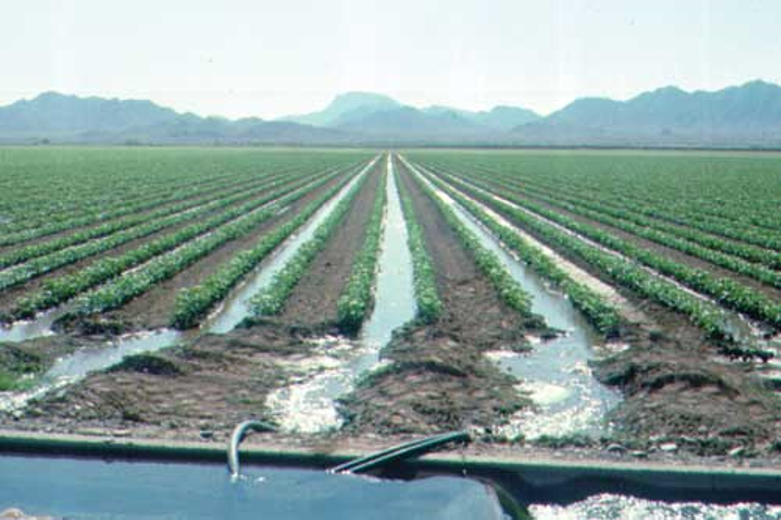
When I first encountered the Colorado, it was unrecognizable to me as it was sprayed at high velocity from circulating sprinklers across the Imperial Valley on the California side of “the crossing”. Precious water evaporated in the dry hot atmosphere before falling to the ground. Row upon row of lettuce, broccoli, and cabbages lapped up what water fell to the ground. As far as the eye could see, this preposterous apparition filled my windshield as I drove through the Imperial Valley at sea level.

My first sight of this phenomenon occurred as I descended from the Continental Divide atop the Laguna Mountains (6500 feet above sea level to below sea level at the base of the mountain and the vast plain of the Imperial Valley. I was driving my son’s El Camino, a great San Diego beach buggy but treacherous in a place as hot as the valley. By the time I pulled into a watering hole near Yuma, I was growing faint. My education in Yuma would include heat stress and heat stroke prevention and how to equip a car for travel through the desert.

In its natural state, the Colorado River began as melt water that ran down through the Rockies, gathering size and speed, carving deep canyons in the red sandstone of northern Arizona. The river ran red where it dropped suddenly down toward the Sonoran Desert, flooding its banks in the spring as it flowed down into Mexico and emptied into the Sea of Cortez (Gulf of California). Where it slowed and spread from its banks, a delta region of marshlands formed that were places of high biodiversity. Plenty of fish and game abound. Indigenous fishers and hunters found a wide margin of mesquite tree forests on the banks of the river, as did French fur trappers and Spanish explorers. During the Gold Rush, however, these trees were cut down to burn in the steamboat business that developed to ferry gold hunters back and forth over the river which was a mile wide near Yuma.  Loss of this tiny tree forest meant fewer deer and loss of a foodshed. The mesquite trees release bushels of nutritious bean pods seasonally. Later, scientists discovered the pods, when ground and made into flour, provide natural immunity to diabetes by regulating blood sugar. Mesquite bread is still made and sold regionally. It is naturally sweet and easily digested. (I made pancakes from it). Legends record that people walked across the river on the backs of large fish.

The Lower Colorado River was once a thriving place of wildlife and river cultures. In our Anthropocene era, the river is most recognizable at its highest elevations where it continues to cut the stone of Colorado and Northern Arizona and carry it tumbling south. Lake Mead collects the lion’s share of water, but starting at Parker, Arizona,  water is pumped 700 ft into the air where it falls into an open canal system (Central Arizona Project or CAP) and travels by gravity toward Phoenix, then shimmies through and on to Tucson and drips into Mexico. The rest goes to Nevada and California. All these artificial truncations are due to something called The Law of the River. In short, this is the pact formed originally in 1922 between states on how to parcel out water to each.

Over decades and extensions of the canal system to accommodate burgeoning populations and infrastructure, the river no longer reaches the Gulf of California. It peters out above the marshy delta region and slowly dries up. Recent efforts by federal, state and tribal nations have managed to restore enough river flow to fill key areas of the marshland again. However, a regional 100-year drought is drying the land, while increasing temperatures from climate change have robbed the Rockies of its snowpack and thirsty alpine soil soaks up more river water reducing flow from the source.

At this writing, Hoover dam and Glen Canyon dam and their respective reservoirs, Lake Mead and Lake Powell, are at historically low levels. Hoover dam was built in the first decade of the 20th century on faulty predictions of average flow. Calculations were made during an unusually high snowpack in the Rockies. This did not become apparent for many decades. Conservation of water did not start in earnest until about 25 years ago. Development pressures continued until, at present, 40 million people rely on the Colorado River for drinking water, farming and ranching, electrical generation and industrial uses parceled out among the seven western states in the Colorado River Compact. A prolonged drought, increasing temperatures, and changing precipitation patterns threaten this broad area of the United States.

Water is the limiting factor in a desert. My students and I gained insights about overharvesting a natural resource—the river in their backyards.

To be continued …

The River People

Chapter 2

From the Diary of Victoria Greenway

February 6, 2002

My duties at the Center for Southwest Studies often sent me on interesting assignments. The story that I am about to tell may be the most unusual among them, and, as I look back, it was surely the most memorable. The experience profoundly altered my basic understanding of American history.

The assignment required me to establish relationships with a small Native American nation whose reservation is located near Yuma, Arizona. The purpose was to develop an environmental education program. The type of program was left for the nation to determine should they agree to such a project. The center for which I worked provided technical assistance on matters such as water quality and protection of native species within reservation lands.  The education program was another way to engage people to assist in these goals.  The irony of this arrangement was not apparent to me right away but dawned over the brief time I had the privilege to meet and talk with the elders and other tribal members.

I eagerly accepted the project, imagining it to be an adventure into a part of the West I had never visited, and a worthy endeavor to foster good relations with a nation whose cultural roots ran as far back as 3,000 B.C. No guidance was offered by my superiors, who hoped I might find success where, apparently, others had failed in the past. That spurred me to try but cautioned me not to plan too far ahead.

~~~

My first trip to Yuma from Phoenix, Arizona began in the sparse landscape of low desert, where creosote, arrow weed, cholla and barrel cactuses dotted flat plains of baked soil covered with mats of pebbles. As the sun rose higher in the sky, and the highway steadily dropped to below sea level, I understood why Yuma was often regarded as a hellish landscape: the heat radiated off everything in shimmering drafts of rising air, sucking what little moisture remained in the soil. The low scrubby plants that grew steadily in this environment possessed superb adaptations that allowed them to thrive there. Dust devils—swirling wind vents that lift desert soil skyward—crossed the highway, carrying skeletons of tumbleweed with them.

On the edge of town, gaudy billboards advertised motels, car repair, and local watering holes where one could hole up with a large ice water or cold beer and delicious Mexican fare. Signs for military bases and directions to several reservations mixed in with my directions to meet David Tejano at The Crossing Restaurant. 

The cool and darkened interior of The Crossing was welcome relief from the heat. It buzzed with diners and scurrying waitresses. On the far side of the main dining area a tall, strongly built man stood from behind his table and waved me over to join him. How he knew who I was remains a mystery as I think back about our meeting that day. Put in the context of his life as I later learned about it, I would just say he navigated his waters well.

David Tejano extended his hand, but his handshake was but a soft touch, nothing like the sudden grip Westerners associate with assertiveness. This was the first cultural difference among hundreds of others I would learn along the way.

“Hello. How was your trip?” he asked as we sat down.

“It was easy driving,” I said. “I have never spent any time in Yuma.”

“Most people are just passing through,” he remarked without emotion.

I immediately regretted my comment.

“Are you hungry? I can make some recommendations,” he offered.

“Yes, and please do, I have not eaten since breakfast.”

Thus, our relationship began through a gastronomical introduction to The Crossing, where Colorado River Indian Tribes, Mexicans, U.S. military personnel, snowbirds from the U.S.  and Canada, and passers-through comprised the new ebb and flow of a once wild river. Instead of the roiling, swift waters of the free Rio Colorado, Yuma residents swelled from 50,000 to 90,000 residents in the winter before receding during the late spring to its die-hard residents, able to withstand the broiling summer temperatures.  The term snowbirds, for those who flew the coop as the sun bore down on the region, was more than accurate. Most of them were seniors with flowing white or silver hair, retirees with money to gamble in the casinos of the local tribes, and the original people of long-standing presence.

~~~

In performing his duties as a social worker, David Tejano held important information about the protocols to observe when meeting with members of the Tribal Council and elders. The population on the main reservation was only 2,000. There were many more below the border where they were known as the Cucapas. He knew everyone.

David’s manners were impeccable. He made sure that I had water first, then suggested his favorite dishes at The Crossing.

“The chili rejenos are almost as good as my mother’s, or, if you like tortillas, try their soft taco platter,” he suggested.

Everything about David was large. His bronzed fingers were notably thick, as he pointed on his menu for me. His thick, dark hair was neatly trimmed, and his dress was casual-professional—ironed by someone who knew how to place a crease. No one ironed their own clothes in Vicky’s world in Phoenix, but the flakes of starch on his shirt collar told her this was probably the work of his wife or maybe even his mother. Oddly, that made her feel good.

Deep lines in his forehead perhaps revealed his age or his work stress, but for the most part he appeared to be in his 40’s.

I noticed as we began to talk about David’s work and the River People Nation that he did not look directly in my eyes as those in my white culture do. Later I learned this was a sign of respect and I adopted the same behavior in meeting and working among the River People.

After the large platters of food were delivered to our table, David began to tell me more about the people of his nation.

“Our people are the ancestral nation of this region,” he said. “We’ve been here for millennia, and our people’s memory goes back to times when this land and its river were entirely different than what you saw on your way down here today.”

He paused to take a few bites, followed by a few sips of iced tea, while I shoveled in cheesy tortillas, hot salsa, and frothy Pacifico beer, not realizing until then how hungry I was, and in need of the mollifying effect of the alcohol. I’d been very nervous about the meeting. White guilt, I guess, was a burden I was carrying with the knowledge that David’s ancestral culture had been all but wiped out by my culture’s dominance over the land and its resources.

“We, like other tribes across this land, grew up with knowledge of the land, its wildlife, its seasons and gifts, and its hardships.” He paused to reflect in silence, then continued his story. We became the River People, living by it, travelling on it, and taking from it the gifts of the creator for our livelihood. Even its mud was used to prevent sunburn and to hold our warriors’ long hair in sculpted shapes. We, like other native people, clothed and decorated ourselves with what nature offered us.

“Perhaps our greatest achievement was how we learned to farm in the floodplains of the river in the late spring after the flooding waters withdrew. The seeds we used conferred great health to our people. If you can imagine it, the river supported forests that grew thickly along the shores. It is said that the forests of cottonwoods and willows, and the mesquites were as broad as seven miles along the river. Imagine that! Game, fruits, and seedpods from mesquite, cottonwood, and willow woods provided many important medicines and materials.” David seemed to drift in his own imagination as he described the land and his people before European contact.

I listened carefully. This man was taking time to help me understand the transformation to present day. I instantly grasped what a gift it was, that he had no obligation to do that, especially for someone representing a culture that had all but destroyed what he described for me.

David continued to present day. The nation was suffering from widespread diabetes, depression, and alcoholism—from generational loss of their lands and the dilemma each person faced about how to live in a culture whose values conflicted with their own.

David was the first college graduate among his people. He had returned to help his people bridge into the dominant culture, to find meaningful work, and to build security for their families once again. It was a daunting task. He referred me to books in the River People Museum and Cultural Center.

“There are a few trusted sources whose work we sell from the Museum. So many have come and taken from us,” David said as he looked up at me. “I wish you luck, Miss Greenway, but you can never tell how it will go. The River People have met with many emissaries such as you, only to have their words and their culture stolen, then printed in some book without their permission. It happens time and time again. So, don’t expect much.”

My heart sank. Suddenly, the nature of this meeting seeped into my awareness: two nations were meeting across our table. I felt like an ambassador, and David, one for his people. I fully realized how delicate and important this work would be. My curt nature with my director a month before made me ashamed. Perhaps he too had not really grasped the meaning of the opportunity to meet with leaders of one of our nation’s original peoples. They had no reason to do it, no reason to trust me. Yet, a hand had been extended by David Tejano.

~~~

I followed David’s vehicle to the reservation. We traveled through back roads among numerous canals lined with orange and almond groves, then out onto country roads that cut through broad agricultural fields of broccoli, lettuce, and corn. It was beautiful in its own way. Colorado River water, diverted by the canals, ran blue and bubbling through the fields.

At the entrance to the main reservation a large tribal seal showed a tall fisherman spearfishing along the river. This was the homeland of the River People. Green lawns in front of the Cultural Center and Tribal Headquarters were planted with rose bushes now in full bloom in shades of red, peach, and yellow. A ramada made of mesquite wood and woven with willow and arrowweed for shade stood outside the main doors of the museum. I noted the beauty and heard the quiet statement it made. There was a feeling of honor about it, like rising from the dust; a sturdy tree would flower there one day.          

I parked outside the headquarters next to David. My first meeting would be with the environmental engineer, a non-native employee from the state, who advised the nation about the condition of its natural resources. David left me with Bill Sherwood and told me that it might be possible to get me on the Tribal Council’s agenda later that week. I thanked him and he left. I watched as he walked across the road to his office, his dark hair shining in the sunlight: he to his work, and me to mine.

Yuma, Arizona Farm Fields