The Land and Waters Speak

At present Lake Mead and Lake Powell on the Colorado River distribution system are at record lows (Lake Mead 34% and Lake Powell 27%).

From 1990 to 2008 I called Arizona home. I lived first in Yuma where the Colorado River channels into myriad canals to water America’s vegetables and grains in the Imperial Valley of California.    

It was in this vast valley that I first encountered the Colorado, unrecognizable to me as it was sprayed at high velocity from circulating sprinklers. Precious water evaporated in the dry hot atmosphere before falling to the ground.  Row upon row of lettuce, broccoli, and cabbages lapped up what water fell to ground. As far as the eye could see, this preposterous apparition filled my windshield as I drove through to Yuma at the confluence of Arizona, California and Mexico borders.

In its natural state, the Colorado River ran down through the Rockies, gathering size and speed, carving deep canyons in the red sandstone of northern Arizona. The river ran red where it dropped suddenly down toward the Sonoran Desert, flooding its banks in the spring as it flowed down into Mexico and emptied into the Sea of Cortez (Gulf of California). Where it slowed and spread from its banks, marshlands formed that were places of high biodiversity. Plenty of fish and game were found by Indigenous peoples and later explorers. All along the river near Yuma, forests of mesquite trees released bushels of nutritious bean pods. Later, university scientists discovered the pods, when ground and made into flour, provide local people with immunity to diabetes. Mesquite bread is naturally sweet and easily digested. River peoples grew crops in rich deposits of mud left by the receding waters. Legends of fish so large and numerous the people could walk across the river.  

In our Anthropocene era, the river is most recognizable in its highest elevations where it continues to cut the stone of Colorado and Northern Arizona and carry it tumbling south. Hoover Dam at Lake Mead collects the lion’s share of water, but starting at Parker in Arizona,  water is pumped 700 ft into the air where it drops into an open canal system (Central Arizona Project or CAP) and travels by gravity toward Phoenix, shimmies through and on to Tucson and then drips into Mexico. Over decades after the canals grew with a burgeoning population and larger farms, the river never made it to the mouth of the Sea of Cortez. It petered out above the marshlands of northeast Mexico which slowly dried up. Recent efforts by environmentalists and indigenous communities managed to restore the flow enough to fill key areas of marshes again. The once rich biodiversity is returning.

At this date, two dams and their respective reservoirs, Lake Mead and Lake Powell, are at historically low levels. Hoover dam was built in the ’30s of the 20th century on assumptions made during an unusually high snowpack in the Rockies that was not the norm. The dam at Lake Powell was later built to collect water  and generate electricity for business, farming and cities. Desert lands where the canals distribute water are biomes with limited water. Turns out that the Colorado River flows are normally lower than the projected. Long-term tree ring studies show regular drought periods of up to 100 years. The area is in one now.

Warming from climate change is causing snowpack changes – faster melting rates and new evaporation of ice crystals directly into a gaseous state.   

As American food security, economy, science and culture face a potential crisis, how will 40 million people live in a hot, dry desert? From LA to Phoenix to Tucson and points between, much will be unsustainable without reliable Colorado River water. Cities have mostly drained their ground water. Some like Tucson are replenishing it with CAP water but that, too, is a scenario with a short horizon.

Now the powers that made the Law of the River (Upper and Lower Colorado coalition of states, municipalities and tribal nations) are talking about draining Lake Powell and sending water to Lake Mead. All partners will see reduced acre feet per year, and some will no longer receive any water from the river. Ongoing talks and mediation have reached no agreement yet. Arizona’s tribal nations are adamant that they must be part of that negotiation.

Lake Powell in southern Colorado was constructed under a huge outcry by residents and tribal governments who ultimately suffered the sacrifice of their homes and property and traditional homelands to fill the huge reservoir. Traditional lands of Indigenous nations must be returned. What about all the people who lost their homes and farms?

Will humanity learn anything from this tragic miscalculation? I’m skeptical given history.

When Congress commissioned John Wesley Powell to survey the West and determine its potential for farming and building cities, he traveled extensively in the West and was one of the first expeditions to make the wild trip down the Colorado River from the headwaters to Yuma. Result? He reported to Congress that the area held limited water for most of the land mass and that if the government should sell lands to enterprising ranchers, farmers and speculators, they should bear the financial burden of providing what water supply they could find. Imagine if they had followed Powell’s advice. Many fewer people would reside in the Western deserts; the food supply would be regionally grown, and the international food markets would be in places where rain naturally falls. The River would run free, nourishing  human and natural communities to the sea.

I once wrote a speculative fiction novel in which, due to changes in climate, local communities formed enterprises that fit the bioregions where they lived. Later, they became small nations with a shared ethic that recognized the ecology of place and innovated within natural limits.

Resources:

  1. Colorado River Management: https://www.azwater.gov/crm/dashboard#
  2. Bioregionalism: https://en.wikipedia.org/wiki/Bioregionalism
  3. The American Southwest: video on YouTube – https://youtu.be/K96ly_uLAPk

The American Southwest is a 2025 award-winning documentary with updated information and spectacular photography. It shows the biodiversity and the role of many animals, plants and insects adapted to the river, and how their lifeways provide sustainable strategies for human life in arid lands.

It traces the original agreements (The Law of the River) on how the Colorado River water would be allocated, the construction of Lake Mead, and subsequent construction of Lake Powell. I recommend the film for citizens and students of ecology and bioregionalism as we enter a defining period when we will all need to work together to mitigate and adapt to a changing climate. If we consider the land and water in that partnership, I believe we can live within the limits of the Earth while innovating in our communities.

Water Is A Basic Right – Right?

Not so according to five of nine U.S. Supreme Court Justices. Read how they consider “trust” established in treaties between the Navajo Nation and the U.S.

Listen to Thirst Gap Podcast on KUNC National Public Radio, Episode 5: First in Time. This Episode features the Navajo Nation (The Dine’ People) water issues.

Following the Trail of Water

Mark Hainds, Border Walker

A friend of mine, Mark Hainds, is a forester and author, who has challenged himself to walk the entirety of the U.S. – Mexico Border. In doing so, he is noting the conditions of the landscape, meeting the people who live there, the people who are passing over the border in hopes of a better future, and experiencing the deep peace from long hours of silent walking. Be sure to visit his site above.

On Friday morning I dropped him off at mile marker 40 on highway 82 near Sonoita, Arizona. This is grasslands – basin and range territory – home of historic ranches, antelopes, and hardy people who love the land.

Grasslands of SE Arizona

To a visitor is can seem very still but to locals who know its subtle changes, it is an exciting place to call home.

Patagonia Lake State Park

Luckily, the Nature Conservancy and the Bureau of Land Management had foresight to preserve large tracks of riparian habitats (those areas where water flows near the surface of the ground, and in wet seasons, runs in streams and rivers). When you gaze out across expansive grasslands and see a line of bright green trees, you have found water.

Cottonwood Gallery Forest

Today I followed the traces of water across the landscape by looking for those trees. While I walked the fields and paths, small herds of tawny pronghorns on far hills bounded in the high grass, white rumps flashing in the sunlight.

At the historic Empire Ranch, I listened for the voices of families, ranch hands, and cowboys lingering in the old structures of the house, cottages, corral, and barn.

Old Barn

Empire Ranch Grounds circa early 20th century

Wandering the paths into a cottonwood gallery, I felt spirits walking next to me. A time gone but with lingering energies, whispering to us modern day visitors.

What are they telling us?

Would it be a cautionary tale? The ranch was passed through many hands, each family working it for 35-50 years, then to developers, and finally into the protection of the U.S. Department of the Interior.

The ranch and 42,000 acres of riparian corridor and grasslands is now Las Cienegas National Conservation Area which we all can visit.

Yet these images show a time gone by, when the big cattle ranches reigned, and then died as water receded, and the demand of beef declined.

Perhaps we live in a more enlightened time. But, that remains to be seen. Will we remember the lessons of the past, or are we doomed to repeat mistakes with forgotten memories?

The ghosts of the land whisper to us. What are they telling us?

One whose spirit speaks to me is Aldo Leopold: “Conservation is getting nowhere because it is incompatible with our Abrahamic concept of land. We abuse land because we regard it as a commodity belonging to us. When we see land as a community to which we belong, we may begin to use it with love and respect.”

When the cows and the buffalo roamed…

And just like that, a second novel

Mountains to the Sea

Well, that second novel has been “cooking” in my mind for many years, and builds on years of experiences that reach back to 1990. That year I moved to Yuma, Arizona to teach middle school students at Crane Junior High School. Yuma first introduced me to the Sonoran Desert, and naturally, I experienced the hottest part of it first. Yuma temps that first summer hit 122 degrees Fahrenheit. My friends and neighbors taught me how to stay safe while traveling, and how to get out early in the morning before the heat made it impossible.

All around the school and neighborhoods where I lived, agricultural fields stretched out in long even rows with canals as borders, while row upon row of blue water soaked into the ground, evaporating in the intense heat. Surrounded by a sea of broccoli, my school was embedded in the large-scale industrial farming operations in which many of my students’ parents labored. On these intensely hot days, I wondered at the ability of human beings to endure hard labor in those fields.

AZ Agriculture Photo

Then, the fact that the water came from the high Wyoming plateaus and Rocky Mountains was only vaguely in my awareness. Precious river water poured down through deep canyons into the dams that controlled the North American Nile, and by a complex system came to Yuma and the Imperial Valley to grow 90% of America’s leafy produce between November through March. Then, I was focused on my students’ daily struggle to learn and grow up under harsh conditions of poverty and discrimination. But, all around us was a BIG STORY about a river, its people, and how it came to be the most controlled and overused body of water in North America. Indeed, the Colorado River is so over-allocated that it no longer winds its way to the Gulf of California as it did for thousands of years.  The  magnificent delta region, one of the world’s largest and most productive wetlands, literally dried up and died.

This is the subject of my second novel, The American Nile: Voices of a River and Its People. I am working with a talented editor and should have a solid draft completed before I return home from Tucson in late April.

Tucson – My Military Life

Tucson became my home from 1999 to 2008, but I had been a resident in the Old Pueblo when I was just a babe. Dad (Major E. B. Feathers at the time) was stationed at Davis Monthan Air Force Base in Tucson. I was 2 years old when we moved there. I remember photos of my mother, sister and me in sundresses and sandals in front of a house with a large shaded porch, cacti and sand.

Little did I know that I would one day return to Tucson as an adult. When I was just getting started in life, I had an early encounter with the desert by falling into an Opuntia (prickly pear). Mom recalled she was pulling needles out of my arms and legs for a month.

Charles Lindbergh dedicates Davis Monthan Field: September 23, 1927

In 1925, Tucson’s City Council purchased 1,280 acres of land southeast of town to relocate the city’s municipal airport. Unknown at that time this new site would become the nucleus of Davis-Monthan Air Force Base. Six years earlier Tucson had the proud distinction of opening the first municipal-owned airport in the nation. Located four miles south of the city on Nogales Highway, the present day location of the Rodeo Grounds, the 82.64 acres was designated Tucson Municipal Flying Field after several name changes. Following years of stalled negotiations with the War Department, city planners elected to purchase the larger site and transfer airport operations in hopes that the military would reconsider establishing an aviation branch in Tucson.

Construction at the new site was completed in late 1927, and on September 23 of the same year, Charles Lindbergh, who months earlier crossed the Atlantic in the “Spirit of St. Louis”, formally dedicated the site in honor of Lieutenants Samuel H. Davis and Oscar Monthan, two Tucson aviators whom died in separate plane crashes after World War I. The city shared another proud moment with the opening; Davis-Monthan Field immediately became the largest municipal-owned airport in the nation.

Military presence at the new Davis-Monthan Field began October 6, 1927 when Staff Sergeant Dewey Simpson transferred the military aircraft refueling and service operations from the old municipal airport. He also brought something very unique with him, a log book that was signed by the field’s patrons. Early aviation greats such as Foulois, Arnold, Spaatz, Vandenberg, Earhart, and Doolittle took the liberty of signing the registry as a record of service. (Currently the Registry is on display at DM’s Base Operations). With only two military personnel assigned to the field, negotiations between the War Department and Tucson would remain at a stand-still until 1940.

My Dad was stationed at Davis Monthan AFB in 1947. He had just rejoined the USAF after it formed from the Army Air Corps after WWII ended. Dad flew B-29s in the Air Force. Davis Monthan AFB began its revival after the war as a location for the successful Super Fortress (B-29 Bomber). The very dry air provided an ideal location to store the Superfortress,  and other air craft accumulated during the 2nd World War in the desert.

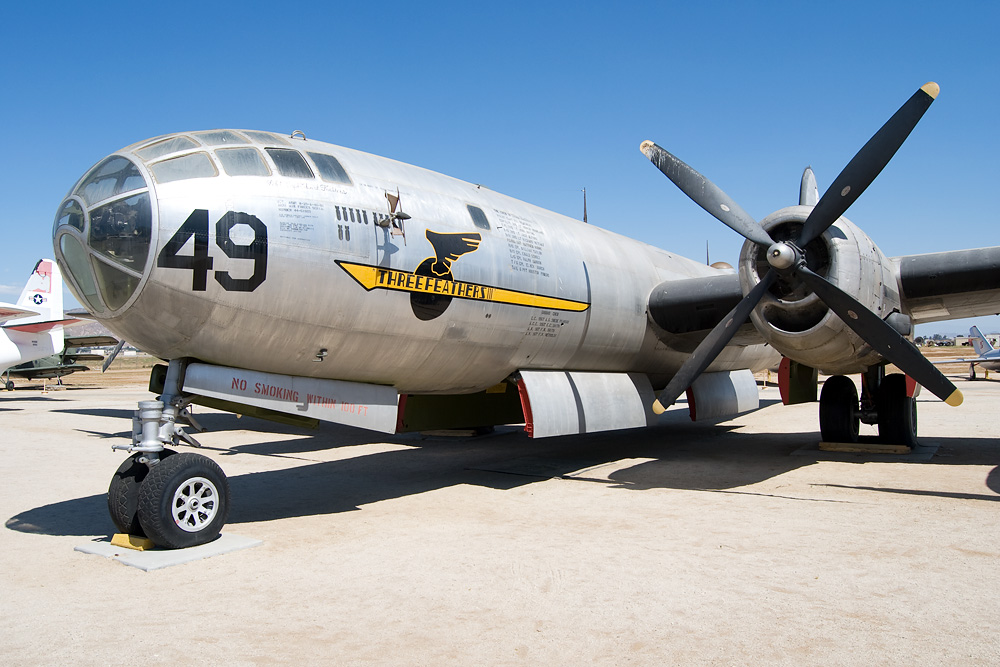
In another amazing connection with Tucson, the daughter of Dad’s co-pilot was instrumental in locating the Z-49–the B-29 my father and her father had flown 35 missions over Tokyo from their base in Saipan. It was found in an aircraft graveyard in the desert. The Z-49 was restored and is now on exhibition at March AFB in California:

Z-49 March Air Museum, CA

The B-29 was dubbed the Three Feathers, originally complete with three nudes on clouds following the pilots’ tradition of painting sexy women on the nose of their aircraft. The Three Feathers had a prestigious life. Read its history here.

Dad talked about flying in the desert. The pilots rose very early to beat the heat, and then cruised above the desert with a view that stretched for hundreds of miles. He recalled the heat and the electricity on the metal and how it gave them all a huge bolt of energy whenever they touched metal on a very hot, crackling dry day.

We soon left for Los Angeles where Dad studied meteorology, a fateful study which later sent him to Fletcher’s Ice Island T-3, a floating iceberg in the Baltic Sea. He was part of a global study, for his team it specifically encompassed ice flows in the arctic.  I was 14 when Dad was featured in Time Magazine after being attacked by a polar bear on T-3. Now in 2016, my first book (Threshold) includes a polar bear–in Carla Conners’ nightmare. I think all this qualifies as the circularity of a life’s path.


It’s Raining on the Desert

If you have never visited or seen the Sonoran Desert, it probably seems an oxymoron to call this desert a place of lushness, but, it truly is such a wonder.

Monsoon on  Sonoran Desert
Monsoon on Sonoran Desert

The adjacent photograph was actually taken in 2007 before I left Tucson, AZ for Pensacola, FL. The location is near my friend’s home in the foothills of the Catalina Mountains that form one boundary of the City of Tucson.

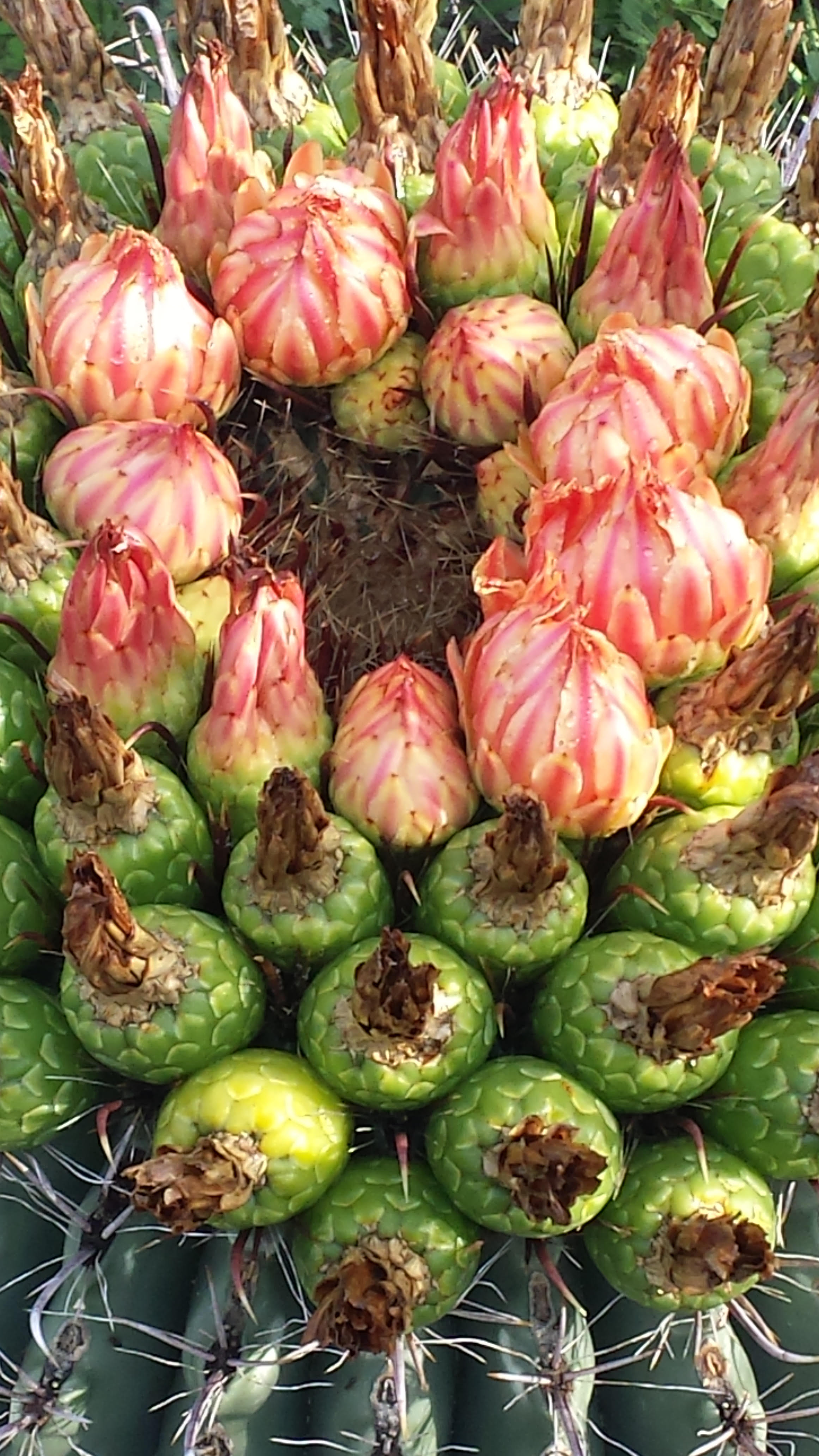
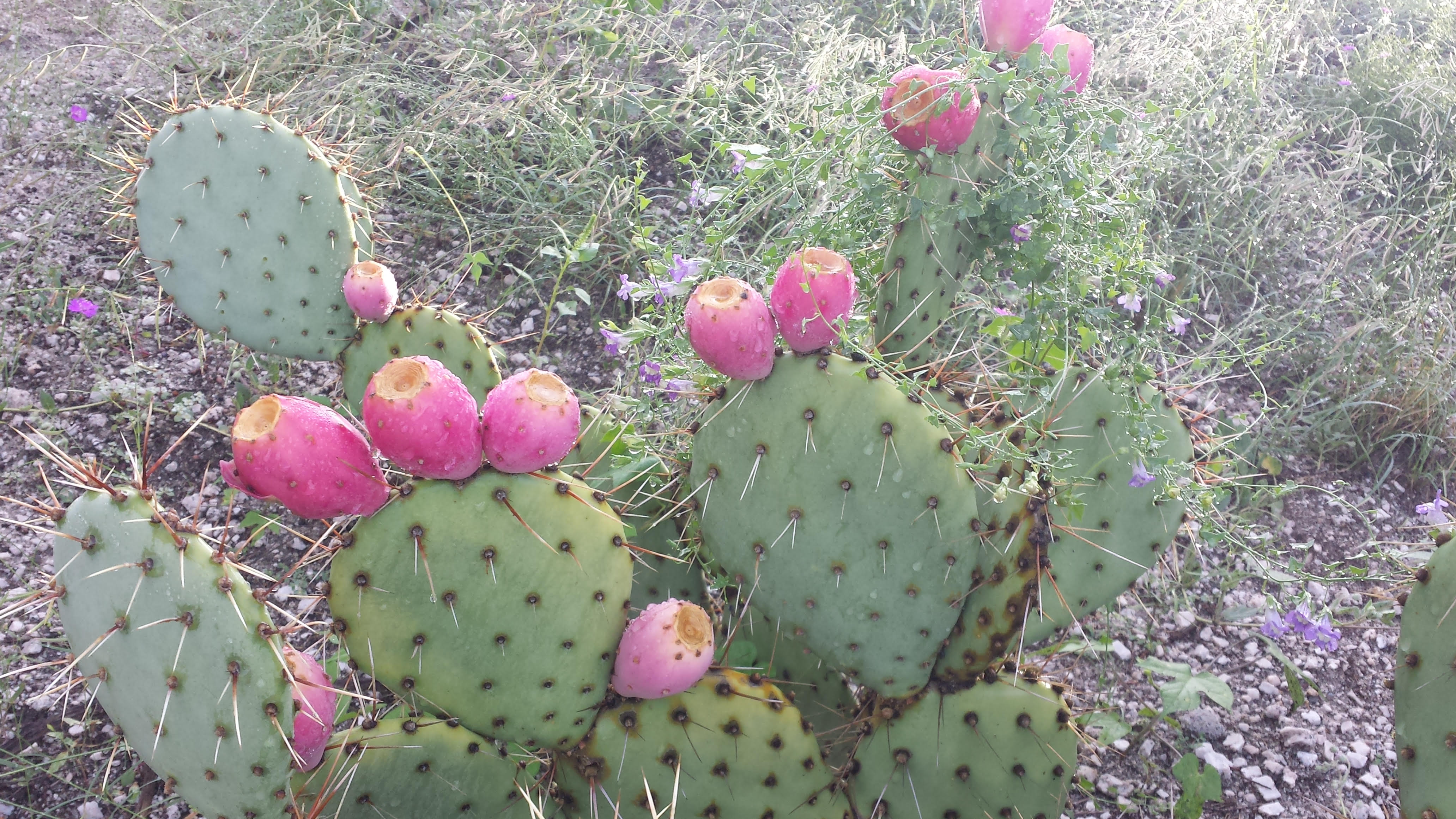
Today I am writing from the Baker’s home on a September afternoon and once again the monsoon rains are falling on this high desert. The desert’s flora is in full glory, cacti swollen plump with water, blossoms forming in colors of lemon and peach, and aqua blue prickly pear pads sprouting cherry red fruit. If you have never visited or seen the Sonoran Desert, it probably seems an oxymoron to call this desert a place of lushness, but, it truly is such a wonder.

Barrel Blossoms
Barrel Cactus Blossoms Ready to Bloom

The Southwest is experiencing a late and strong monsoon season that some expect may go right on into the rainy winter season. If so, that will be a huge blessing for a region in a long-term drought. Rain on, oh great monsoon clouds! Let the liquid wonder work its magic down into the desert pavement, and travel into the arteries of the giant saguaro, and down the throat of desert critters, and gather below in rock lined aquifers. Rain on! Rain on!


Prickly Pear Fruiting