One of the greatest gifts of my father was that of a B flat clarinet when I was in third grade. Perhaps this is why I’ve remained partial to woodwinds in orchestral arrangements. When I was a young teen, I played this concerto in a competition in New York State while living in Plattsburg. This clarinetist, Sharon Kam, plays Mozart’s work for clarinet with tonal shades and a lively spirit that brings the work to life.
Author: Susan Feathers
Family, friends, nature, books, writing, a good pen and journal, freedom of thought, culture, and peaceful co-relations - these are the things that occupy my mind, my heart, my time...
IPBES Report on Biodiversity and Ecosystems
Intergovernmental Science-Policy Platform on Biodiversity and Ecosystem Services (IPBES)
Summary PDF for Policy-Makers (and the public)
Biodiversity is a key driver of ecosystem health and resilience. The more variety of genes and groups of genes in a particular habitat (# and kinds of living plants and animals, invertebrates, etc) the greater is its resiliency to impacts such as climate change, and human development and habitation.
A good example can be seen in our coastal ecosystems where an abundance of grasses, landforms, certain trees, sea grasses and coral reefs, promote resiliency to storms, development, etc. Dense human habitation along coastal areas has polluted waters that kill sea grasses, result in erosion of beaches which once provided a barrier to incoming storms and sea level rise.
Read the report and chat with your local city council and with your representations. Send them this short summary report. summary_for_policymakers_ipbes_global_assessment
What makes us human?
Earlier I blogged a book review of E.O. Wilson’s The Meaning of Human Existence. Now this extraordinary book is a documentary.
I strongly encourage you to watch it to gain a fuller understanding of what makes us human, and how that must be understood to make the complex decisions we now face. Simply, we need to know when instinctual inclinations are at work, and that they may or may not be what we need in the new technological complexities we face together today.
I originally posted this in 2015 after the publication of Wilson’s book.
Revisiting Jack London
 Jack London is one of my favorite American writers.
“I would rather be ashes than dust!
I would rather that my spark should burn out in a brilliant blaze than it should be stifled by dry rot.
I would rather be a superb meteor,
every atom of me in magnificent glow,
than a sleepy and permanent planet.
The proper function of man is to live, not to exist.
I shall not waste my days in trying to prolong them.
I shall use my time.” ~ Jack London (1876 – 1916)
Amazon has a two-part documentary of London’s life and work that is worth watching for insight into the personal and historical influences that shaped London’s development and ultimately, his contributions to literature. It is also a great teaching film for new writers.
Here is the link to the documentary.
Read Call of the Wild online. Serialized in the Saturday Evening Post.
Toby Hemingway Part I End
 Until Social Services and Child Protective Services could approve Vern and Shirley as foster parents, Marsh was placed with another family. Their location necessitated he change schools. His networks and supporting mentors vanished overnight.
Marsh had a loving mother in his first 10 years of life, and even though his father abandoned them when he was a child, that stable, unconditional relationship had served him well since her death. However, even such a beginning can shatter when subject to years of abandonment. Marsh should have been able to stay with Vern and Shirley. Anyone who bothered to get to know them and observe Marsh with them would see they would be fine caregivers. A bond had already been formed.
Protocols often get in the way of logic. Marsh began a painful journey to maintain a positive view of the world. He spoke to Shaundra frequently, pouring out his feelings. Her parents talked with him by phone when he first moved to the foster family. But, social service suggested that the foster family not allow these calls until the people could be evaluated by their staff. So, even that support was cut off.
Having had an independent life at Uncle Albert’s, Marsh found his new environment stifling. There were four other kids in the house — three foster kids. He was the oldest. The next in age was eight years old. His foster parents were very strict. He had a list of chores to do each day, homework was a sitting affair at the dining room table. If he finished early, he was asked to tutor the younger kids.
Marsh experienced a loss of identity. Depression and anger followed. He plotted to run away, and run away for good.
###
When Toby reconvened her writing group, she learned of Marsh’s fate. Immediately, she began to intervene. Between Toby, Shirley, and Barbara, they amassed a legal team to get him back as soon as possible.
The loss of the boy to foster care infuriated Toby. Finding Marsh and getting him back to his community either at Shirley and Vern’s or her home, or the home of one of the Fishin’ Chix, became her new focus, and a direction to pour all her energy, to forget about the cancer that could return and take her life.
“You know I feel about the foster care system like I do about environmental policies,” Toby said, sipping from her glass of wine. “For all the good intent, the system shoots itself in the foot.”
She was sitting with Barbara, Shirley and Vern on the deck at The Fish House in Pensacola. They gathered to discuss how to speed up a court hearing for Marsh. Intuitively, they each understood that time was of the essence before real emotional damage may occur in the boy they’d all come to love.

Thank you for reading Part I of Toby Hemingway. Please leave me a comment on what you liked about it, or what you may have questioned. Writing daily online for readers proved enjoyable for me. The story is a weave of several stories I separately developed during the same period of time in Pensacola, Florida.
Here is the complete sketch of what may become a novella: Toby Heminway_Part I
Please leave any helpful comments or suggestions you may have about the story so far. What would you suggest in terms of plot lines going forward? Character development?
Thanks to all you readers of this blog. I follow many of you and enjoy your posts. Would love to hear from you.
Gratefully,
Susan
Dream Acres
DREAM ACRES FARM
Holding-Out and Holding-On in America’s Heartland

Golden meadow grasses wave in the afternoon breeze along a far bank of dark green pine and hardwoods aflame in fall colors. The trees form the meadow’s northern border. Lover’s Lane, Old Towne Apartments, and Interstate 65 serve as other borders to Dream Acres Farm—a sliver of Kentucky farmland and noble hold-out against development.
The white picket fencing, farmer’s house, and rolling green lawn that face Lover’s Lane were built when this land near Bowling Green was “the country”. I imagine teenagers romanced in a car along a moonlit dirt shoulder, and that dense forests still grew to the horizon. The farm’s 15 acres are worth millions now that the town has grown up around it. Everyday another few acres of Lover’s Land churn under the blade in becoming hotel, medical center, nursing home…

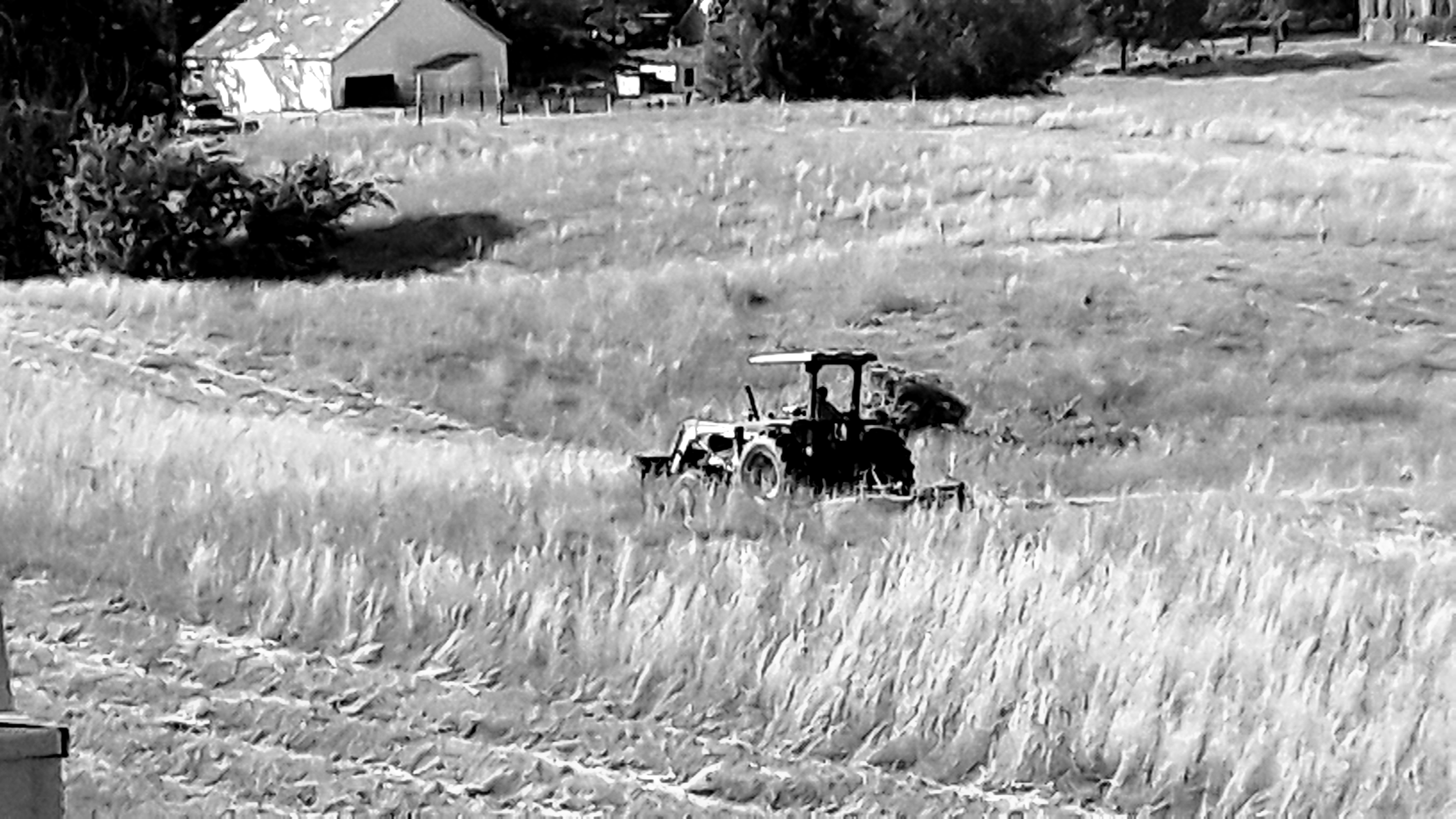
Every day I thank the farmer for holding fast to his farm amidst the pressure of land sales. He tends a dozen fine steer and occasional cow and calf to graze and grow in his meadow. Because the windows of my small apartment face the meadow, I am a constant observer of the herd’s movement, their presence or their absence. When the first hard frost arrives, they are gone to groceries and restaurants, and suddenly the meadow feels abandoned. Slowly, I’ve learned much about bovines: how they form attachments with the farmer, running and frolicking around him whenever he drives his rusty tractor out to inspect fences. I never knew cattle could move so fast. I’ve sketched their charcoal-black postures in the emerald grass of springtime and photographed them hip deep in a field thick with golden grasses in the fall.
This spring a community of swallows took up residence at my apartment complex, nesting on windows and gables facing the meadow and from which they emerged and returned with lightening-speed, providing me with more entertainment. After some time, I realized why they had come. As the cattle moved in the high grass, grasshoppers and gnats rose in swarms. The swifts careened in and around the thick calves and heavy hooves like fighter pilots after targets. When the insects’ life-cycles ran their course, the swifts disappeared into thin air.
Daily observation helped me discover the diversity of life in the meadow beyond the obvious farmer-bovine-grass relationship. Black silhouettes circled in the late afternoon sky portending prey moving in the grass sea: rodents, rabbits, snakes, perhaps frogs. I am sure there is an owl perched in the far border of trees whose throaty hooting I cannot hear over the constant roar of I-65. The life in the meadow also includes a neighbor’s acre of goats attended by sheepdogs that escort them in and out of a sagging, grey barn. Dream Acres Farm has its own barn from which the cattle emerge and return, but most days they sleep out under the stars.
When the farmer dies, will his heirs sell the farm and make millions? Probably—in the way of progress. When they do, I will disappear as the swifts to find another teacup of wild. And then, when no teacups remain, shall we all disappear like the swifts, into thin air?
I pray for the old farmer to live another day—my knight, my muse.
Unsheltered – Barbara Kingsolver
 With authors I value, like Barbara Kingsolver, the wait for a new work can often be lengthy. My wait was amply rewarded. In Unsheltered–2018 HarperCollins–she had created parallel narratives that articulate across two centuries in the American experience. Her device is a house and property shared by the characters in different centuries. The 21st Century Wilma and 19th Century Thatcher are adults navigating giant shifts in social paradigms. For Wilma and her family it is the economic collapse of the middle class and the dissolution of the ideals her generation pursued. Climate change knocks ominously at her door. For Thatcher it a pre-Darwin American culture in a panic to hold onto Christian perspectives by rejecting rational observation of how the world works (akin to today’s denial of science).
Wilma’s multigenerational family reflects at once a 1) disenfranchised, racist white America (grandfather); 2) boomer parents (Wilma and Iano); 3) grown kids who pursued differing paths–Harvard financial education (Zeke), and post-apocalyptic youth (Tig). Add Baby Dusty, Wilma’s grandson whom she is mothering after the death of Zeke’s wife, and you have four generations, each navigating their own realities. The dialogue along the way explores the contemporary ocean of conflicting values and ideas of today’s American society with our economic, social, and environmental challenges.
Unsheltered is a nuanced conversation between Kingsolver, her characters, and the reader that is slow at times but never boring and long enough to examine previous and contemporary times for understanding the confabulations of collective memory–an existential wail of ‘Who are we?’
Twenty-something Tig exclaims to her mother, “The guys in charge of everything right now are so old. They really are, Mom. Older than you. They figured out the meaning of life in, I guess, the nineteen fifties and sixties. When it looked like there would always be plenty of everything. And they’re still applying that to now. It’s just so ridiculous.”
For individuals like me, awash in Trump-a-Con, Unsheltered is a beacon. Kinsolver’s Afterward explains her own journey to understand “the times”, explaining to readers how she wrote a novel about real historical figures and set the novel in South Jersey in a small town, Vineland. Along the way, she traveled many miles, including London where walked in the footsteps of Charles Darwin.
This book is a needed contribution to understanding our time as one when the “world as we know it” appears to be ending. It is ultimately a great story that takes us into the author’s creative mind. I am so grateful to Kingsolver!
Leadership by Doris Kearns Goodwin

The great historian and writer, Doris Kearns Goodwin, has gifted students of American history with a rare treasure. Leadership In Turbulent Times, is a masterwork by one of America’s preeminent presidential historians. Abraham Lincoln, Theodore Roosevelt, Franklin Roosevelt, and Lyndon Johnson are examined through three lenses: 1) Ambition and Recognition of Leadership; 2) Adversity and Growth; 3) The Leader and the Times: How they Led
Goodwin has written biographies of each President, and she worked in Lyndon B. Johnson’s Administration as a student fellow and later helped him organize his presidential library and archives which are extensive.
I highly recommend this book for its relevance to present turbulent times. How can we recognize a great leader? What do they share in common? How do their leadership qualities emerge over a lifetime, and how do they use their particular talents to lead the largest democracy on Earth?
Goodwin is a great storyteller. The intimate portraits she paints for us are gritty, truthful, and surprising. In the last section on Visionary Leadership Goodwin becomes a classroom professor subheading points she wants to make clear such as 1) Make a dramatic start; 2) Lead with your strengths; 3) Simplify the agenda — and so on. One critic felt this was too elementary. But I like to think that Goodwin, out of her concern for the state of leadership in Washington was giving us a primer on how to identify a true leader. And for younger men and women who are coming up in the political ranks in their counties and states, she may also be showing them how the greats managed to bring our country together in times of very dangerous challenges such as the Civil War, the Depression, WWII, Civil Rights and Vietnam.
Call it a primer on Leadership. Here is an interview with Doris Kearns Goodwin about the book.
Dear Martin by Nic Stone
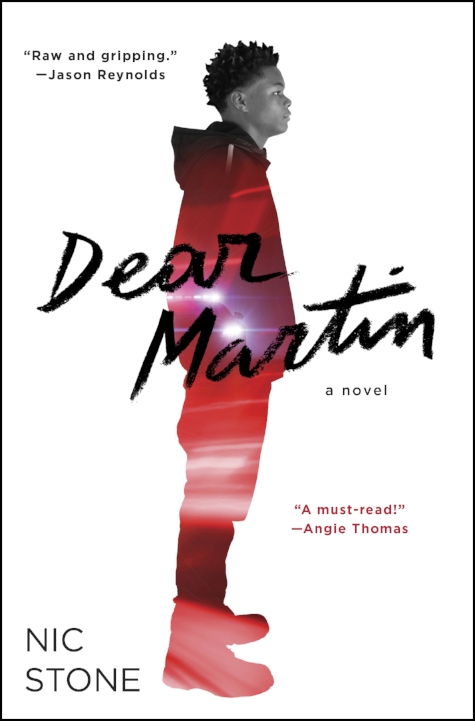 Dear Martin by Nic Stone is a YA novel for our time.
It deals with injustice and racial profiling but in the most personal manner. Stone used newspaper articles, and stories from real teens who have faced similar injustices to develop her story. Stone writes a nuanced plot and characters as real as the people around you. Everyone is welcome in Justyce’s story because diverse perspectives are represented in the characters, their thoughts and responses to events in the story.
This is a national bestseller. Free copies were distributed by the Warren County, KY library in my home town of Bowling Green, KY. Nic Stone will be here in October and I cannot wait to meet her.
The novel is a short book (less than 200 pages) but it moves powerfully along to an ending that made me weep with joy, sorrow, and HOPE!
It is my wish for this coming year that Americans will read it because it shows a way forward in addressing injustice in our law enforcement as well as in society in general–what we must finally deal with to complete the Long Road to Freedom.
Some books are necessary. This is one of them. A brilliant achievement.
Jodi Picoult Explores Racial Injustice In “Small Great Things”

Kudos to Jodi Picoult for taking on America’s most entrenched injustice. and helping readers discover in themselves how he or she may perpetuate racial injustice. Small Great Things is sheer bravery by a white American writer.
This novel bravely goes where few white writers would venture without the risk of their white privilege bleeding through the narrative, or of committing cultural appropriation. Jodi tells us readers that is exactly why the original idea and partially written manuscript were put aside for more than a decade.
Before Picoult decides to take up the gauntlet, she joins a white privilege workshop to delve into her own prejudices, she gathers to herself men and women from the black community who speak the hard truth to her and help her understand her role in perpetuating injustice. She interviews reformed white supremacists. Picoult dives deep to show how racial injustice is sustained by a thousand small cuts a day, carried out by whites who are often clueless to their own complicity.
Small Great Things explores how racial privilege, even more than outright discrimination, pervades white consciousness. A person may think “I’m color blind,” or “race makes no difference to me”. However, Picoult’s book reminds us it is easy to think that when you are a beneficiary of the culture’s every advantage.
Yet, Picoult also shows how “minorities” can play into perpetuating the injustice by remaining silent to hold on to tenuous advantages they may have and that are working to help them accomplish goals like owning a home and sending their child to college. The main character, Ruth Jefferson, demonstrates how that works.
Picoult shows in the character of Kennedy, Ruth’s public defender when Ruth, a respected labor and delivery nurse, is accused of killing the baby of a white supremacist couple. Prior to their son’s death, they demanded that Ruth, an African-American, be forbidden to touch their child (Davis). Ruth is removed from the family’s service after Davis is born. She is mystified. As one of the most capable nurses, she can’t imagine why they do not want her to help care for their son. Then she observes the tattoos on the father’s arm and head, and she realizes he is a white supremacist. As the story advances, Baby Davis is discovered to have an inherited disorder that contributes to his death.
By following the developing relationship between Ruth and Kennedy, Picoult takes readers with her on the discovery of white privilege, peeling it back layer by layer until finally Kennedy is seeing it in herself. We also follow Ruth’s discovery that she has blinded herself to racial assumptions that arise regularly in her peers. Ruth’s determination to discuss the role of racial hatred in her case — a strategy strongly opposed by Kennedy — is a result of finally understanding her complicity in the persistence of racial discrimination by remaining silent.
The story of Turk Bauer and his wife Brittany, both white supremacists, brings to light the complexity of racial hatred. We learn the circumstances that led to Turk’s induction into the Aryan Nation. We go to events where racial hatred is cultivated, taught to youngsters, and how it is organized across the nation. Inside Turk’s head, we see how he is influenced by fear and anger in his particular life circumstances. We witness Turk’s the awful suffering from the loss of his child. We see his humanity even when his beliefs and actions are despicable to us. Jodi is showing that racial relationships in America are complex and nuanced.
Critics have reviewed the novel’s sometimes cardboard stereotypes and slow action, but really, Picoult took on a monumental task as she worked through her own racial biases and white privilege, inviting her fans to do the same within themselves. This is how hard it is. Picoult is a skilled writer. We can give her a little slack if at times the characters may lack realism or the plot slows here and there. She took on America’s deepest wound, most entrenched injustice, and one that is still festering in the hearts of us all. We must get at it in ourselves until we can live a free nation. Picoult offers us her experience as one way we might get there.
MORE RESOURCES FOR READERS:
Michael Eric Dyson: Tears We Cannot Stop: A Sermon to White America
Watch Frontline: Documenting Hate which aired on August 10. It is a documentary of the white supremacists at Charlottesville, VA uprising over confederate monuments. It was so much more, of course. This ProPublica investigation helps us learn about how a permissive environment ushered hate groups into the American mainstream.
Read Jon Meacham’s book “The Soul of America, the Battle for Our Better Angels”. In the Introduction, Meacham compares Strom Thurman’s Dixiecrats to Trump’s nationalist movement.
Extremism, racism, nativism, and isolationism, driven by fear of the unknown, tend to spike in periods of economic and social stress — a period like our own. Meacham, p. 4 of Introduction.
 Susan Feathers