Pensacola’s Moving Planet drew a hearty crew of bikers and riders. We had an enjoyable ride and speaker program and bike-building demonstration. View Photos. Our Mayor, three City Councilpersons, and the Director of the Escambia County Environmental Services.
At a time when unprecedented climate events are impacting all areas of the United States and much of the planet, renewed interest in climate change action is more than timely. Moving Planet is an international day of action organized by 350.org, a global community for reducing global warming by transition to non-fossil fuel economies.
In Pensacola, a dynamic event is planned with representation from bike shops, cycling clubs, University of West Florida Yellow Bike Program, Pensacola City Council Members, local activists, artists and citizens. Moving Planet-Pensacola will bring hundreds of people together to ride and to act to transform city neighborhoods and downtown to walkable, bikeable communities and area accessible to everyone. Sherri Myers and Brian Spencer will speak to the crowd about the ordinances and activities they are promoting at the council level, and to hear from citizens who walk and bike about kinds of planning and modifications that are needed on the street level.
This local event is part of an international day of action planned by Bill McKibben and 350.org, the organization he founded to galvanize collective action to reduce carbon emissions to 350 parts per million or less. Since its founding in 2007 350.org has raised awareness of the imperative to reduce carbon dioxide emissions to safe levels and how citizens can empower themselves to make a difference while having a Whole Lot of Fun!
September 22th update: An NPR program aired today about legislation that would support cities trying to improve bike infrastructure receiving resistance by Republicans in Congress.
“The future is a construct that is shaped in the present, and that is why to be responsible in the present is the only way of taking serious responsibility for the future. What is important is not the fulfillment of all one’s dreams, but the stubborn determination to continue dreaming.”
~ Gioconda Belli, The Country Under My Skin
Nothing can replace the act of seeking knowledge for oneself. I can read about it, have it explained, or live it through another person’s experience, but in each case I see it incompletely, like the blind man holding the elephant’s tail.
For Americans eighteen and older this has never been more relevant.
In 1990 I sought to learn about our nation’s first people by going to them. I left a high profile position at a well known institution, sold or gave away most of my possessions, packed up my pick up, and traveled to a dusty border town trusting my inner compass. There was a man and woman who agreed to take me on as an apprentice and student to help me understand American culture and my own life’s course through an examination of my country’s historical relationship with the First Americans and with the land, water, air, and wildlife of the North American continent.
Why did I do that, you may wonder. I had come to the realization that instead of my nation being a beacon of light in the world, it was in fact an empire to many other nations and peoples whose cultural beliefs and lands were at odds with ours. How could there be hunger in a land of plenty? Why were democratic rights applied conditionally to members of our own society and in the world – and my culture accept that? How could we destroy the great natural beauty and abundance of our lands even while extolling how much we love it?
It made no sense to me and created a pervading sense of living a lie. I remember the unreality of my life then as I drove to work where architecturally beautiful buildings and the expansive green of a golf course tumbled down to the deep blue of the Pacific ocean. My day was stressful administering programs at a world renown health care facility where patients—banged up in the American market wars and social striving—suffered from heart problems, addiction, or complications from obesity.
One day I sat looking out the picture windows of my corporate office on a singing blue-sky day in southern California. Internally I felt lost and weak. My eyes settled on a book that had lain unread on my shelves for many years: Touch the Earth (T.C. McLuhan.) It is a book of Indian values from Indian voices.
At the first reading I experienced a profound sense of sanity return to me. In them I found a direction to pursue the answers to my deepest questions. I became aware of a pulsing hunger at my core for this knowledge, like something precious lost and then vaguely rememberd. Could it be that we have within us the knowledge of past human wisdom buried in our brains at birth? Looking back now, I realize that I had no choice but to make the decisions that led me to seek guidance and leave all I had known before – to clear the decks and make way for something new.
The next three years of living in the daily presence of two American Indian educators (one a Mojave elder, college professor, Korean veteran and social worker; the other an Iroquois artist and musician.) Their guidance changed the way I see myself and the world around me. I still believe the experience made me a better person. But the story of how that evolved is a hard one and definitely not what I had expected. The path to self-understanding is a crucible where falseness is burned away and a tender new skin grown. It requires humility, determination, and humor. It is anything but glamorous.
I hope you will return to my blog for journal entries about my experiences. Until then, here are some links to explore:
I know that my discovery of “On Being” at 6 am on my local public radio station, WUWF.org, reveals just how out of it a person can be in a world with a cornucopia of media sources. Apparently the program has been broadcasting since 2008! However, humbly, I submit this link to this interview with Terry Tempest Williams.
The recorded podcasts on their main page are a treasure trove of some of our greatest spiritual voices and cultural innovators. This might be a very good way to “reset” your moral compass after a day or week out on Main Street.
Krista Tippett is the moderator. The link above to the unedited discussion with Terry includes many personal statements by both Terry and Krista that give additional insights into their focus and personalities.
I’ve been reading Terry’s books, blogs, and following her activities for the last 15 years. I am convinced that she is on the forward edge of an emerging sensibility that seeks to bring together divergent perspectives in American culture for open dialogue and understanding. She gives numerous examples of how she personally is able to sit with people who hold opposite points of view and learn from them and stay in the dialogue….
If you read one book by Williams, read Refuge. You will understand then how Terry weaves the deeply personal, landscape, religion, spirituality, politics and the art of dialogue. This perspective might be similar to present and previous Earth – focused cultures (e.g. native cultures worldwide; ancient earth-based cultures.) However, what is evident in this interview and many others on the site, is an emergent blend of our best past and present thought. There is a heightened awareness of something much greater than ourselves, the issues at hand, and what we can perceive.
Listen and learn from a person who has learned to stay in the crucible of conflict and transform it into something of beauty….
Hope Beneath Our Feet, Restoring Our Place in the Natural World is a new anthology of essays by authors who responded to this question: In the midst of environmental crisis, how can we live NOW?
I am unabashedly promoting the book because I am one of the authors. To be published along with the writers and thinkers to whom I have turned for inspiration over the last twenty years, is a huge honor for me. Some of these mentors are: Frances Moore Lappé, Bill McKibben, Wendell Berry, Barry Lopez and Howard Zinn.
The book’s genesis is the work of Martin Keogh, its Editor. In the forward, Martin describes how his children expressed a sense of hopelessness about the future as they considered climate change or nuclear war—challenges that dwarf our sense of being able to make a difference. He wondered how human beings can keep hope and live well in very uncertain times. In 2006 Martin issued a call to writers to submit an essay answering the question above.
The book is published by North Atlantic Press and is now in its third printing – barely a month after its release.
Turtle Island churns under the soles of my feet on this fair-weather day on the Gulf
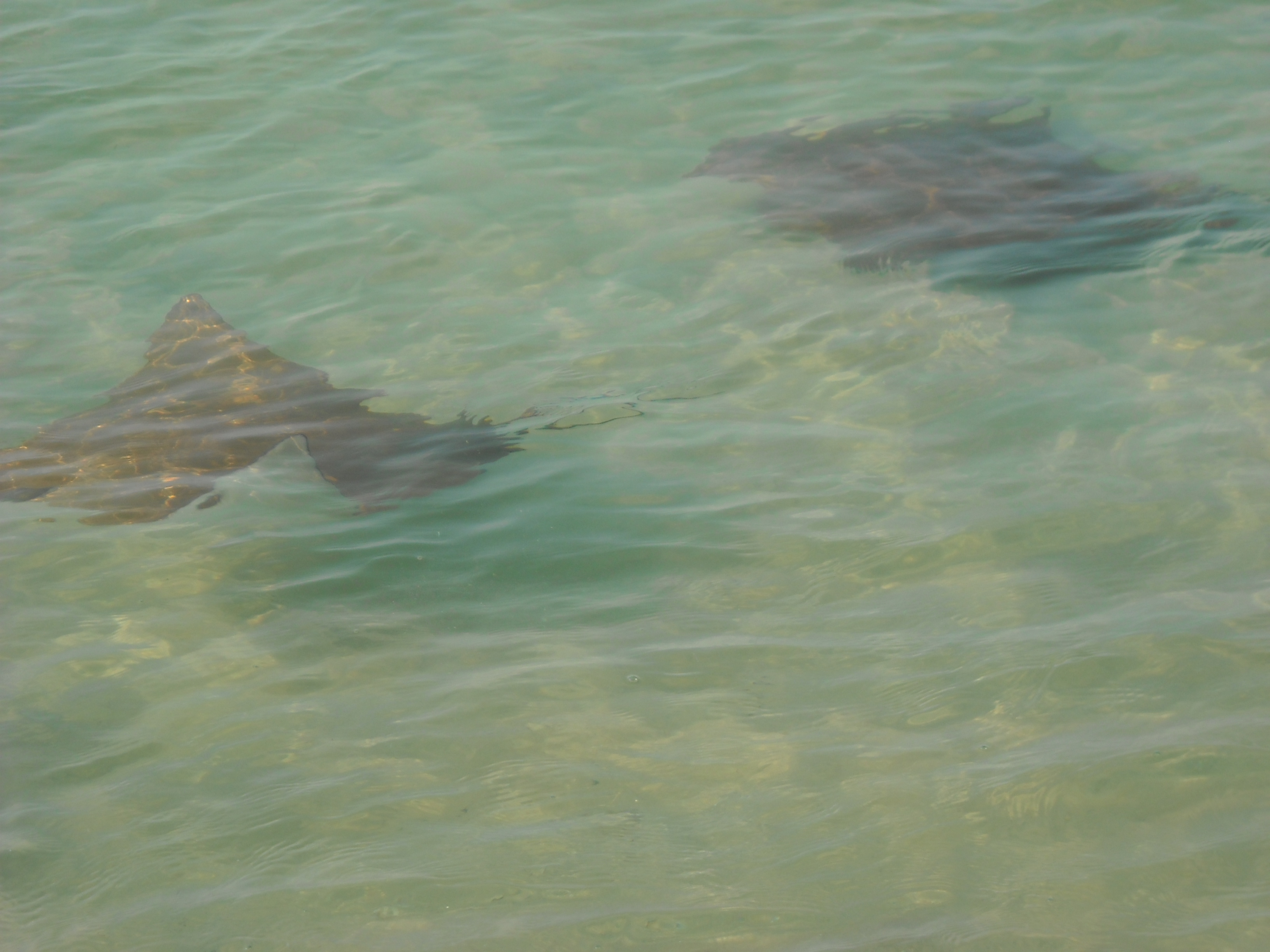
NOAA Photo
Turtle Island churns under the soles of my feet on this fair-weather day on the Gulf. The ocean is green near the shoreline—pea green. I’ve never seen that before. I wonder if an algal bloom is forming in warmer seas. A battalion of brown pelicans coasts on dark arched wings over the waves.
Children build sand castles and bob in the surf while far out at sea large fishing vessels ply the waters for bigger catch. I can see one person atop a scaffold with a line trawling behind. I wonder about toppling into the cold, thick waves so far from shore.
There are few shorebirds but it is late in the day. They are probably on the bay side of the island resting in warm dunes. A moveable feast of beauty and abundance, we call this Santa Rosa Island named to honor a young woman from Lima, Peru who lived 500 years ago.
How arbitrary our histories.
Take the story of Caretta caretta. She doesn’t even know we’ve tagged her with a dichotomous term to set her species apart from others. Her only inclination is to find a darkened shoreline and lay her burden down.
Buoyed by the salty water she paddles with strong legs through the currents.
Through heavy lid, she looks toward shore and vaguely remembers its smell and warm, gritty touch. Suddenly she recalls the hovering gulls with their piercing eyes and angular beaks. She quickens her advance in hopes she might outpace the probabilities.
The moonlit shore is quiet as she takes purchase on the shifting sand below her. She looks from just under the water. Bright lights might turn her away to find a place where pale moonlight guides the way instead. It is instinctual.
And should she come ashore and dodge the beach chairs and plastic bottles, to lay a hatch of eggs, and later when they emerge, so tiny and vulnerable, will her young head toward the sea with its shimmering moonlight, or will they head for the Holiday Inn instead?
Countless volunteers tend turtle nests all along these Gulf shores to redirect hatchlings toward the ocean. Does it mean they are no longer self-sustaining?
Caretta caretta, loggerhead turtle mom, come back! Come back!
Will she find a place to lay her eggs? If she doesn’t, will she release them into the water and watch as a devouring host of predators gobbles them up as fast as they emerge?
And, what of it…what if all the Caretta caretta’s disappear? Will it change my walk on the beach?
To answer that question we would have to observe this beach over the long arc of time—not the brief period of a human lifetime.
If we could go back even a thousand years (a bleep on the screen of geologic, Earth time) we’d see an abundance of birds, perhaps many we’ve never seen here before. And the waters would team with crustaceans; you could just scoop up dinner with your hands.
We’d be looking at an ocean web of life that compares to today’s web like intricate lace to an old net. But if we do not know that, the old frayed net looks pretty good.
A Yale psychologist gave this phenomenon a name: intergenerational, environmental amnesia. Basically, we’ve failed to remember our origins; we’ve forgotten to tell the human story.
That story tells us how we evolved with a host of other species, interdependent on each other. In a far distant land, in a far different world, our kind began humbly dependent on the whole.
We were part of something that worked, found its rhythms in a sort of give and take that leveled the playing field for all. Some little guys had the gift of a poisonous bite that made the big guys shy away and so on.
Then we evolved an opposable thumb and a frontal cortex. We were powerful beings by virtue of our new intelligence. We learned to cooperate and bring down beasts that towered over us. We covered our bodies with their hides and set out to explore the world at large.
We got caught up in our own ingenuity; we forgot our origins, intent on harnessing nature to our collective dreams. This was our infant sensibility.
Today our task as a species is a difficult one: we need a dose of emotional honesty to accept that we aren’t as great as we’d thought. What’s superior about spoiling paradise, about circumscribing the futures of our children?
Well, we can chalk it all up to immaturity, for our species’ evolution is new and our learning curve is a sharp one. We’ve got to use our talent for the good of all. We can’t repair nature’s living webs, but we can give her a chance to do it herself.
For Caretta caretta we can turn down or turn off our lights, sit out on the decks of our homes and watch the waves glisten in the moonlight, listen to the oncoming waves. Is that so bad?
Native American wisdom recognizes the Earth as Turtle Island, the continents forming plates on her back. In this era of human pervasiveness, we are changing the body of the Earth in which every living thing finds a source of life.
For most of our species’ history we did not know that. But now we do recognize our impacts on the ecosystems that created the biosphere.
Caretta caretta’s plight to find a darkened beach points us toward a path we could take. If we turn off our lights, she might find a place to lay her eggs, her hatchlings a way back to the ocean, and for us a reduction in energy consumption and carbon emissions.
It is rare for us to make these connections. Small though they seem, it is myriad of these that need correcting.
Global warming threatens our very existence. Since we are the cause of it, we can stop it. Doing so will correct our species’ relationship with so many others and begin to set things right again.
Caretta caretta’s story is mirrored in the stories of countless species feeling our footprint.
We must take up the cause for each of them where we live with the firm conviction that enhancement of life anywhere enhances life’s chance of survival everywhere.
Identify a small area of land or a nearby river and defend its integrity with your life.
Caretta caretta…no, it’s not a song. It’s a symphony.
Late this afternoon I drove to Santa Rosa Island, to the entrance of a seven-mile stretch of undeveloped barrier island, protected by the Gulf Islands National Sea Shore, one of our priceless U.S. National Parks. While there was a long stretch of beautiful beach, as I walked west toward the end of the island, I began to see oil – firsts dime-sized, then bottle-cap, then hand-sized: thick crude oil, pooled and hardened among shells and sea grasses on the high tide line. Adjacent to this pollution, black skimmers sailed by with their long lower jaw skimming in the shallow edge of the surf and Least Terns dive-bombed for small fish not far off shore. Surely they must be tasting and smelling this invasion of foreign substances. We can only guess what is happening to fish, corals, jellies, dolphins, plankton…I am so profoundly sad about this awful time when we are facing our ourselves – our ways and wants. It is NOT a pretty picture.
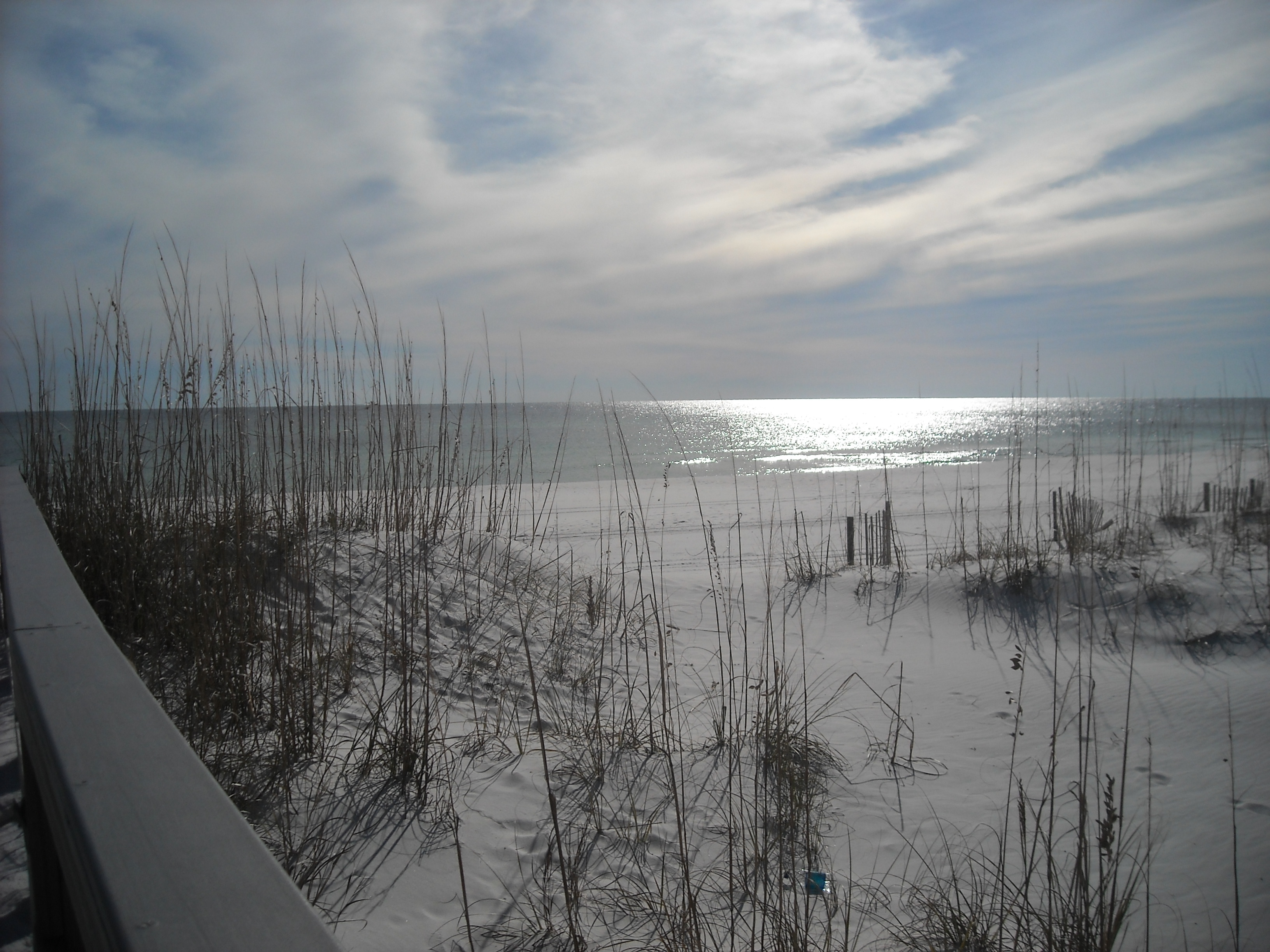
Only a few days ago this was the image of this treasured coast at sunrise:
And to think we are risking this and our families health for a culture addicted to speed and consumption and which cannot function without an enormous and uninterrupted supply of oil. Will it be worth it when all this plays out? And, it will continue to playout over months and years and there will be other catastrophes like it where we have taken enormous risks as the People of the Forward Stampede.
They will all be impacted by the oil catastrophe and eventually it will reach to our children and us through our air, food, and spirit.
This morning I checked into Skytruth.org to learn the extent of the oil plumes. A blog contributor took me to the Gulf Oil Blog of the U.S. Marine Sciences. There you can find results of sampling in suspected deepwater plumes of oil. The measure is called a CDOM (colored dissolved organic matter). Scientists measured above and below the plume then sampled from the middle of the plume. Above and below they found no organic matter but within the plume they got a strong reading and could see an oily residue left over on the filters. Skytruth is tracking the movement of oil plumes from the Maconda well and it appears to be moving in the loop current and toward the Florida straits.
Skytruth cautions that there are natural processes that can also create oil sheen on the surface. But when you go to the U.S. Marine Sciences site you learn to “trust your senses”. This spill, if as White House energy and environment adviser Carol Browner warned, goes on through August when relief wells will be in place to receive the oil, we could see lasting and extensive impact on marine ecosystems along the whole of the Gulf, Florida and perhaps even the Atlantic shorelines where the loop current turns north and runs up the eastern coast.
…what if we did something revolutionary and base our decisions on a set of conditions that assures we don’t harm the Earth and thus ourselves since we are one community, interlinked?
Most of us have copious information about the oil spill (I think we can agree that GOBS MORE oil is spilling into the Gulf waters than we have been told by BP and by the EPA. Go to links on this blog for more accurate estimates).
The impacts are starting to show up in Louisiana and threatening Alabama and Florida. Things are not static this time of year with the tropical storm season and strong south easterly winds and thus currents. We can only guess what is happening to plankton and all the vulnerable life underneath the surface, out of site. It has to be devastating.
What has been growing in my mind is much greater than the stats on this spill, though important. What I am thinking about is how we make (or don’t get a chance to make) decisions about our technologies, even at the origin when inventors are “out there” thinking up stuff. Right now the values that underpin most of our biggest industries are based on providing a natural resource or product from it that has been evaluated to make a lot of money for its creators and sellers. Our principle is: if it can be made and make money, make it! Figure out later if it is harmful in which case the American citizen or the natural systems that support us will take the blows, and while down, have to wage a near impossible battle to bring the barons to court. Even then there is no certainty justice will be done.
What if there was much more thought on the front end of the process where we carefully consider the impacts on the health and well being of our people and all the wildlife and natural systems that produce health and wealth? And what if we did something revolutionary and base our decisions on a set of conditions that assures we don’t harm the Earth and thus ourselves since we are one community, interlinked?
Consider what Wendell Berry suggests are bad solutions to problems versus a good solution:
“A bad solution is bad because it acts destructively upon the larger patterns in which it is contained. It acts destructively upon those patterns most likely, because it is formed in ignorance or disregard of them.” ~ p. 137 The Gift of Good Land
“A good solution is good, on the contrary, “because it is in harmony with those larger patterns.”
Good solutions:
Accept given limits
Accept the limits of discipline (i.e. agricultural problems are solved by agriculture not technology, etc.
Improve the balances, symmetries, or harmonies within a pattern
Solve more than one problem
Will satisfy a whole range of criteria
Embody a clear distinction between the biological and the mechanical
Have wide margins
Answer the question, “how much is enough?”
Should be cheap and should not enrich one person by the distress or impoverishment of another
Exist in proof
Imitate the structure of natural systems
Are good for all parts of a system
Preserve the integrity and pattern that contains it
Are in harmony with good character, cultural value, and moral law~ pp 141-145 Ibid
Simply, greed. Could that be why we have an incredible 3500 oil rigs in the Gulf of Mexico and 1500 miles of pipeline criss crossing the ocean floor in a hurricane prone zone. Follow the money and you will discover the reasons why we do most of what we do in America. Our bottom line is STILL profit. Preoccupation with the market and belief in it, which is a metaphysical movement unnamed as such, is driving us to the edge of environmental degradation after which no one can really predict outcomes – exactly where we are with this oil spill.
See the Lindbergh Foundation website. They support innovative research that establishes a healthy balance between technological development and preservation of the Earth’s ecosystems. Click on each of the funded scientists and educators whose work they are supporting to understand the concept that Wendall Berry was getting at. We need a lot more of this kind of thinking!
Read Barry Lopez to understand what it means to live connected to everything around us, our own nature knit tightly into the fabric of all the creation.
Apollo is the Greek god of reason, morality, and maintenance of society. Perhaps in our cultures these have not always been united.
The Apollo Moon Program took Neil Armstrong and Buzz Aldrin to the moon’s surface in 1969. During the third mission to land men on the moon (1970) an explosion left the Apollo crew in grave danger.
The story of Apollo 13 offers an important message for humankind as we face up to climate change: “Failure is not an option.”
These words were uttered by Gene Kranz, NASA Flight Director, when he addressed the engineers and scientists responsible for returning the three crewmen to Earth under what appeared to be impossible circumstances and limitations.
As we learn more about the daunting task of reducing carbon emissions well below 1990 levels even while the world’s population grows exponentially, the challenge feels every bit as awesome as that faced by Krantz on that fateful mission.
Kranz advised his team to not be emotional but to “work the problem.” It seems to me that is good advice. We have to cut through the arguments and individual beliefs that each of us holds to create a sustainable human enterprise on Earth.
And like Apollo 13, the clock is ticking for us, too. Beyond a certain point we will not be able to reverse the physical adjustments of Earth’s atmosphere and oceans and of living communities most vulnerable to them.
So just how did these scientists and engineers “work the problem?” Well, to begin with they erased the previous flight plans and went back to the drawing board. Then, they looked at what was on hand that could be used in new ways to meet the needs of the moment: “We’ve got to take this square battery pack and make it fit into this round receptacle,” the engineer explained to his team.
And what were they attempting to solve? Chillingly for us, the crew was experiencing a lethal build-up of carbon dioxide on board their small craft, and the engineers were attempting to build a carbon scrubber with the stuff on board the spacecraft.
Cutting through all preconceptions, the team put their heads together and managed to build a new scrubber with a square end that fit into a round hole.
Without being simplistic, much of what we have to do to come together as communities, nations, and international bodies seems just like that: a square peg in a round hole. So far nothing fits very tight.
But here is a simple example of how a great accomplishment was achieved:
Work the problem, skip the rhetoric;
Gather what is on hand and if necessary use it in new ways that can get us the solutions we seek;
Failure is not an option – we do not have the luxury to try this another time, therefore our leaders, social institutions, and citizens must all come to the table with sobriety and willingness to think anew.
Apollo is the Greek god of reason, morality, and maintenance of society. Perhaps in our cultures these have not always been united. Just as the Apollo crew was buoyed by the worldwide prayers and hopes of people and nations, we could look at the human community, and all the living communities that keep us alive and happy, as a crew on an endangered spacecraft that we have got to bring home safely.
Most of us have been glued to the news about the immediate assistance to Haitians following the 7.2 magnitude earthquake and its continuing aftershocks. We all most likely contributed initially to the Red Cross and other humanitarian aid organizations. Aid is finally arriving but much is still in the emergency phase.
What remains is the larger logistical questions about how to rebuild a devastated infrastructure and how to rebuild entirely differently to provide people with the safety and resilient systems many developed countries are not only used to but expect. What does this massive restoration and innovation mean for the world community?
While there have been many preceding natural catastrophe’s to the collapse of Haiti’s infrastructure, this event has to become a kind of flag and marker for humankind about the much greater work we may share as climate change, entwined with nature’s natural furies, makes Haiti one of dozens of catastrophic events. We cannot let that happen.
While humankind cannot control the natural cycles of the Earth’s systems, we can control how we as a species add to the impact of them. As a Gulf coast resident in Florida, I am eying the predictions for an average of 11 Atlantic storms in the 2010 hurricane season. Haiti is right in their path as well. How will the people there, how will all the countries who are going to be there helping to rebuild Haiti, deal with major storms?
An article in Science Daily recently described how climate change could impact poverty, deepening it by virtue of collapsing food systems due to climate change.
I watch my countrymen and women and representatives in Washington and realize how easily distracted we are by seemingly more pressing problems like health care and jobs. But up the road we need to be charting our next moves to prepare for many more natural disasters. Resilience to them can be seen in a country like ours which has such a high standard of living, so much social and economic infrastructure, that we find it hard to imagine a place where there are no options and everything that could go wrong does.
What hurt the Haitian people so much is poverty. How can we get to work to make sure poverty does not deepen but is turned on its head and becomes a solution? All the people without jobs…all the things that need doing…is there a bridge between these two realities that might create a third: better living standards by investing our time, talent, money, and sweat into GOOD WORK, and in quitting our bickering, deal playing and investment in wars.
For now, I plan to set up an affordable monthly withdrawal from my bank for Haiti relief, however small, and keep it there for the time it takes to get the job done. What we are investing in is not so much clean-up as raising a standard of living so that whatever may come their way, Haitians will have the resources to protect themselves and to build structures with the latest safety standards and materials that we Americans have come to expect.
Every Haitian child is one of ours, our future in an increasingly connected world community.


 Susan Feathers