We hear the expression “the new normal” so often that the phrase has entered the lexicon as a substitute for transformation of something previously thought to be a truth or a given. It means thinking about or doing something differently with a new set of parameters.
The New Normal is a pulse that heralds a significant change so that what is present no longer resembles what was past, and the operating instructions are still under construction.
“Our big heat waves in Tucson won’t be 115, 117. They’ll be 130. And that means we’re going to have more than 100 days, probably pushing 150, 200 days a year above 100 degrees,” [Johnathon] Overpeck said. …What is the new normal we can expect?
“(It will not be) long before we start breaking 120 in Tucson and maybe even 125 or hotter in Phoenix. So that’s the new normal that we have to get used to,” Overpeck said. “(We’ll) probably continue to warm until about mid-century, but slowing down as we reach that point where we stabilize things. And then we’re stuck with that climate for hundreds of years.” ~ From Tucson News Now
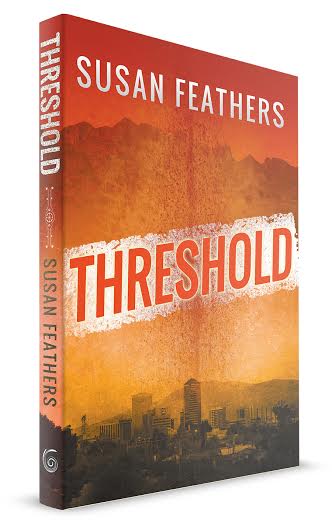
Enrique, a youth living in Tucson’s poorest neighborhood, begins his life with “the cards” stacked against realization of his dreams. Caught in a web of drug traffickers who recruit disadvantaged youth in his barrio, he navigates each day as one in a war zone with the goal to survive between sun up and sun down. Yet like each of us, he has innate potential that, under supporting circumstances, can change his life.
On the back stoop in the alleyway, he lit a cigarette, drawing deeply, breathing out a cloud, letting the afternoon sun warm his chest and arms. His thoughts turned to friends who had joined Bloods Southwest. He decided to talk to Pepe tomorrow at school. Then he went back inside to do his math homework. At least he could work numbers with no problem. He liked that math was governed by rules that never changed, and when he sought answers, he could always work them out. ~ Threshold(2016), Fireship Press, Tucson, AZ
Research shows that a person’s zip code predicts how healthy they will be, how long they may live, what degree they may earn in school, and the size of their pay check. Your zip code can predict your chance of being obese, asthmatic, a drug addict or alcoholic, whether your baby is likely to be born prematurely or with a disability — and even how likely it is that you will live past age 5.
Where you live is a powerful determinant of your life outcomes. What’s more, your zip code may determine how resilient you can be as climate change advances.
How can we end this terrible injustice? Read Threshold to learn how characters find solutions.
Living on the Gulf Coast I am painfully aware of what its like when the grid goes down. Moist, hot coastal air enveloped residents in Pensacola after Hurricane Ivan. In some areas of the seaside city, residents were without power for two weeks. Life came to a halt: no business could be conducted, no schools could function, only emergency services were available; finding potable water and food became residents’ daily preoccupation.
But, what if the power grid in the U.S.A. went down? Security would be nonexistent, vulnerable people would perish from lack of cool or heat depending on the season. Markets would be down and silent. No trade could take place. The lifeblood of capitalism would be cut off.
How vulnerable is our grid? An article in the Wall Street Journal, How America Could Go Dark, reviews how substations on the grid are wide open to sabotage:
The U.S. electric system is in danger of widespread blackouts lasting days, weeks or longer through the destruction of sensitive, hard-to-replace equipment. Yet records are so spotty that no government agency can offer an accurate tally of substation attacks, whether for vandalism, theft or more nefarious purposes.
In my novel Threshold, a plot to disable the grid where hydropower is generated along the Colorado River system is discovered. It is designed to deliver a double whammy: loss of power and water. In the Southwest, that could be devastating.
The point is this: life percolates along in the face of climate change and other long-term security problems as long as citizens can turn on their lights and get water from a faucet. We are distracted by what is immediately before us : terrorism and violence and a failed political process that obfuscates the truth. Meantime, we are not paying attention to the trumpets sounding for our action.
Solutions will come at all levels of society. For example, the millions of dollars we need to secure our grid will require governments and business collaborations to make it happen. On the community level, citizens can bring pressure on officials for these reforms, and they can plan on municipal and neighborhood levels to protect people in the event of a grid failure or compromised water supply. See what Tucson is doing to promote neighborhood organizing for the latter.
The novel Threshold explores possible outcomes in Tucson, Arizona as climate change continues to dry out and heat up the Southwest.
The National Climate Assessment targets heat, drought, and insect outbreaks among other impacts for the Southwest. Surface water supply is expected to decrease as snowpack and stream flow decrease.
Projected regional temperature increases, combined with the way cities amplify heat, will pose increased threats and costs to public health in southwestern cities, which are home to more than 90% of the region’s population. Disruptions to urban electricity and water supplies will exacerbate these health problems.
Threshold tells a story about characters caught in a spiraling heat emergency and black out that stuns the city. South Tucson, a city within the Tucson city limits, rises to become more self-reliant through a solar field and solar gardens.
Yesterday, Reuters published an interesting review about changes in solar industries, showing how big solar (large scale solar fields for example) are becoming cheaper and more efficient than roof-top solar.
Many trace the tipping point for utility-scale solar to a 2014 announcement by Austin Energy that it would buy power from a new 150 megawatt solar plant – enough to light and cool 30,000 homes – for 5 cents a kilowatt hour. At the time, it was a record low price for solar power. Since then, projects have brought the price below 4 cents a kWh.
In Tucson, the Bright Solar program offers residents an opportunity to buy blocks of solar power from a solar field. When the grid goes down however, how can residents continue to generate power if they do not have their own home or neighborhood solar panels and battery storage?
It is important to think carefully about these new technologies and the opportunities they offer people for more democratic ownership of common resources. See the concept of Solar Commons.
As solar power becomes cheaper to generate, will everyone benefit? How can a city and utility work to make solar power available to everyone? As the solar industry develops, how can communities make sure their residents have access to new training and skills necessary for employment in the solar power industry?
In Threshold, South Tucson answers those questions and solves another challenge: the high rate of unemployed youth in their community.
On March 23, Pensacola citizens, ranging from age 7 to 70, traveled to New Orleans to protest the sale of 45M acres of Gulf Coastal waters and land for oil and gas exploration. 350 Pensacola rallied citizens to represent our area. Forty members of the community made the trip–nearly 20% of the 200 protesters who disrupted the sale of coastal lands at the Superdome on Wednesday.
During the protest, representatives from the oil and gas industry bid on the lands. Two chilling aspects of the experience were: 1) hearing the actual bids, some very low, for our precious resources called out during the chants from protesters; 2) observing the implacable faces of the industry representatives in the face of uninterrupted chanting and singing from protesters.
Later, as we enjoyed a beautiful day in New Orleans, I kept thinking about those faces, unmoved, like masks. I wondered what happens to people to become part of a violent process that is destructive to marine waters and impacts the health and well being of the people who live in the path of oil spills or areas where petroleum is refined. Hilton Kelley, a Texas citizen and winner of a Goldman Environmental Prize, addressed the protesters and media about the struggle and successes of his community in Port Arthur, Texas to work with industry to protect people from harmful chemicals and spills from petroleum refining. Kelley is also a poet:
Escambia and Santa Rosa County face their own threats to ocean and estuary habitats. Florida – a state which has notoriously exploited its own natural resources – banned offshore drilling to protect its major industry: tourism. Now, however, the state legislature is opening up its fragile aquifers to fracking and oil exploration. Santa Rosa County has already approved applications from oil companies for exploration in the shared aquifer with Pensacola. Escambia County has an application from Breitburn Operating for one as of July 2015. In a parallel process, the Escambia Board of County Commissioners is making decisions about how to spend $10M in BP fines from the Deepwater Horizon Oil Spill which devastated Pensacola’s economy and impacted the health of marine environments locally.
As I think back about my experience on Wednesday, this chant, and the little children up front chanting with their homemade signs rang in my memory:
Bill Moyer’s & Company featured this article. Children and youths ages 8-19 filed a complaint in Eugene, Oregon’s U.S. District Court that their rights to a safe environment have been violated.
The nonprofit, Our Children’s Trust, filed on behalf of the children. The Justice Department filed a motion to dismiss the case; a federal court judge is considering the request.
By favoring the current generations over their generation, and not acting to reduce the impacts of climate change, the children contend the U.S. government – the President and the federal, state, and local agencies charged to protect the environment – has denied their generation the rights that emanate from a safe environment.
This is a violation of the public trust.
On the NOAA Vital Signs of the Planet website today, the current concentration of carbon dioxide in the atmosphere is 402.26 parts per million (ppt). 350 ppt or lower is considered a safe concentration for earth’s ecosystems and life within the biosphere. Concomitant rise in temperature from rising CO2 atmospheric concentration (a greenhouse gas) is unevenly applied on Earth. However, to date the average rise in temperature is 1 degree Centigrade or 3.4 degrees Fahrenheit across the whole planet. Small changes in average temperatures on Earth are associated with massive changes in climate such as the beginning or end of an ice age.
Question for Readers:
Are the children within in their rights to sue our generation, our government, for violating their rights?
Please comment to spark a discussion. See 2 video interviews on the link above.
For a look at how Terry relates to our public lands and actualizes her beliefs, here is a short interview with her on Democracy Now where she describes buying more than 1700 acres of public lands in a rather private sale of public land for oil leasing where an acre costs about a $1.50 for the right to drill and keep the profits. She is redefining “energy” in how she intends to explore these public lands. This is a very enlightening and motivating example of what one person can do to stop the destruction of critical, sacred habitat.
My grandparents were long time Republicans, small farming families from east Tennessee. Their values of self-reliance and Christian values remain in what is today a mostly Democratic family. Perhaps for that reason, I’ve always had an “ear” for the Republican side of politics and governing.
Moreover, I consider it an American citizen’s duty to consider both or all sides of politics before making decisions. Yet today, like no other time in my life as an American, can I remember when a candidate who openly supports xenophobia, hatred, and incivility, is rising to the forefront of the Republican party.
Historians liken our time to that of Germany and the rise of Hitler, another state where whites began to fear the “other.” In the 1930’s, Germans began to point a finger at one group as the reason for economic ills: Jews.
Donald Trump is rising on a wave of hate and frustration among white Americans feeling a threat to their economic security. This is part of a general loss of faith in institutions overall, a point made by Juan Cole on his blog, Informed Comment.
The fact is that our demographic is changing in color. If the idea of our Republic was to establish a white, Christian state with men in power forever, then it was never a Republic. What our forefathers did (when in fact the starting point was white, Christian, male) was to set into motion the idea that everyone can obtain the right to pursue their own happiness as long as they are willing to meet a basic set of criteria. And that criteria requires we participate actively in a democratic way of life. Discourse (the exchange of points of view for consideration by all), not debate (where one view wins over another) is a hallmark of democracy. Granted, Americans struggle to live up to these high ideals. But, that’s what makes us great.
History shows us that tolerance is a key component of American life, too, that we must all be able to listen to each other with respect, and to engage in reciprocity as we exchange ideas. That is really hard. But its required in a Republic.
What we have today are two forces rotting the core of our Republic: 1) good people who remain silent (of all political persuasions); 2) giving media time and voice to a demagogue who represents nothing about the American way of life. The latter is a function of the erosion of the free press into vacuous and dangerous entertainment.
Losing our Republic is possible in our lifetime. And, oh, what a tragedy when I think of what it took of our forebears to win it, and all the generations – Republicans, Democrats, and Independents – who have fought so hard to keep it, improve it, and rise to its ideal of civil discourse and cooperative living.
We are just about finished with the examination of the education and early influences that shaped each of the Presidential candidates. This exercise was inspired by W.E.B. DuBois:
If we make money the object of man-training, we shall develop money-makers but not necessarily men; if we make technical skill the object of education, we may possess artisans but not, in nature, men. Men we shall have only as we make manhood the object of the work of the schools—intelligence, broad sympathy, knowledge of the world that was and is, and of the relation of men to it—this is the curriculum of that Higher Education which must underlie true life. On this foundation we may build bread winning, skill of hand and quickness of brain, with never a fear lest the child and man mistake the means of living for the object of life. ~ The Talented Tenth
MIKE HUCKABEE
Education and Early Life on Wikipedia:
Huckabee was born on August 24, 1955, in Hope, Arkansas,[11] son of Dorsey Wiles Huckabee and his wife Mae (Elder) Huckabee, conservative Southern Democrats. Huckabee is of English ancestry, with roots in America dating to the colonial era.[12][13] He has cited his working-class upbringing as the reason for his political views;[14] his father worked as a fireman and mechanic, and his mother worked as a clerk at a gas company.[15]
His first job, when he was 14, was at a radio station where he read the news and weather.[16] He was elected Governor of Arkansas by his chapter of the American Legion-sponsored Boys State program in 1972.[11] He was student council vice president at Hope High School during the 1971–72 school year. He was student council president at Hope High School during the 1972–1973 school year.[17] He has one sister, Mrs. Pat Harris, a middle school teacher.[18]
Kasich was born in McKees Rocks, Pennsylvania, an industrial town near Pittsburgh.[9] He is the son of Anne (Vukovich) and John Kasich, who worked as a mail carrier.[10][11]Kasich’s father was of Czech descent, while his mother was of Croatian ancestry.[12] Both his father and mother were children of immigrants.[10] He has described himself as “a Croatian and a Czech”.[13]
After attending public schools in McKees Rocks, Kasich enrolled at Ohio State University, where he joined the Alpha Sigma Phi fraternity.[14] As a freshman he wrote a letter to President Richard Nixon describing concerns he had about the nation and requesting a meeting with the President. The letter was delivered to Nixon by the University’s presidentNovice Fawcett and Kasich was granted a 20-minute meeting with Nixon in December 1970.[15][16]
Earning a Bachelor of Arts degree in political science from Ohio State University in 1974,[17] he went on to work as a researcher for the Ohio Legislative Service Commission.[18]From 1975 to 1978, he served as an administrative assistant to then-state SenatorBuz Lukens.[19]
Continuing this blog’s recent discussion based on W.E.B. Du Bois’ belief that a person’s education should develop his or her character and be driven by ideals rather than simply a trajectory to an occupation.
If we make money the object of man-training, we shall develop money-makers but not necessarily men; if we make technical skill the object of education, we may possess artisans but not, in nature, men. Men we shall have only as we make manhood the object of the work of the schools—intelligence, broad sympathy, knowledge of the world that was and is, and of the relation of men to it—this is the curriculum of that Higher Education which must underlie true life. On this foundation we may build bread winning, skill of hand and quickness of brain, with never a fear lest the child and man mistake the means of living for the object of life. ~ from The Talented Tenth in The Negro Problem
So we are looking at a Democrat and a Republican Presidential candidate with each subsequent blog. So far we have looked at: Bernie Sanders and Donald Trump; Hillary Clinton and Marco Rubio. Hint: Click on the book links; most allow the reader to read partial chapters in the book. Education and early influences are presented in all of them.
Born in Washington, DC, Martin O’Malley was raised in Rockville, Maryland by parents who taught him the importance of public service. His father, Thomas, served as an Air Force bombardier in World War II, flying 33 missions over the Pacific. After the war, he attended law school on the G.I. Bill, working his way up to become an Assistant United States Attorney. O’Malley’s mother, Barbara, has worked in Congress for nearly 30 years, where she continues to serve on the staff of the state’s first female United States Senator, Barbara Mikulski. ~ https://bio.martinomalley.com/
Cruz’s senior thesis at Princeton investigated the separation of powers; its title, Clipping the Wings of Angels, draws its inspiration from a passage attributed to US PresidentJames Madison: “If angels were to govern men, neither external nor internal controls on government would be necessary.” Cruz argued that the drafters of the Constitution intended to protect the rights of their constituents, and that the last two items in the Bill of Rights offer an explicit stop against an all-powerful state.[22][39]




 Susan Feathers