Affirmation of life is the spiritual act by which man ceases to live unreflectively and begins to devote himself to his life with reverence in order to raise it to its true value. To affirm life is to deepen, to make more inward, and to exalt the will to live.
Albert Schweitzer became my hero/mentor at an early age. The United Methodist Church library had a copy of a little book, “All Men Are Brothers” by Charlie May Simon. This is a very special book. Follow the link to purchase one of the remaining copies.
This introduction to Schweitzer seized my imagination. To live by one’s own inner thought and develop a life reflecting values you embrace — this has guided me all through my own Earth walk.
When I was in my early 30s, I read Out of My Life and Thought, which is Schweitzer’s memoir of the major events that informed him in his search for an ethical basis for living.
“The most immediate fact of man’s conscientiousness is the assertion ‘I am life that wills to live in the midst of life that wills to live.'”
The quote is found on page 156 in Chapter 13 of the 1990 edition of Out of My Life and Time, published by Henry Holt and Company, Inc.
With this assertion, a person can manifest their destiny. It is the basis from which decisions are made and a person manifests in thought, word and deed the realization of it as they may choose to live it.
Today we need to return, each of us and together as a nation, to affirm the values at the core of our actions, words, and dreams. Americans are challenged to find our true compass: what do we affirm as the ethical basis for our government?
We can then turn to the Declaration of Independence to examine its words, the basis on which it is realized: “We hold these truths as self evident that all men are created equal….”
But I would add that its time to embrace all life on earth as living relatives without which humankind cannot live. “I am life that wills to live in the midst of life that wills to live.”
We can thank the destructive forces let into the heart of Democracy for showing us the truth of our founding principles among which are consent of the governed and the rule of law.
We witness an attempt to overthrow our government by a despot and the foolish people who follow in his path. Mostly, it is a party of grievances against the restraints imposed by principles established at our founding. These establish how we treat each other and live together.
Individuals who throw off the restraining standards of behavior toward one another and detest those principles of decency, respect and caring for each other are tyrants.
Further, neglect of the Earth from devouring forces that eat at her heartwood, not only rob our children of a future but imperil all life on the planet.
Our collective culpability is grave.
Unbridled capitalism is on display in the highest offices of the land, elected by unknowing citizens concerned with the costs of living while forgetting our responsibility to elect leaders who are grounded in the virtues that our founders asserted as a restraint on the forces of tyranny.
Let us join the choir of truth tellers emerging everywhere as our nation awakens to what we have done: we let a fox into the henhouse. This is not political but our individual responsibility to conduct ourselves with respect for each other.
The preservation of our republic is of vital importance today for another reason: the mounting threat to life on Earth. We are a nation that has forgotten that we live here only by the grace of Earth’s living, breathing body and spirit. For too long we have plundered the Earth for coin.
And now we have put a despot at the helm when the Earth is teetering on massive changes which may not include life as we know it. The entire planet is in flux. Even when we watch our fellow Americans fleeing raging fires, epic floods and death, and temperatures that render farmlands barren, this despot denies even his own body and thus imperils all of us.
The first step out of this dilemma is to admit the truth of our present reality. From there, we must resist every attempt of the now unrestrained actions of a man filled with anger and hair-brained ideas detached from the truth.
We may at a time not too far from now have to make bold decisions and risk all to stop him and the hoard who follow hoping for power, money, or at least to duck his vicious nature. If we don’t, we’ll not appear in any history book as standing up for a nation of free people but for the fact that no one will be around to write that history.
Emerging Resources for Citizens Searching for Truth and Community:
“Even a wounded world is feeding us. Even a wounded world holds us, giving us moments of wonder and joy. I choose joy over despair. Not because I have my head in the sand, but because joy is what the earth gives me daily and I must return the gift.” ― Robin Wall Kimmerer, Braiding Sweetgrass: Indigenous Wisdom, Scientific Knowledge, and the Teachings of Plants (from goodreads)
“Our challenge is to create a new language, even a new sense of what it is to be human. It is to transcend not only national limitations, but even our species isolation, to enter into the larger community of living species. This brings about a completely new sense of reality and value.” (Thomas Berry, “The Ecological Age,” in The Dream of the Earth, 42). https://thomasberry.org/quotes/
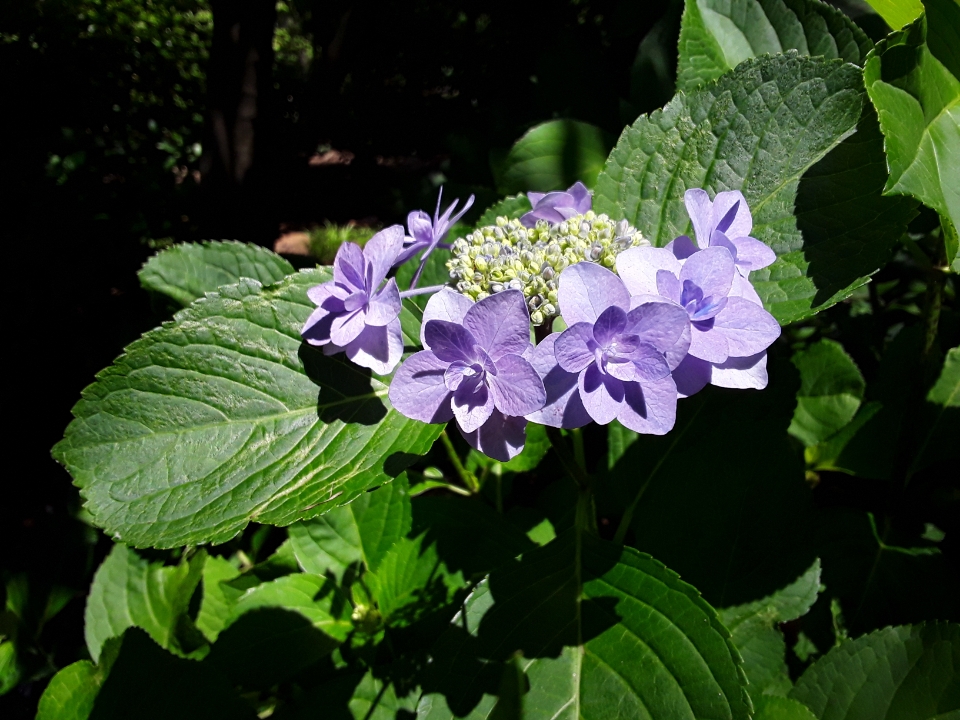
Photo by Susan Feathers at Virginia Beach Botanical Garden Hydrangea Park
M. Scott Momaday, reading his poetry, A Man Made of Words.
To read or listen to powerful voices of people who have devoted their lives to celebrating the Earth is to heal and to find our way home. Each offers us solace and a direction for our lives as we anticipate times of destruction in America and around the world. Earth teaches us to live in community, to know each other and to be in reciprocal relationship with each other and all of life around us. I highly recommend these great teachers, each of whom has helped me understand a way forward in uncertain times. They offer hope and a longer point of view than ephemeral politics. They are an antidote to avarice. We need this deep resonance now to stabalize our spirits and our collective wish for unity, equality and peace.
Listening
Here is a brilliant conversation between Robin Wall Kimmerer and Emanuel Vaughn Lee of Emergence Magazine. Robin describes the wonderful serviceberry tree and what she has learned from its generosity. I also recommend Emergence Magazine for its films from artists and thought leaders across our great planet. I go there frequently to keep the balance.
“A reader lives a thousand lives before [s]he dies . . . The [hu]man who never reads lives only one.” ~ George R.R. Martin
Readers of this blog know that nature is a constant theme in my writing, reading and public work. We all have our roots plunged in soil we call home as did Lauren Groff, a magnificent writer who first found her inspiration at the family farm in New Hampshire.
Groff’s recent novels The Vaster Wilds and Matrix. pose profound questions about how religious and cultural practices have led to the depletion of nature’s resilience and how both men and women contribute to it when acting from an anthropocentric view. The journeys of discovery of both female protangonists is personal, imbued with hopes and dreams in the crucible of living their lives in times when women possess little social agency.
Groff is currently writing the third in the “triptych” of stories that carry the thread of inquiry and discovery. Readers are led to consider our present predicament of killing the very thing that gives us life: the living Earth.
Here are two excellent interviews that explore how Lauren Groff came to write each story, all the complex threads of thought, stories and influences that helped her conceive these outstanding novels.
The first interview explores The Vaster Wilds which takes place briefly in Jamestown colony in the “starving time”and mostly in the American wilds in 1609 North America.
The Matrix concerns Marie de France, the first published female poet in France, a poet and deep thinker whose writings are surprisingly free of social and religious strictures on women at a time of low female agency. Many sources contributed to the final story Groff tells. I found this instructive and supportive for writers of fiction.
This lecture from the University of Notre Dame is in my view the best exploration of how Matrix evolved and the exceptional thinking of one of America’s most brilliant writers of our time.
There is a music interlude to begin. Start of the Interview is 5 min. 23 sec
As a writer who shares the theme of nature I am so grateful to Lauren Groff for demonstrating the power of fiction to move us to understand the deep roots of our misunderstanding.
I learned more about David Tejano on this trip. We met again at The Crossing restaurant. David brought his wife, Sharon, and their three children who were 8, 10 and 14. I learned that David worked a 14-hour day as one of three social workers. I observed some friction between David and his wife in their exchanges about his busy life. Sharon explained that David was a spiritual leader as well, a Bird Singer, and he participated on several committees.
The kids were quiet but lively. I told Sharon about my job at the university as an environmental educator, and how I hoped that we could organize an interesting project for youth. The older boys made suggestions, mostly about sports, and the youngest, a girl, wanted to do an art project. I was glad to see that at least children thought it was a good idea.
We ordered. David went for the fried foods again for which Sharon admonished him and patted his round stomach. Later he slathered butter on his corn tortillas as Sharon looked on and he laughed.
“So, I managed to get a small grant for whatever project the River People may wish to do,” I said, changing the subject.
David nodded approval and said that would be good for the meeting with the elders, to show we had some skin in the game. I marveled at his use of language and how he seamlessly managed the two worlds he navigated with apparent ease.
“Do you know what the elders have in mind?” I asked.
“Not a clue. They don’t share much with me either.”
I laughed. “That makes me feel better.” Sharon smiled in recognition of my position. David had filled her in on the Tribal Chairperson’s welcome.
“That was brave,” she said.
“Self-defense, I believe!” I said.
“You were honest. That goes a long way among our people.”
David filled me in on where to meet him as we parted ways. I took a carton of flan back to the hotel. That had to be the best dessert in the world. A caramel custard to rival my mother’s egg custard. I was feeling more comfortable in Yuma and with the idea that I might be able to establish a lasting relationship with this amazing nation of people. They were still present, and they were reviving their cultural traditions. But much had been lost.
~~~
I met David at his office. It was the first time I noticed how many people, mostly men, were in wheelchairs . . . amputees from advanced diabetes. They stared right through me or did not look anywhere at all. I felt very uncomfortable there in the waiting room of his building. The weight of what has happened here is manifest in these people, sick and depressed about their conditions.
David greeted me about ten minutes late and apologized. By my demeanor, it must have registered how difficult that time had been for me. I could not shake a profound sense of guilt.
“Don’t go down taking the sins of the fathers upon you,” he said as we walked down a long hallway into the sunlight at the back entrance.
“I can’t help it. Our policies, our theft . . . I am struggling with it.”
“Well, then do something about it. It’s not like it’s over,” he bluntly stated. I looked up at him and saw that he was smiling.
“I guess that’s why I am here, though I am not sure how a little environmental education program can make a difference.”
“You might be surprised. Some things get done by just continuing to show up.” David was wise beyond his years.
~~~
I was pleasantly surprised to join the museum director and elders at the new cultural center. It was small but beautiful, featuring the art of the River People and their history and material culture: clothing, fishing and hunting implements, war clubs, and many other everyday objects from times past. The director was a tall stately woman dressed impeccably in a long flowing skirt and jacket top, with dramatic makeup and jewelry. Her long dark hair was pulled back on both sides with beaded hairpins. She looked almost Asian, with very pale skin and watery grey eyes. Her assistants, though younger, presented themselves as grandly as their director. A breakfast buffet with coffee and juice had been prepared. Compared to my last meeting with the elders, this felt closer to how I greet guests at our offices in Tempe. However, later I was told by the director that the cultural center and museum always prepare a lavish spread for the elders. That was a reality check. This was for them, not me.
David left me there to mingle in the all-women gathering. He said he would return at noon. I would miss his supporting presence. I gulped and joined the group. I felt too casually dressed compared with the museum crew. My culture’s ways of relating were varied, and my workplace had gone casual. For a moment, I wondered if I should upgrade how we do things in the almost all male Southwest Center. As a daughter of a military officer, my mother had taught her girls how to dress to show respect, but then the women’s liberation movement shattered that tradition. The culture of casual dress at the University sealed the deal. I made a mental note to clean up my act on the next visit.
Marion, the director, introduced me to her assistants and then invited the elders to the table, suggesting her assistant could also bring them a plate if they preferred. I waited with her as the elders were served; then she indicated I should go next. After we all had our plates and beverages and returned to our seats, which were arranged in a circle, we simply ate in silence with an occasional comment from someone about the food, or an observation about the beautiful morning, and so on. It was an old fashioned social meeting among women. I had not been in on a scene like that since sorority days in college with tiny sandwiches, frosted demi-cakes, and punch.
After everyone finished and the plates were collected, we began a formal meeting with the elders. Marion led the way.
“The elders have discussed the idea of a project for youth. They think it might work well if the children learn something about gardening in the old way and then learn the names of the traditional plants and farming practices. It could also be a way to add to the language recovery efforts.” She paused and looked among the elders to make sure she was communicating what they intended. “Do any of our elders wish to comment?” she asked.
A woman named Georgina spoke up. She had wavy, graying hair, shoulder length, fleshy cheeks with many wrinkles, and dark merry eyes. She was rotund and wore a flowing rose-patterned dress over her large bosom and belly. She was wearing support hose and heavy black orthopedic shoes. Her ears were adorned with long shimmering pink and white beaded earrings.
“Back when I was a little girl, we still farmed in the mud of the river after the flood was finished. The seeds we planted are the old ones, the ones that grow well here.” She pointed toward the landscape visible through the large glass windows in the meeting space. “Most of our kids today have neither seen nor tasted the native melons, beans, and greens that were all we had to eat back then. I think that kids could grow some of these old ones in a garden near the museum.” She looked over at Marion.
Marion was quiet for a while. Another elder spoke up. “It will be a challenge to interest the teens; they are too far into the modern culture to care. But the little guys might want to do it.”
We sat in silence while thinking about this idea, to start with much younger members of the nation.
Another elder spoke. “Teens are lost, you know. Many are already showing negative attitudes.” She was a little younger than the other elders, slim by comparison, with beautiful hands, Vicky noticed. “I am thinking we should ask them to help the little guys. Give them a leadership role. They will learn along with the kids. Saves face.”
That made the women giggle.
“Miss Greenway, do you think the university would support such a project?” Marion asked.
“Yes. I think it fits very well with the intent of the center,” I said. “Learning the native plants is directly connected to land and water and will be a wonderful, fun . . . a delicious way for children to learn at the same time.” Then I decided to announce that the center had agreed to invest $5,000 in this project. “That should be enough to buy whatever you may need and have some money left over to support the ideas the kids may come up with.”
There were murmured comments among the elders. Marion cautioned it would only be successful if kids wanted to do it. She suggested that the project be based in the museum programs and that the museum staff manage the money. The elders and Marion had already determined a place for a garden in their original blueprints for the museum.
That seemed to be a good way to implement it, so I agreed.
Kentucky is a land of dozens of tribal nations. Once densely populated with virgin forests, the people cleared some of these wooded areas to create meadowlands. Game inhabited these areas to graze on the wild grasses. Good hunting. The people kept the meadows productive with a light firing each season, creating the meadows seen today, a gentle impression on the land. See Native Americans of Clay County and Kentucky pdf below.
When I walk around the countryside in Southcentral Kentucky, I am aware of trees and farms and rivers and lakes and sandstone or limestone outcrops–a porous land on and through which waters flow. Karst landscape it is called. Carved by water, there are caverns, caves and blue holes where springs surface like eyes peering up at us terrestrial beings.
I am writing a new novel based in Kentucky in Bowling Green. The frame of the novel is the land. Its presence permeates the story about a young girl whose family has deep roots in the land, five generations of farming on what was indigenous land. She is a new generation with dreams in her eyes about regenerating her family’s land, back to what it might have been when reciprocity between human and soil was natural and both thrived.
She wonders, “What would reparations look like? What could I do to make it right?” See the PDF below about how many tribal nations originally inhabited the land on which the hunted and lived for thousands of years.
More conversation with Amitav Ghosh, author of The Nutmeg’s Curse on Emergence Magazine brings up similar themes incorporated into Threshold, a novel about climate change in the Southwest. In it, I layered the rich cultural endowment of the Tucson area, with ancient Indigenous and current day Native Nations wisdom, and Mexican American land and agricultural practices that have and continue to shape the local zeitgeist. But, like most communities in the Southwest, capitalistic systems drive commerce rendering the living Earth mute. All these ways of living mix together yet one has dominated the political and economic forces, imperiling Tucsonans to climate emergencies.
Listen to a chapter from Threshold as a major character of Mexican descent, Delores Olivarez, takes a hike up “A” mountain observing the changes in the Tucson valley that trace all these cultural ways of knowing. Thanks to Terrain.org for publishing this chapter of Threshold.
Southwestern Novel From Fireship Press—A fictional novel exploring the dramatic affects of climate change in the desert community of Tucson, Arizona
A Love Story in a Time of Climate Change
Susan Feathers will be present to sign and sell copies of Threshold during the Indie Authors Pavilion at the Tucson Festival of Books on March 5, Saturday from 10 a.m. to 1 p.m.
Confronted by crisis in their own world—climate scientists, politicians, and desert museum curators face the biggest challenge man can encounter—no water, anywhere. In the barrios, families and community leaders, band together as they face unbearable heat and the crushing weight of the gangs that intimidate them. Amidst the turmoil, three teens navigate adolescence to become leaders in a new world. With shifting sand underfoot, characters follow their intuition and learn new skills as they chart a way into a viable future. Threshold will make you think while it celebrates the enduring nature of communities as they search for what is lasting and true. Threshold is a powerful new western novel in the best of its tradition. Appropriate for high school classes.
“In a riveting, multi-stranded plot, Threshold translates the conceptual worry over climate change into immediate, interpersonal dramas.” –Mary Lawlor, Muhlenberg College
“Such a well-written and thoughtfully conceived novel regarding very poignant issues of the day; THRESHOLD is a valuable contribution. The author continues a tradition in Southwestern Literature of social and environmental consciousness –Mark Rossi, Frank Waters Foundation.
About the Author
Susan Feathers is a writer and educator with 30 years of experience communicating science to the public. She served as the Director of Education at the Sonora-Arizona Desert Museum. Her writing focuses on the importance of place in forming character and destiny. Susan is an excellent speaker with years of experience delivering programs to the public. Her blog, WalkEarth.org, now in its 14th year, has an active following.
Sugar Maple and Grove, Bowling Green, Kentucky 2021 Photo by Susan Feathers
The beauty of the land near my apartment complex, tucked among sprawling medical buildings and a new bank, can still be found if you look with an eye for the lone tree and all it nourishes. The sugar maple above is a mother tree, probably in the dying phase of life, but none the less still harboring many forms of life in its canopy and beneath its graceful limbs.
Dream Meadows Farm, Lover’s Lane, Bowling Green, Kentucky photo by Susan Feathers
One side of my apartment looks out onto Dream Meadows Farm, a 17-acre remnant of once large farms along what is known as Lover’s Lane, or 880. Steadily, development has destroyed the farmland and wild areas to make way for rapid growth. The cooling provided by mature trees, deep grass roots that percolate heavy rain and prevent flooding, and deposits of fertilizer by cattle and sheep are all illustrative on this small farm — the last working farm on the lane. It inspired the draft of a new novel which I am finishing now. It tells the story of a young woman, Belle, who dreams of becoming a regenerative farmer. She learns how to replant native trees in field rows and create orchards. Only 19, her roots on the family farm reach back centuries. She has the long view.
Mature Sugar Maple near I-65, behind Social Services, in Mt. Victor Development, Photo by Susan Feathers: “A Mighty Fortress”
Go out and you will see the beauty of nature between buildings, in back lots, rising under sidewalks and streets, and animal life following these islands of life–navigators in a perilous time.
What have we forgotten? The Dream of the Earth. Reawakening this dream in you is a step toward sustaining life for all.
From my earliest memory, I have loved being in nature. I frolicked in the out of doors, savoring every second I could:
rolled down a hill with gravity pulling me faster and faster, out of control; jumped into a fragrant pile of leaves trusting it would cushion me;
plunged into a pool when the air popped with heat; shushed down a quiet, snow covered slope toward a tiny chalet, smoke twirling above its chimney;
rocketed a backhand, uncoiling the power of my body to propel a fuzzy ball on an accelerating arc to my opponent’s feet.
These are the gifts of being alive on Earth, this magnificent creation.
Only here can I be carried away by the scent of orange blossoms; only here can I gaze into the blue mirror of a lake at mountain peaks and passing clouds.
I come away from digital kingdoms that replicate at exponential speed; I come away to a world made whole, and wholly holy.
For years I sensed Earth’s wholeness, whenever I remembered and returned.
For years I pursued knowledge to understand why it was that way.
And then, I just accepted the world was made whole.