Right of Passage in a Monsoon Storm

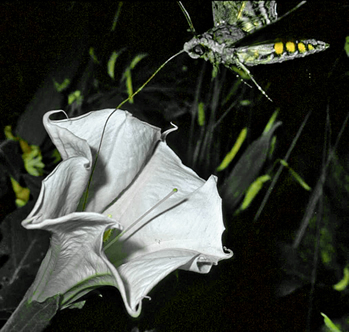
moth-daturacroppedWhen I fist moved to Tucson, Arizona, I was new to the high desert. Biologists refer to its flora and fauna as “lush”–a term that up until then I would not have chosen for a desert.

Through colleagues at the Arizona-Sonora Desert Museum, I learned about a poetry reading at University of Arizona by Dr. Ofelia Zepeda, 

Dr. Zepeda is a member of the Tohono O’odham Nation, a lifelong desert dweller, a linguist, and cultural preservationist. In 1999 she was awarded the MacArthur Fellowship for her work creating a Tohono O’odham book of grammar. However, Dr. Zepeda’s poetry is what I wish to focus on and how the chance encounter with her performance in the first week of my residency in Tucson led to my deep feeling for a place and community as culturally rich as any I’ve known.

The poetry reading took place in the circular auditorium (kiva) in the American Indian Studies Department at U.A. In the large room with rows pitched down toward the lectern in its center, a soft voice rose and fell. Dr. Zepeda’s was reading from her book, Ocean Power She spoke in O’odham and English, alternating between each as she read.  I closed my eyes to listen to the language of desert communities at Tucson’s origin.

She explained the relationship of her family and community to rain in the desert, its precious nature, and how, after the long hot, dry foresummer, the first monsoon clouds gather, and people point and wait for the first cold dollops of rain.

After her lecture, I walked to my hot, dusty car to drive home. Not long after I was on the road, a massive monsoon cloud, as black as coal, threw lightening strikes like explosions on the ground, and rain burst from the sky, falling n buckets, cleansing the car and blinding my sight. I had to pull over. Flood waters gushed around drains, cars stalled as the water rose, but all the people smiled behind their windshields or stood outside their vehicles with open arms, letting the storm soak them to the bone. It was a celebration, first delivered through Dr. Zepeda’s poetry and, then, by the monsoon itself.  I believe to this day that hearing about rain on the desert in O’odham made the impact of the storm much deeper for me. It was a true rite of passage. Listen to a short video about Dr. Zepeda.
 

Shhh: my book is about . . .

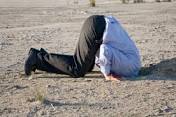
head in sandAs a new writer, taking on the task of a first novel with climate change as the protagonist is tantamount to declaring failure before lifting your pen.

Many dystopias have been written about climate change, and numerous Armageddon-style films produced which draw large audiences. Their stories are so outrageous that we count them as impossible. It may be an entertaining read or box office hit but these forms obfuscate the real threat we face.

When I first conceived the idea for writing Threshold, it followed on a years of reading climate science, talking to local scientists about changes they were seeing in local and regional environments, and reading the latest popular books written for the public’s understanding. The Weather Makers is one that comes to mind. The author, Tim Flannery, is an imminent zoologist who has continued to write about world-wide environmental issues related to climate change.

Yet, a great percentage of people still do not accept that climate change exists. Are we hard-wired to not accept climate change? What is it that defies logic, what we know, to respond instead to what we believe? Does it strike at our deep seated need to protect home and family, to disbelieve something as uncertain as uncertainty?

George Marshall devotes his professional life to studying these questions. In his recent book, “Don’t Even Talk About It: Why Our Brains Are Wired to Ignore Climate Change”, Marshall presents the results of interviews and research that make a credible case that our natural inborn defenses and beliefs keep us from responding. But, Marshall is hopeful because what we share in common is so much greater than what separates people about climate change. That fact may be key to bringing about a consensus to act in time.

Planning the book I had to consider who I was writing it for, who would be my readers. How could I write a popular story that gains the attention of people who normally would not read about climate change, may even vociferously deny it (like Ed Flanagan in Threshold). How could I invite everyone into a discussion about it, and what would I learn in doing so? These questions have occupied my mind over a decade, as I drafted, edited, put aside, and finally returned to finish the story.

TO BE CONTINUED


Birth of a novel…

Books I read that informed Threshold.
Books I read that informed first draft of Threshold.

In terms of years spent writing as a principle activity, I am a relatively new writer. In 2003 I decided to leave working full time to begin a life as an independent businesswoman. This gave me time to write with more purpose. Up until then, I had written memoir and nonfiction pieces, attended a few writing workshops, but had not truly found my purpose nor honed a writing life.

When I made the Big Transition from working for an institution to working for myself, I had been serving the Desert Museum in Tucson as the Director of Education. This was a great privilege for me–one that brought me close to many experts and passionate defenders of the biodiversity and cultural diversity of desert communities.

At the same time, scientists were reporting increasingly disturbing forecasts about climate changes on global scale. The Tucson and Phoenix metro areas were also reexamining their water management plans. Working for myself gave me more uninterrupted time to read and to plan a book.

Writer's Cabin - Frank Water's Foundation
Writer’s Cabin – Frank Water’s Foundation

Threshold was first drafted at the Frank Waters Foundation in 2006 after I was offered an 8-week writer’s residency. The little adobe artist’s cabin on the Frank Water’s property sits at the base of the Sangre de Cristo mountains. Frank Waters’ spirit pervades the property. He is considered the grandfather of the Southwestern novel, writing and publishing fiction and nonfiction works from the late 30s to the 80s. All his books are still in print, a fact that proves the relevance of his thoughts and writing. As I wrote my story, I felt Frank’s spirit about.

Aspen grove by cabin - Frank Waters Foundation
Aspen grove by cabin – Frank Waters Foundation

Armed with an outline for a plot that spanned three novels stretching to 2100, I drafted a speculative fiction novel with an enormous cast of characters. I left the mountains with a 400-page manuscript.

This was an impossible task for a new writer of fiction. But, sometimes ignorance allows a creative mind to accomplish more than expected.

TO BE CONTINUED

Threshold: Waatteerr!

water imageNumerous American films portray the desert as a place where victims crawl across the sand, silently screaming –  “WAAATTTERRRR!”

There is nothing worse, or more dangerous, than thirst. Without enough water, anyone crossing or living in a desert region will become dehydrated. Athletes have to pay attention to the hydration of their body or risk serious health risks. If the weather or climate is also hot and dry, it is even easier to become dangerously overheated.

How much water do we need each day? We have all been advised to drink 8 glasses of water per day. Another rule of thumb is to drink half your body weight in ounces. Most of us do not drink that amount. We walk around dehydrated and functioning below our maximum energy level.

Heat stroke or hyperthermia has been identified as the two most dangerous health impacts of climate change on populations living in hot, dryland habitat. See how Tucson, Arizona professional community is addressing this with citizens:

citizens-guide-resilience-climate-extremes


Our Military is Well Ahead of Congress on Climate Change

U.S. Marines from the 26th Marine Expeditionary Unit unload food and supplies to Pakistanis in support of the flood relief effort in Pano Aqil, Pakistan, Sept. 11, 2010. (U.S. Army photo by Sgt. Jason Bushong/Released)

Tonight 350 Pensacola brought Brigadier General John Adams, Ret. to describe how the military is involved in preparation for the consequences of climate change. Among them are sea level rise, food shortages, migration of large groups of people from countries destabilized by climate change impacts, and larger and more powerful storms. See this link to The Center for Climate and Security.

General Adams reviewed changes in the Arctic that will eventually keep it open (free of ice) for global trade and military maneuvers for as much as six months out of the year. Arctic Patrolling is now another security responsibility of the U.S. Military.

Where troops train and in major ports that harbor military ships, adaptations must be made now because the infrastructure take years to develop. We are likely to see relocation of military bases–which will also impact communities that rely on the economic income from their presence. He mentioned Norfolk bases as likely impacted. Pensacola Naval Air Station (PNAS) will not be impacted because Hurricane Ivan destroyed coastal infrastructure which the Navy decided not to replace. PNAS is the home of Naval Aviation, the main activity that will not be affected by sea level. However, it is subject to stronger than normal storms as is our whole coastal area.

General Adams explained that the drought in California and other areas in the Southwest is making it impossible to conduct troop training (major fires and the risk of setting off fires from troop fire) and these conditions are likely to drive base relocation.

General Adams began by describing climate change as a global security threat. Adams is the CEO of a global security consulting firm, Guardian Six. They have an impressive team assembled to analyze security risks for clients. He speaks from experience and current projects his team is conducting around the world to assess security risks.

As General Adams focused his comments country by country, targeting regions most vulnerable to climate change impacts, it was obvious that national security will be greatly affected, if for no other reason than troops deployed for disaster relief will take the focus away from national security activities. While only 17% of the world’s land base will be subject to sea level rise world wide, 50% of the world’s population lives in those regions.

The military looks at climate change from a risk management perspective, Adams explained. We plan for the worst case scenario, expect the most likely outcomes, and then hope for a better future. This is a cautious approach, but proactive, accepting the facts – the science – to plan for any future contingency. 

A participant asked the General how the military manages to act proactively when half of our congressional representatives do not even accept there is such a thing as climate change. He answered military leaders just go about the business they are charged to implement. We strive to speak truth to power, but in the end the military has to protect the nation. That is our mission.

A special concern of mine is local, national, and global food security. Hunger and poverty drive insurrection, wars, migrations. We know this. I do not believe most Americans are paying attention to the fraying food system in the U.S. General Adams explained that over the next six years, it is projected that million’s of acres of California’s farming operations will come to an end due to the long-term drought and heat.

The NOAA satellite system known as G.R.A.C.E. – gravity measurements of the world’s aquifers by changes in the mass of water in aquifers that underlay the world’s vast agricultural areas – shows the shrinking mass of available fresh water for food production. The Ogallala Aquifer is one of them. It underlies the U.S. Great Plains under 8 states. It has been in a state of overdraft. Its recharge is from rain and snow melt.Drought and overdraft could see this major source of water depleted in just a few years.

We would all do well to act as our military and start planning for the worst case scenario in order to ensure good outcomes down the road. I will continue working with my own local, state and federal representatives to move in that direction.

What the military knows about climate change…

350 Pensacola will host a talk by Brigadier General John Adams, (U.S. Army, Retired) on April 12.  He will discuss how the U.S. military is making plans for climate change at home and abroad.

When I worked in the Office of Research and Sponsored Programs at the University of West Florida, I reviewed grant opportunities from the various military branches for research related to climate change. Going back to 2010 when I began serving UWF as a Senior Grant Specialist, I became aware that our own military was well “down the road” in planning for climate change. In contrast, our city and state were hard-pressed to let the words climate change leave their lips.

This disconnect is critical to American citizens working in their own communities to help plan for climate change.  Check out these sites below to see what our military is doing to prepare to mitigate climate change, and be sure to mark April 12 on your calendar. Go here for time, location, and more about General Adams’ lecture and discussion.

U.S. Military Links

Department of Defense (DoD)

Center for Climate and Security

Warming Earth, Changing Climate

Everywhere there is evidence that the Earth is warming at rates not seen in recorded history. Ice ages and temperate periods like the epoch in which we live (the Holocene) have come about over thousands of years. As human populations have increased exponentially, and as we have mined and refined carbon rich ores and deposits of oil, the concentration of greenhouse gases has increased in concert with emissions.

Warming the planet, changing the dynamics of wind and ocean currents, we are beginning to see changes in our ways of life. Agricultural changes include drought, floods, insect booms, and altered growing seasons. The ranges of tree and plant populations, and the insects and birds associated with them, are moving to higher altitudes in many places–changes that go unnoticed except by scientists and Peoples of Place (farmers, naturalists, indigenous cultures).

Without significant and coordinated actions at all levels of human government, we are likely to see major disruptions in our ways of life, and social conflict from disparities in resources to respond and survive.

Find out what your community is doing. Do you have solar companies? Other alternative energy companies? What is your state doing about carbon dioxide emissions?

SOLUTIONS ABOUND: WE NEED CITIZEN PARTICIPATION TO GET THERE

Florida Solar Energy Center

Southeastern Solar Research Center

Rocky Mountain Institute

Go to NOAA’s Vital Signs of the Planet to keep track of Earth changes.

Children File Suit in Court for a Safe Environment

From article on Bill Moyers & Company: http://billmoyers.com/story/should-kids-be-able-to-sue-for-a-safe-climate-this-federal-court-is-about-to-decide/

Bill Moyer’s & Company featured this article. Children and youths ages 8-19 filed a complaint in Eugene, Oregon’s U.S. District Court that their rights to a safe environment have been violated.

The nonprofit, Our Children’s Trust, filed on behalf of the children. The Justice Department filed a motion to dismiss the case; a federal court judge is considering the request.

By favoring the current generations over their generation, and not acting to reduce the impacts of climate change, the children contend the U.S. government – the President and the federal, state, and local agencies charged to protect the environment – has denied their generation the rights that emanate from a safe environment.

This is a violation of the public trust.

On the NOAA Vital Signs of the Planet website today, the current concentration of carbon dioxide in the atmosphere is 402.26 parts per million (ppt). 350 ppt or lower is considered a safe concentration for earth’s ecosystems and life within the biosphere. Concomitant rise in temperature from rising CO2 atmospheric concentration (a greenhouse gas) is unevenly applied on Earth. However, to date the average rise in temperature is  1 degree Centigrade or 3.4 degrees Fahrenheit across the whole planet. Small changes in average temperatures on Earth are associated with massive changes in climate such as the beginning or end of an ice age.

Question for Readers:

Are the children within in their rights to sue our generation, our government, for violating their rights?

Please comment to spark a discussion. See 2 video interviews on the link above.

Nature’s Trust

Pensacola Says Yes to a Climate Change Task Force

cropped-244.jpgLast night the City Council passed a resolution to establish a Climate Change Mitigation and Adaptation Task Force.

This has been over a year in the making. Introduced by Councilwoman Sherri Myers, and spearheaded by 350 Pensacola, the resolution was unanimously adopted as council members observe the impacts of a changing climate on our land and waters.

This is a huge victory for Pensacola. Experts agree that cities are the centers of climate change mitigation, having the most control over how their city handles its emissions, energy efficiency, and citizen participation in reducing its emissions footprint while innovating to improve quality of life. These strategies include green building, slowing traffic, improving public transportation, walking and biking lanes, and supporting local business. Making sure we protect water quality, build environments that reduce heat, embellish the natural environment, and enable all citizens to participate will be the concerns of this task force.

All these initiatives create jobs, save money, and set up the city to receive funding from foundations, state and federal agencies that are pouring more money into climate mitigation programs.

Challenges are: 1) the Mayor has not shown interest in the Task Force; 2) the State of Florida lacks leadership from the Governor and legislature to enact the policies and support to truly help cities make the energy and infrastructure changes that are necessary to become truly climate adapted. Citizen participation is crucial to bring leaders and experts to the task.  Check the City Council site to get to meetings and to contact council members to express your ideas. Write Mayor Aston Hayward to express your desire that he become an active participant with the Task Force.