AMID DESTRUCTION, TRUTH EMERGES UNDAUNTED

We can thank the destructive forces let into the heart of Democracy for showing us the truth of our founding principles among which are consent of the governed and the rule of law.

We witness an attempt to overthrow our government by a despot and the foolish people who follow in his path. Mostly, it is a party of grievances against the restraints imposed by principles established at our founding. These establish how we treat each other and live together.

Individuals who throw off the restraining standards of behavior toward one another and detest those principles of decency, respect and caring for each other are tyrants.

Further, neglect of the Earth from devouring forces that eat at her heartwood, not only rob our children of a future but imperil all life on the planet.

Our collective culpability is grave.

Unbridled capitalism is on display in the highest offices of the land, elected by unknowing citizens concerned with the costs of living while forgetting our responsibility to elect leaders who are grounded in the virtues that our founders asserted as a restraint on the forces of tyranny.

Let us join the choir of truth tellers emerging everywhere as our nation awakens to what we have done: we let a fox into the henhouse. This is not political but our individual responsibility to conduct ourselves with respect for each other.

The preservation of our republic is of vital importance today for another reason: the mounting threat to life on Earth. We are a nation that has forgotten that we live here only by the grace of Earth’s living, breathing body and spirit. For too long we have plundered the Earth for coin.

And now we have put a despot at the helm when the Earth is teetering on massive changes which may not include life as we know it. The entire planet is in flux. Even when we watch our fellow Americans fleeing raging fires, epic floods and death, and temperatures that render  farmlands barren, this despot denies even his own body and thus imperils all of us.

The first step out of this dilemma is to admit the truth of our present reality. From there, we must resist every attempt of the now unrestrained actions of a man filled with anger and hair-brained ideas detached from the truth.

We may at a time not too far from now have to make bold decisions and risk all to stop him and the hoard who follow hoping for power, money, or at least to duck his vicious nature. If we don’t, we’ll not appear in any history book as standing up for a nation of free people but for the fact that no one will be around to write that history.

Emerging Resources for Citizens Searching for Truth and Community:

The Contrarian

Civil Discourse

Letters from an American

Public Citizen

Emergence Magazine

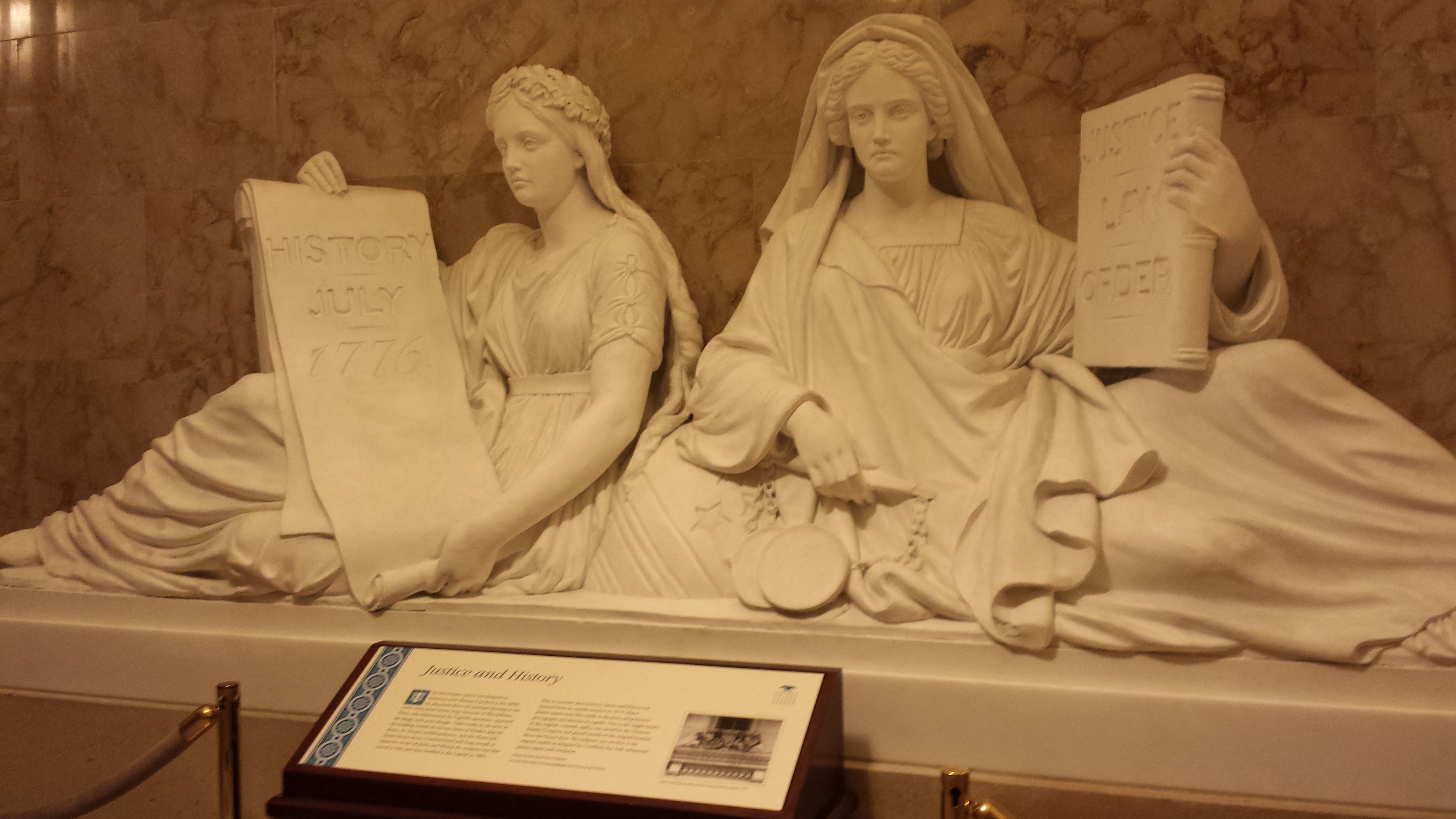
Capitol Building Rotunda, Photo by Susan Feathers

A Book for Our Time: The Crystal Beads, Lalka’s Journey

A mother and child in 1939 Poland are talking. This is our way into a new book—The Crystal Beads, Lalka’s Journey written by Pat Black-Gould and illustrated by Katya Royz. It is a book written for children but is for any age and as I will show, particularly for today.

The time and place alert adults immediately to the context but for children they are gently led into the experience. A mother has found a way to gently guide her seven-year-old daughter on a safe path while terror stalks right outside their door. She asks her daughter to trade her Star of David for crystal beads – a rosary.

The author guides readers along with the illustrations driving the narrative and lending emotional texture. Tension builds with a terrifying encounter with Nazi interrogators. What might happen? We anticipate the worst. The terrifying men leave and we can breathe again. Lalka asks a question of the Mother Superior. It is not just any question: it is the question yet unresolved among us. Which of these is better: the Star of David or the Rosary?

Pat Black-Gould weaves a story of trust and love confronted with evil and brilliantly captured in Katya Royz’ art.

When I finished reading the story, my first thought was of Leo Tolstoy’s parable The Bear. Written for children, it has lasted through the centuries as a warning about the perils of oppression. Tolstoy showed how the bear became immured in a prison of its own thinking. It performs everyday for its master who has tethered it to a stump. Not until the bear is reminded he is endowed with the strength to break his bonds does he free himself from his oppressor.

I foresee The Crystal Beads will find its place among stories that illuminate dark times with truth. Everyone is endowed with his or her own right to be free and to pursue his or her own dreams. Each person is as valuable as the next. All faiths promote that and it is the soul of democratic governance.

The Nazis vilified the Jews leading to unspeakable crimes against humanity. This old dark root has risen over the last decade in many forms of hatred toward “the other.” Anger and hatred pit people against each other, playing out this old and tragic story about the human race. It must be illuminated for what it is: evil in many forms. We must be ever vigilent to guard against it for it can happen anywhere strong men’s manipulation of followers who, like the bear, are imprisoned by their own misperceptions and thinking.

I am so glad for the publication of The Crystal Beads. Pat Black-Gould is a practicing psychologist, playwright, and fiction writer. Perhaps this is why her book is so vital. The author has created a timeless story for all ages. The book has already garnered many awards.

Study guides for children and for adults are included.

The River People – Chapter 3

A novel by Susan L. Feathers, Copyrighted 2021

Chapter 3

Not a Drop of Water

Bill Sherwood was a lanky man who impressed me by his warmth. His rounded shoulders spoke of the heavy load he had carried in defending wild places from development, and perhaps his own personal struggles, whatever they may have been. His light brown hair fell in straight locks across his forehead, shading his eyes. He seemed like a kind grandfather figure to me.

Bill took a lot of time to help me understand potential issues that might be part of an environmental education program. I appreciated his earnest effort but was dazed by the time our two-hour meeting came to an end. I tried to review what I thought I’d heard as he listened keenly.

            “Okay. Basically, there is no Colorado River water that flows past the River People’s reservations. They are high and dry. Most of their land is leased out to farmers who buy allotments of Colorado River water to divert it via canals to the farmlands for their crops. Correct?”

            “Yup, that’s about it.”

            “And, the natural communities of mesquites, willows, and cottonwoods are gone except for scattered communities where the water table is high enough to support growth. The River People have planted tamarisk trees that are fast growing in those places, right?”

            “Yes, there is a great need for these trees because the tribe’s traditional ceremonies for their departed—cremation and other related ceremonies– require a constant source of firewood,” Bill affirmed. “But that is only a small part of why the old forests were necessary. Those forests, they are called bosques or woodlands, harbored abundant wildlife that fed the tribe, drew water up from the water table, and provided medicinal substances that kept the River People healthy. The worst part is that the River People helped harvest that wood to fuel the steamboats used by the U.S. Army and ambitious businessmen to ferry supplies and people across or up the river to support settlers moving westward. The River People were hired as steamboat pilots because they knew the river better than anyone. They were paid in beads, later in coin. Their way of life began to transform like the forested land along the river.”

            I reviewed my notes. An uncanny silence filled the space of Sherwood’s office as I took in the information. We both felt the weight of knowledge about our own culture’s impact on the River People we now came to serve.

            “Bill, it is not at all clear to me how a little environmental education project will have any impact on these matters. In fact, it now feels trivial. What’s your sense of it?”

            He stood up and moved to the window behind his desk. Bill was lanky and skinny as a rail except for an old-age paunch around his waist. He possessed a sculpted, long-jowl face, the kind illustrators love to sketch.

            “You know, it might actually be just the thing needed.” He turned toward me to finish the thought. “Kids need to know what was lost and be a part of bringing it back, at least to some modern form of the natural habitat. Restoration can be healing for those who participate.

~~~

Leaving Bill to his work, I walked over to the Cultural Center. Inside, a small but exquisite gift shop exhibited the beadwork of Cocopah artists—multicolored yolks in geometric patterns. A young woman in a cobalt blue blouse and white skirt was wearing one of the yolks in patterns of white, yellow and red beads. Against the darker cloth, it was striking. Her long black hair hung in waves, held back on one side by a matching beaded clasp.

She greeted me warmly. “Welcome. Are you looking for something special?” she asked. In contrast to her impeccable appearance, including heavy eye make-up and ruby red lipstick, I suddenly felt very plain.

“Well, no. But…yes!” I suddenly remembered the upcoming university graduation party I’d been invited to. “I have a silver top and black skirt that one of these necklaces would truly enhance. What would you recommend?”

“These are yolks, a traditional form of adornment that our women invented when we began to trade with foreigners. I think they may also have been inspired by the yolks from pioneer women’s dresses. How about this one?” She held up a yolk comprised of iridescent red beads with geometric patterns of black and white beads. She came out from around the counter to help me put it on in front of a mirror. It was the most beautiful beadwork I’d ever seen.

“Yes, this will be dramatic against the silvery top. Thank you,” I said. “How much does it cost?”

From behind the case again, she checked the tag, and said, “This one is by one of our best artists, an elder. She is asking $500 for it.” She looked up to see my face probably go a little pale. She smiled and explained that hundreds of hours go into the making of the yoke.

“Then, I will wear it with pride. Yes, please wrap it for me; I am traveling and do not want to damage it.” I figured it was one of those moments, like the meeting with David, when two nations converge. Investing in an elder, in the traditional arts of the River People seemed the right thing to do. Besides, I had squirreled away money for a vacation and this seemed like a good use for it.

The young woman’s name was Sabrina Johnston. Her comportment communicated humility blended with self-confidence. The River People were not a weak nation. They had withstood an onslaught of injustices. Yet here they were. It was good to see and made me feel even more confused about the assignment I’d been given. Just who needs the help? I wondered to myself.

            On a bookstand in the small gift store, I found a history that Sabrina affirmed was the one everyone trusted as correctly describing their lineage, language, traditions, and art. It was a book written by a nonnative woman affiliated with the state university, which encouraged me in my thinking that relationships could be built from trust and a good intent.

But that thought turned to ashes at the Tribal Council meeting some days later.

~~~

            “I’ll just start by saying, Miss Greenway, that I don’t trust you.” The Chairperson sat behind a microphone on the curved oak desk in the Tribal Council chambers.

I stood in the center of a horseshoe circle of council members, many of whom burst into laughter upon hearing the Chairman’s statement. My knees literally shook as I realized just how unprepared I was to address the leaders of this Nation. I couldn’t wait to get back to Phoenix to let my boss know what I thought about him and his irrational idea.

Clearing my throat, I said, “I understand that…but frankly, I don’t trust you, either.” Where did that come from? I had no idea. It just leapt up into my throat and I let it fly! It would be over in a blink. But then the room erupted in laughter and even the stern face of the Chairman broke into a grin.

Most of the council members were large, heavy-framed men and women, with countenances that did not inspire casual conversation. Their laughter did not alleviate the tension for me. It only confused my thinking more.

“Well, now that that’s settled, maybe you can tell us why you are here.” The Chairman was extending me another chance.

Had I passed a test?

I followed with a lame description of the project I no longer believed in after my long meeting with Bill Sherwood. The Council, to their credit, listened without interruption or any indication of how they felt about what I said.

“Well, I am sure our elders will tell you what they think,” the Chairman said flatly. “I wish you good luck.”

Then he addressed David Tejano, who was present in the public seating area. “Mr. Tejano, I trust you will direct Miss Greenway where to begin.”

And that was that. I left somewhat dumbfounded yet grateful I’d made it through. Nevertheless, I realized as I walked to my car that no commitment or comments as to its potential relevance were made about an environmental education project.

David said goodbye with the assurance he would be in touch, and I left with my history book about the River People to return to my motel room. I flopped into bed, weary from tension, and began to read an incredible story about America’s Nile culture.

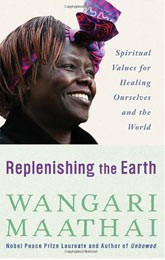
Replenishing the Earth – Wangari Maathai

Winner of the Nobel Prize for Peace in 2004

Wangari Maathai grew up in her homeland in Kenya, living close to the earth and learning traditional Kikuyu values and practices. Her memoir, Unbound, describes her daily activities as a child, her mother’s teachings, and how her people regarded the streams and forests in a land where the balance of nature is delicate, not to be abused without serious consequences for its inhabitants.

In Replenishing the Earth: Spiritual Values for Healing Ourselves and the World, Maathai’s wisdom is distilled onto each page, every sentence the next drop in the flow. Wangari describes herself as working practically to solve problems she learned about in discussions with communities and among women’s groups. Their need for clean water, and for access to earn a living, were her daily concerns. Eventually, Wangari and the women she served established the Greenbelt Movement that planted over 30 million trees in Kenya.

In Replenishing, Wangari’s concerns about the destruction of the environment in Kenya are examined in light of the world’s sacred traditions. Always a practical perspective, her observations and reflections give readers much to consider often through humor. For example she writes that God in his wisdom created Adam on Friday. If he’d created him on Monday he’d have perished for lack of food!

Wangari Maathai’s clarity of thought is invaluable in this age where massive destruction of oceans, rivers, wildlands, and forests have imperiled life the world over. She and the women of Kenya remind us of the earth-shaking power of people to replenish the earth, if we choose to do so.

Listen to an interview with Wangari Maathai on OnBeing.org.


To gamble well, study God

Update: In a discussion about the making of the film Lincoln, Doris Kearns Godwin, Tony Kushner, and Steven Spielberg identify their favorite scenes in the movie, Steven talks about the ability to accept a great idea from the “other side”: this illustrates the point of this post!

God rolls the dice, shuffles the deck for endless possibilities, knowing not how anyone of us creatures of Earth may respond – ignore, expire, excel. But, rolling and dealing endless possibilities is the key to God’s success.

Trees know this for through God each tree grows thousands of seeds in all shapes and configurations but in the end it releases them to the wind, to hitch a ride on the fur of a passing creature or fall into the fast moving stream nearby. Will a seed find rich soil? Will it be nourished to survive? Will it fall upon concrete? Or be gobbled up, later to be excreted with a wrapping of fertilizer?

With all the possibilities, each with its potential outcomes, some seedlings will grow. And, IF there is enough sunlight and just the right amount of moisture and warmth, it will grow into a mighty tree and someday throw its own possibilities into the winds of the future.

The Creator exerts patience and rationality: a kind of detachment that allows all possibilities to emerge.

That’s where we come in. Will we respond or ignore an opportunity, or more often, doubt ourselves? God observes. We might get another “hand” or not. I think the Creator must love the folks who take a chance knowing they might fail. Because that’s what the Gambler must do: keep rolling the dice, keep open all the possibilities for a winning hand! Indeed, all great things require it.

Therefore, let us consider all the possibilities rather than spend our time criticizing ideas, even despising the source of them; let us work broadly and earnestly to solve our common problems: climate change, war, peaceful relations. etc. by keeping many ideas and strategies in play.

What if together we just might play a winning hand?

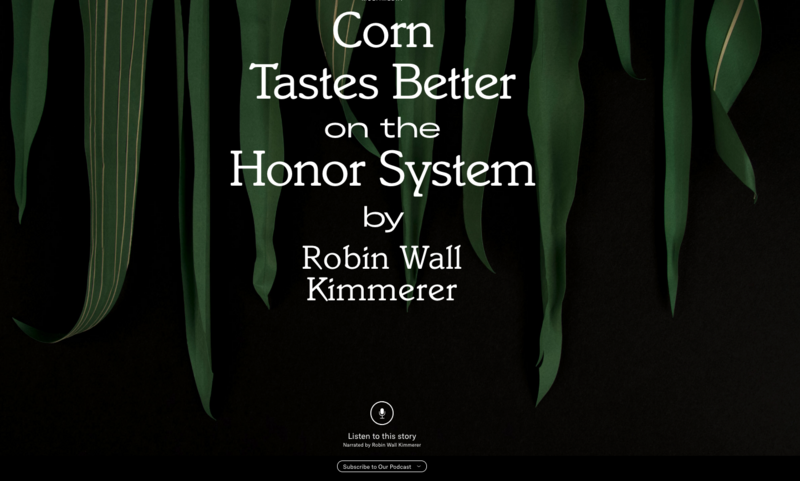
Corn Tastes Better on the Honor System – Robin Wall Kimmerer

Robin Wall KimmererRobin Wall Kimmerer is a member of the Citizen Potawatomi Nation and a botanist who explains her knowledge of an indigenous worldview about plants with that of the western worldview. In that process, Kimmerer embeds whole Earth teaching along with botanical science. Here in this beautiful essay, ” Corn tastes better on the honor system” published in Emergence Magazine, is one of the author’s best teaching contrasting indigenous ways of knowing with western perspectives about the Earth. At this time in American history, it feels like a return to sanity. Listen.
Robin Wall Kimmerer is a mother, scientist, decorated professor, and enrolled member of the Citizen Potawatomi Nation. She is the author of Braiding Sweetgrass: Indigenous Wisdom, Scientific Knowledge and the Teaching of Plants and Gathering Moss: A Natural and Cultural History of Mosses. She lives in Syracuse, New York, where she is a SUNY Distinguished Teaching Professor of Environmental Biology, and the founder and director of the Center for Native Peoples and the Environment.

Letter to the Editor – Virginia Pilot

The following Letter was submitted to the Virginia Pilot on June 14. I recently moved to Virginia Beach and subscribe to the Pilot.

It is great to be back in a military town! Growing up in the Air Force, my sisters and I absorbed the pride and pomp of being an officer’s child. Dad flew bombers, the big guys (B48s and B52s). WWII took his crew over the Pacific during low-level bombing of Tokyo and Saipan. They survived—barely.

You might surmise that my dad was a gung-ho patriot, but you would be mistaken. He was a discerning man who thought for himself. War is never an answer but sometimes its all we get when not to go to war would imperil the nation.

If Dad were alive today, he would be alarmed that we are not paying attention to the forces of authoritarianism in our country and the world. This was how Hitler and Stalin got so far. People doubted that such men could rise to power. Some welcomed them thinking they were intelligent, bold men.

It’s a curious thing that people confuse strongmen with strong leadership. If I am not mistaken, these are two different creatures. The first acts as a centrifugal force, sucking minds to its ideology, the latter upholds the law and invokes the principles that we have agreed to live by.

Beware America. Don’t look to strong men but rather to strong leaders who remind us of our common pledge to uphold certain inalienable rights for every person. Each one of us voters signed up for it. We are a nation governed by laws and each of us is responsible for making sure this is a Republic for the people and by the people. Whoever we choose to represent us must abide by the laws that govern us.

Submitted on June 14, 2022 In Response to the January 6 Insurrection Commission

https://www.c-span.org/video/?520282-1/open-testimony-january-6-committee

Photo by Susan Feathers

A Prophet for All Seasons

This film about Aldo Leopold’s life and the development of his thinking about our relationship with land is a true gem. I could not find when it was created, however, the people interviewed are his biographers and scientists who knew and worked with Leopold. It was shown on Wisconsin Public TV. A special treat is narration by Lorne Greene best remembered as “Pa” on Bonanza.

The film gives viewers an in depth history about Aldo Leopold’s life and how his ideas about The Land Ethic evolved over his lifetime.

WATCH EARLY THIS YEAR TO SET YOUR COMPASS TOWARD TRUE NORTH.

Lions, Tigers, and Bears, Oh My!

Lions, Tigers and Bears – Oh, My!

A story from the Coconino National Forest in Arizona

When Dorothy set off to find the Wizard of Oz, she and her companions encountered a lion in the dark wood just as they had feared, but, the cowardly beast only drew their disdain, for what good is a spineless lion?

Therein lies the dichotomy between our visceral fear of carnivores and our psychological need for them to be wild, fierce and free—a varmint or an icon. One gets them killed, the other immortalized, but neither will help them survive.

Neither perception tells us why lions, tigers and bears are important. A wolf takes the weakest of the herd, controlling not only numbers but removing the least adaptive genes from the population’s gene pool. A dynamic balance results between wolves, deer, and vegetation and myriad lives each dependent on the other.

That we do not understand the importance of these relationships was memorably recorded by Aldo Leopold. He wrote about an experience shooting wolves one afternoon, a common practice among Forest Service rangers in 1949. Leopold watched a “fierce green fire” flicker out in a mother wolf’s eyes. 

Dawning on his consciousness was the realization of a bigger death̶, a death of wild things and something greater still: the very foundation of a healthy ecosystem. The wild, beautiful landscapes that inspired Leopold were created over centuries among myriad species until a dynamic stage was reached with an elaborate set of checks and balances.  The wolf Leopold killed was one of the checks in a living community.

Until that moment Leopold lacked the understanding that he later identified as something only a mountain possesses. Mountains have the long view, he wrote, whereas humans are newcomers. A mountain has no fear of wolves, only deer, because too many deer will devour vegetation and the rains will wash away soil causing all kinds of havoc on the mountain.

The rancher who compares the life of a wolf against the current market price of his cow misses the much greater value of leaving the wolf wild and free. That “home on the range” where cattle roam depends on a natural community to sustain it – a community that evolved over thousands of years.

Leopold was writing about this phenomenon in 1949. Six decades later we are still acquiring that wisdom. We witnessed an ecological rebirth in Yellowstone National Park following the return of the wolf. Riparian willows and cottonwoods returned because elk spent less time eating them and more time hiding lest it become wolf scat. Other species like beavers returned in the rebounding willows and cottonwoods and their activities created habitat for insects and birds, and so on.

Further Reflections: The Elk Problem

One summer I attended a public meeting in Arizona in the Coconino National Forest convened to address the “elk problem.” Present were the U.S. Fish and Wildlife Service, Arizona Game and Fish Commission, White Mountain Apache biologists and tribal officials, ranchers, tourist industry reps, a hunters’ association, local residents, and curious campers like me.

It soon became apparent that a  showdown was imminent.

The problem stemmed from an exponential increase in the elk population. A rancher testified that elk herds of 600 to 1,000-head could be found every morning on her land, leaving a swath of denuded range in their path . She was passionate and demanded that Game and Fish raise the limits for hunters to help bring the population of elk under control.

A rancher – tanned from a life in the sun and a silver mane pulled back in a thick pony – made her plea. She gestured toward the Apache contingent, and complained that the White Mountain Apache reservation, which bordered the national park, was serving as a nightly refuge for the elk who had discovered safety within its boundaries (1.67 million acres) of forest.

I imagined a tide of elk ebbing into the ranchland to graze by day then flowing back at night into the forested reservation. The rancher wanted the Apache Nation to help kill elk and bring the herds under control.

They would not, a tribal spokesman asserted in reply. The Apache would not do so based on ethical principles and the belief that restoring the natural ecosystem would be the only true answer to controlling the population.

I think I caught a twinkle in one tribal elder’s eye as this statement was made. “We take elk when we need meat for our people,” he said and sat down.

Tourist agencies pleaded their case for the presence of elk.  Seen from the roads and campsites, thousands of families enjoyed watching wildlife. Tourism brings $16 million in revenues to Arizona each year, they reminded the crowd.

The U.S. Fish and Wildlife Service (FWS) deferred to the Arizona Game and Fish Commission which is charged with maintaining populations of wildlife. The FWS rep made a statement about the traditional range of the Mexican gray wolf—a keystone species of the disrupted ecosystem.

Sheer mention of the gray wolf acted like a match on tinder. The packed meeting room erupted in arguments from ranchers and tourism folks alike who didn’t welcome wolves in the woods.

Then a rancher with the look of one who had spent his life in the sun gained the floor. “We are victims of our own schemes – me included. First, we saw the wolf as our enemy and we systematically exterminated it. We saw it killing too many elk, too many cattle. We feared for our own lives. Once it was gone, we saw elk and deer populations explode. Well, maybe it’s time we examine our own nature to see if maybe we can control that!”

As I walked back to my cabin at Deer Springs Inn, I considered that I’d just witnessed a complete reenactment of the opening and closing of the West with all the historical parties represented as on a stage.

The sun was setting behind the dense Ponderosa pine forest. At Deer Springs Inn, families gathered around a campfire. I happily joined my family, spearing marshmallows. Wine flowed. Stars clustered overhead. A breeze fanned the flames setting our faces aglow. An owl hooted. The fire popped and sizzled as we settled down for stories and laughter.

Back at the end of the Yellow Brick Road Dorothy got her wish to go home, the tin man a heart, and the lion, his courage. Maybe the wolf will be restored at a time when our wizardry returns us to the natural order of things.

Deer Springs Inn