Dream Acres

DREAM ACRES FARM

Holding-Out and Holding-On in America’s Heartland

Dream Acres Farm in Bowling Green 2018

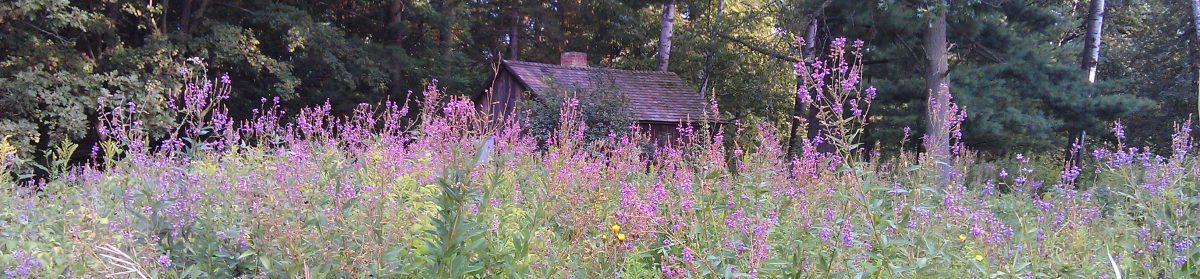
Golden meadow grasses wave in the afternoon breeze along a far bank of dark green pine and hardwoods aflame in fall colors. The trees form the meadow’s northern border. Lover’s Lane, Old Towne Apartments, and Interstate 65 serve as other borders to Dream Acres Farm—a sliver of Kentucky farmland and noble hold-out against development.

The white picket fencing, farmer’s house, and rolling green lawn that face Lover’s Lane were built when this land near Bowling Green was “the country”. I imagine teenagers romanced in a car along a moonlit dirt shoulder, and that dense forests still grew to the horizon. The farm’s 15 acres are worth millions now that the town has grown up around it. Everyday another few acres of Lover’s Land churn under the blade in becoming hotel, medical center, nursing home…

Cutting the Meadow

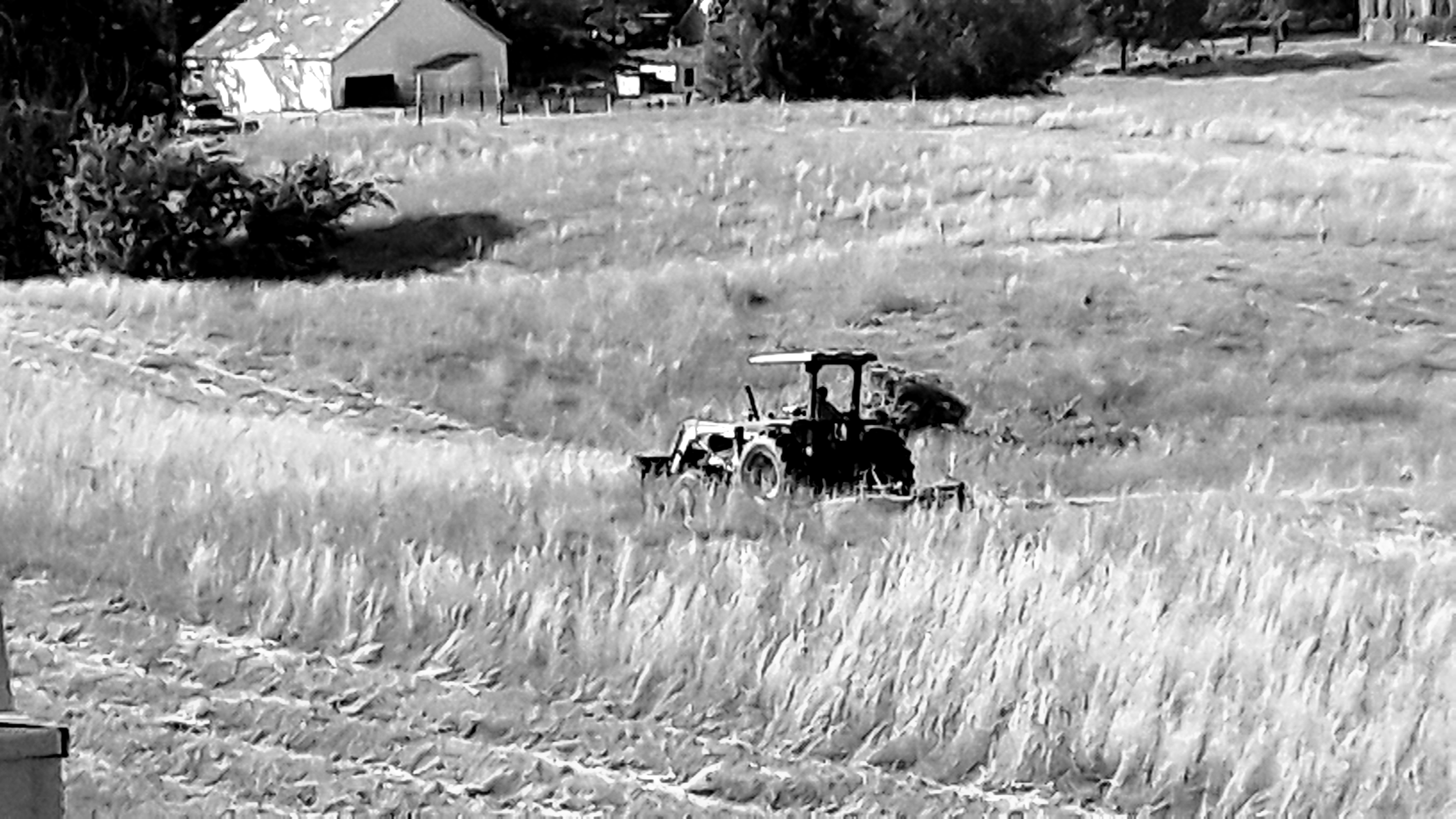
Every day I thank the farmer for holding fast to his farm amidst the pressure of land sales. He tends a dozen fine steer and occasional cow and calf to graze and grow in his meadow. Because the windows of my small apartment face the meadow, I am a constant observer of the herd’s movement, their presence or their absence. When the first hard frost arrives, they are gone to groceries and restaurants, and suddenly the meadow feels abandoned. Slowly, I’ve learned much about bovines: how they form attachments with the farmer, running and frolicking around him whenever he drives his rusty tractor out to inspect fences. I never knew cattle could move so fast. I’ve sketched their charcoal-black postures in the emerald grass of springtime and photographed them hip deep in a field thick with golden grasses in the fall.

This spring a community of swallows took up residence at my apartment complex, nesting on windows and gables facing the meadow and from which they emerged and returned with lightening-speed, providing me with more entertainment. After some time, I realized why they had come. As the cattle moved in the high grass, grasshoppers and gnats rose in swarms. The swifts careened in and around the thick calves and heavy hooves like fighter pilots after targets. When the insects’ life-cycles ran their course, the swifts disappeared into thin air.

Daily observation helped me discover the diversity of life in the meadow beyond the obvious farmer-bovine-grass relationship. Black silhouettes circled in the late afternoon sky portending prey moving in the grass sea: rodents, rabbits, snakes, perhaps frogs. I am sure there is an owl perched in the far border of trees whose throaty hooting I cannot hear over the constant roar of I-65. The life in the meadow also includes a neighbor’s acre of goats attended by sheepdogs that escort them in and out of a sagging, grey barn. Dream Acres Farm has its own barn from which the cattle emerge and return, but most days they sleep out under the stars.

When the farmer dies, will his heirs sell the farm and make millions? Probably—in the way of progress. When they do, I will disappear as the swifts to find another teacup of wild. And then, when no teacups remain, shall we all disappear like the swifts, into thin air?

I pray for the old farmer to live another day—my knight, my muse.
A Gathering of Birds

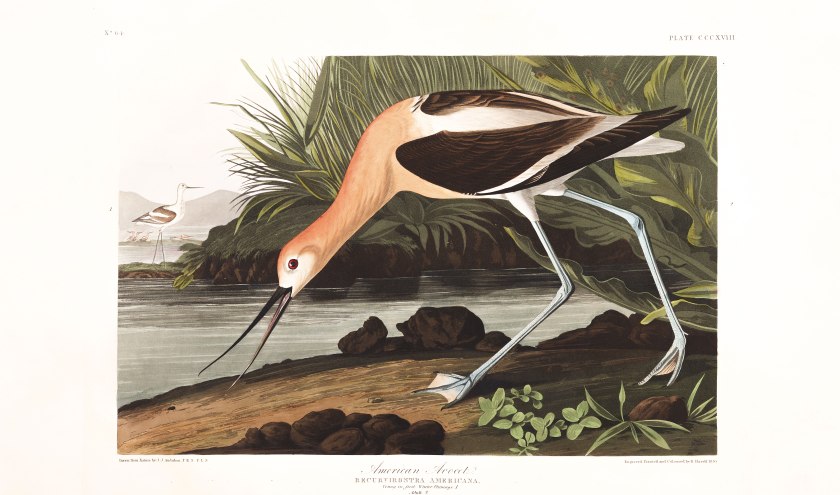
From John J. Audubon’s Birds of America

Dad loved to birdwatch. He was an armchair ornithologist observing from his cozy chair near a picture window in his condo in Florida.

He kept binoculars and a bird guide on a stack of crossword dictionaries near his post as well as tobacco for his pipe.

Regular as a clock, I could keep time by the sound of that first pipe being lit, the front door opened if warm, and bright warbles and shrills from a cardinal pair on his feeders, or the chitter chatter of chickadees.

Because Dad kept the feeders and his vigil for more than two decades in the same location, his observation post would have been very useful had he taken the time to record his observations. But alas, he did not.

Scientists and conservationists missed an important record of changes over time from a citizen scientist. Well, Dad simply watched for the esthetics not the science. But my generation and those coming behind me are critical participants in helping ornithologists track bird movements all over the world – for the first time.

Today is the Big Day 2018  See video below. Then go to the link and establish an account. Download the mobile app on Google Play or Apple Store. Start recording!

LITERATURE CONNECTION

Read from John J. Audubon’s Birds of America printed in 1834 and presented online: you can explore and read by species and you can download a high quality print image of many of Audubon’s matchless paintings.

GLOBAL BIG DAY VIDEO

Nature Writers for Earth Day

My writing practice began with love for nature writers. Rachel Carson in particular seized my imagination with her ability to combine science and lyrical language. No one in my view achieved what she was able to do–immerse readers in nature. Most of us know Silent Spring as her “manifesto” on the interconnections among humans, wildlife, and the earth. But, how many of you have read Under the Sea Wind? In this small book, her first, Carson writes life stories of three particular individuals: a Black Skimmer, a Mackerel, and a Sandpiper during one season bringing each alive as characters in a novel. The Black Skimmer (Rynchops), Sanderling (Blackfoot), and a Mackerel (Scomber) live, breed, avoid predators, and follow the urgings of seasonal changes, migrating, nesting, and feeding–all within exciting adventure writing. Readers dive deep into unseen lives nevertheless connected to them by large forces in seas, winds, and landforms. Under the Sea Wind is an immersion experience much like a 3-D visual experience today. Note: Under the Sea Wind was published about the time the U.S. was drawn into WWII. It was not until a dozen years later that it seized the popular imagination. For a superb biography of Carson’s life, read Linda Lear’s Witness for Nature, and for an excellent glimpse into Rachel Carson’s writing life, read Paul Brooks’ The Writer at Work.

Watch American Experience for the latest film about Carson’s life. It chronicles her writing and features the commentary of her biographers.

http://www.pbs.org/video/american-experience-rachel-carson/

For a regional writer of nature, I can think of no one better than Jack Rudloe who writes about the Gulf near his home and Gulf Specimen Marine Laboratory and Education Center. Jack was inspired by Ed Rickett’s whose work and life were enshrined in the popular imagination by John Steinbeck. Jack Rudloe, the 19-year old would-be scientist and nature writer, corresponded with Steinbeck in the latter year of Steinbeck’s life. Read any of Jack’s books for a another immersion adventure in: The Living Dock, The Sea Brings Forth, and the Search for the Great Turtle Mother. Anne Rudloe, his wife and marine scientist, wrote books with Jack that are reminiscent of Carson in their deep love for and accurate science about the landscapes they love and defend. Anne Rudloe passed away in 2010, and Jack and his sons carry on as Titans for Nature–like Carson in Silent Spring.

Enjoy Jack’s video about his book, The Wilderness Coast.

If you have time to sit down to read the record of Ed Rickett’s and John Steinbeck’s travels in the Sea of Cortez–The Log of the Sea of Cortez–you will be treated to a glimpse into evolving ideas about ecology as an ethical basis for living. Then, treat yourself to the film Cannery Row with Nick Nolte, Debra Winger, and John Huston. John Steinbeck’s novel, Cannery Row, is based on Rickett’s marine supply business in Monterey, California when the coastline abound with sea life.

Songs of Ourselves – Great Read

In 2015, Blue Heron Book Works published a collections of blog posts, journal entries, and other writing forms from writers across the nation. Bathseba Monk, the intrepid and visionary editor of Blue Heron Book Works, and her editor Mary Lawlor, put together a book of American voices as varied as the landscape between our coastlines.
Songs of Ourselves is a real trip into and across Americana. If you haven’t read it, I compare it to about two dozen Blue Highways wrapped into one volume.

Listen to Tomas Benitez: Quietude in the Gully. No moaning animals or ruckus. It’s as if the Pomona Freeway Ocean knows and slows to a steady heartbeat rhythm. The waves rumble with a distant peace. La Luna is framed by the dark outline of the palm fronds on the left, the Yucca tree on the right seems to be reaching up like a hand holding her aloft. She is so beautiful tonight; it is all about her I suspect. Maybe the animals are huddled in their shadowed hollows also watching her. Not even Jinx is dancing in her moonlight. We’re in church. ~ pages 15-16.

Well worth the read. A treasure of American voices across our land. Buy it here.


Healers of the Land

One of the best activities of my mature life has been an association with the Aldo Leopold Foundation and the Land Ethic Leaders. In 2012 I traveled to Baraboo, Wisconsin to attend a training to become a Land Ethic Leader in my community.

Leopold’s now famous essay on The Land Ethic is excellent guidance for our time.

The Land Ethic_A Sand County Almanac

I’ve continued to learn from leaders and staff at the Foundation but mostly from my fellow Land Ethic Leaders. John Matel is one who is blogging about the restoration of the Long Leaf Pine Ecosystem on his land. He is doing the careful, long term work of bringing fire back to the land to awaken long dormant seeds for the sedges and grasses on the land, grooming the understory and the pines themselves.

Read his latest blog and explore others to appreciate that there is a man, and many others like him, who are working on the long term solutions to our environmental crises. For example, read about the Panhandle Watershed Alliance and the Bream Fisherman’s Association led by an intrepid water ecologist and friend, Barbara Albrecht in Pensacola, Florida.

So, take heart that there are these menders and planters, stewards of land and the human spirit OUT THERE working against the tide of destruction.

Spirits of the Mountains

Mt Humphreys at 12, 800 ft. in San Francisco Mts.

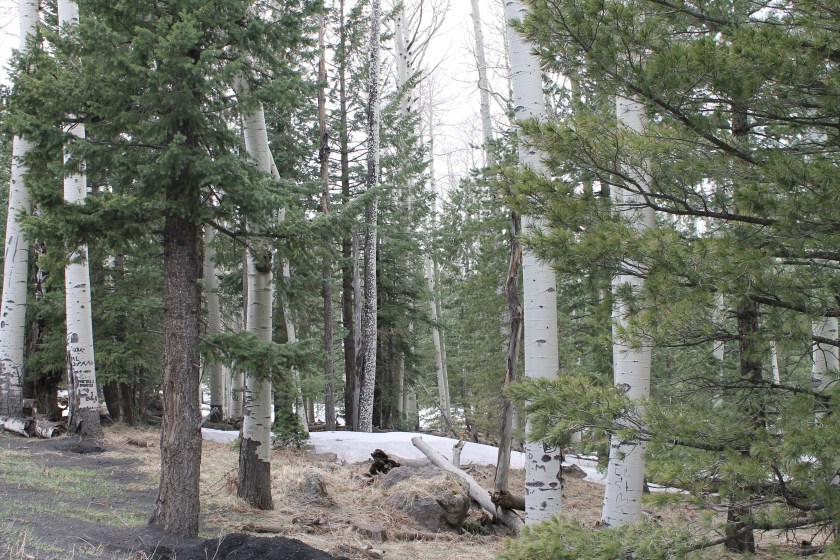
The spiritual nature of the San Francisco Peaks near Flagstaff was an awesome experience for me. The sight of these sacred mountains took me off guard when they first came into view, and indeed, were the focal point of the sky all the way to Holbook, Arizona. I can see why so many first nations hold these mountains in such reverence, when from anywhere for hundreds of miles the shimmering white peaks are a beacon of light and orientation. The Hopi believe the Kachina spirits live at the top of the peak. Looking at this forested hillside on the way up the mountain to Snowbowl, I can almost feel the spirits there.

Birches and Pines on Mt. Humphreys on the way up to Snowbowl.

And just like that, a second novel

Mountains to the Sea

Well, that second novel has been “cooking” in my mind for many years, and builds on years of experiences that reach back to 1990. That year I moved to Yuma, Arizona to teach middle school students at Crane Junior High School. Yuma first introduced me to the Sonoran Desert, and naturally, I experienced the hottest part of it first. Yuma temps that first summer hit 122 degrees Fahrenheit. My friends and neighbors taught me how to stay safe while traveling, and how to get out early in the morning before the heat made it impossible.

All around the school and neighborhoods where I lived, agricultural fields stretched out in long even rows with canals as borders, while row upon row of blue water soaked into the ground, evaporating in the intense heat. Surrounded by a sea of broccoli, my school was embedded in the large-scale industrial farming operations in which many of my students’ parents labored. On these intensely hot days, I wondered at the ability of human beings to endure hard labor in those fields.

AZ Agriculture Photo

Then, the fact that the water came from the high Wyoming plateaus and Rocky Mountains was only vaguely in my awareness. Precious river water poured down through deep canyons into the dams that controlled the North American Nile, and by a complex system came to Yuma and the Imperial Valley to grow 90% of America’s leafy produce between November through March. Then, I was focused on my students’ daily struggle to learn and grow up under harsh conditions of poverty and discrimination. But, all around us was a BIG STORY about a river, its people, and how it came to be the most controlled and overused body of water in North America. Indeed, the Colorado River is so over-allocated that it no longer winds its way to the Gulf of California as it did for thousands of years.  The  magnificent delta region, one of the world’s largest and most productive wetlands, literally dried up and died.

This is the subject of my second novel, The American Nile: Voices of a River and Its People. I am working with a talented editor and should have a solid draft completed before I return home from Tucson in late April.

Farmers Could Help Reduce Climate Change Impact

In Threshold, Dr. Carla Connors takes a 2-yr sabbatical from her job as a climate scientist to learn from ethnologists at the Mission Garden in Tucson who are growing heirloom seeds to test for viability in new climate conditions, while demonstrating many previous cultures’ farming practices in their Timeline Garden.

Carla investigates the potential of plants to sequester carbon from the atmosphere and deposit it into the soil. While this is a normal activity of some kinds of microbes in the plants we call legumes (barley, soy, clover), she wants to know if the ways farmers planted, grew, and harvested crops actually may be important clues to how farmers might help stem global warming.

carbon-farming-heroIts called CARBON FARMING. See this article from Modern Farmer, “Carbon Farming: Hope for a Hot Planet” by Brian Barth, March 25 2016.

Scientists now believe carbon framing could become an important and beneficial tool in fighting the rise of carbon dioxide in the air and could potentially reverse it while producing healthier food and enriching top soil.

A Brand New Kind of West

In 1878, John Wesley Powell submitted A Report on Arid Lands to the U.S. Congress. In it he proposed that land grants to settlers in the arid lands of the country be determined by the geology and physiology of the land. That may seem perfectly logical to modern readers, but in that time, myths about the productivity of the land dominated over reality. Manifest Destiny was a locomotive roaring across the lands of the west.

Powell’s ideas were based on science, as Wallace Stegner, in his brilliant biography of Powell’s service to the U.S., Beyond the 100th Meridian, dramatically illustrates.

NPR’s 2003 Program on The Vision of John Wesley Powell

Powell proposed that tracks of land for raising cattle or sheep be 2, 250 square acres, and irrigable land for farming be only 80 acres with water rights. Both of these proposals were based on the aridity and productivity of landscapes in the west which, for grazing, required much more than the 160 acres provided in the Homestead Act to find enough water sources for animals to thrive. He also demonstrated that the productivity of desert soils with the addition of water required only 80 acres–all one farmer and his family could reasonably manage.

Had government agencies deeding land to settlers west of the 100th meridian used scientific reasoning, we would have a different west today. As we did not, most of the settlers who obtained 160 acre allotments soon failed. Their land was not returned to the U.S. lands in public trust but rather it went to the banks who financed farmers production. Powell points out that the Homestead Act resulted in millions of acres of public lands going to corporations. Again, using scientific research Powell busted another popular American myth.

Powell further proposed that the government require land owners planning to use a given water source, such as a river, be required to form an irrigation district made up of nine potential land owners, to demonstrate they could successfully share the water over a three year period before obtaining title and water rights.  He based his recommendation on successful models of the Mormons in Utah and Spanish land owners of New Mexico Territory with their ejidos resource commons.

Science was the basis of Powell’ prescience regarding the development of the western lands of the U.S.  Today, science must help major Southwestern cities and regions rethink how to manage water among themselves. We will not be able to return to zero, but we can try to develop policies today that fit the landscape.

For the entire history of water development in the west, science has not dominated decision making but rather economics. Millions of Americans now live in cities where a reliable source of water is threatened, and millions of acres of agricultural lands, supporting American households and the world are on the brink of collapse due to long term drought conditions projected to last hundreds of years.

What kind of thinking and planning will be required to move us in the direction of a sustaining system for water usage in the West? How will our economic models need to change to run concurrent with the physical realities of the land and resources we wish to use?

Who Owns the Water, Air, and the Land?

As the people gather in solidarity with the Standing Rock Sioux Nation, and the voices of Native American and justice activists are heard, I want to consider the issue at hand as fundamentally a land ethic issue.

Energy Transfer Partners and Dakota Access LLC are in the process of hooking up an extended pipeline that will connect existing crude oil pipeline to a tunnel pipeline to shunt crude oil to Illinois. The tunnel pipeline is planned to go underneath the Missouri River, and Lake Oahe–near the point where the Standing Rock Sioux Nation’s reservation uses the water for drinking water and irrigation. They are a poor nation whose water infrastructure is aging and constructed in such a manner that if a leak were to occur, it would essentially shut down the water supply for the people at Standing Rock Sioux reservation. Read More: dakota-pipeline-article from Inside Climate News.

The truth is that water, land, wildlife and people can not be owned. Each has the inalienable right to exist free by virtue of our common creation. What we can do is equitably share and protect resources to ensure that all people and wildlife have basic needs fulfilled within the limits of the land to provide them. In other words, human needs have to work within the ecological ability of the land and waters to provide them. This requires an ecological awareness.

Aldo Leopold advanced a land ethic in his writing, as he grew in his understanding of what a community really is:

Leopold understood that ethics direct individuals to cooperate with each other for the mutual benefit of all. One of his philosophical achievements was the idea that this ‘community’ should be enlarged to include non-human elements such as soils, waters, plants, and animals, “or collectively: the land.”  Aldo Leopold Foundation

Should the Energy Transfer Partners and the Dakota Access Pipeline operation have the right to build a pipeline underneath Lake Oahe and near the Missouri River that flows past the land  of the Standing Rock Sioux Nation? And will flow through four states and other communities?

The 1134-mile pipeline will carry 500,000 gallons of crude oil each day to Illinois. Seventeen banks stand to profit and are advancing money to make it happen.

Three U.S. agencies warned against it, but the U.S. Army Corps of Engineers used a corporate report from Dakota Access Pipeline to rule in favor of the construction. After a federal judged ruled in favor of the pipeline going forward, the U.S. Department of Justice and the Interior, and the Army together enacted a stay on that decision so that the EPA can reassess the original assessment of its safety.

As climate change impacts the world, should our society support continued drilling and transportation of crude oil to be burned and thereby increase warming of the planet and acidification of oceans? Of course not.

In the Southwest, where access to precious water will bring municipalities, tribal nations, corporate interests, and the U.S. government into negotiations over water rights, what values and ethics will we use to determine who gets what?

It is a question we must answer now.

Read about the proposed Dakota Access Pipeline