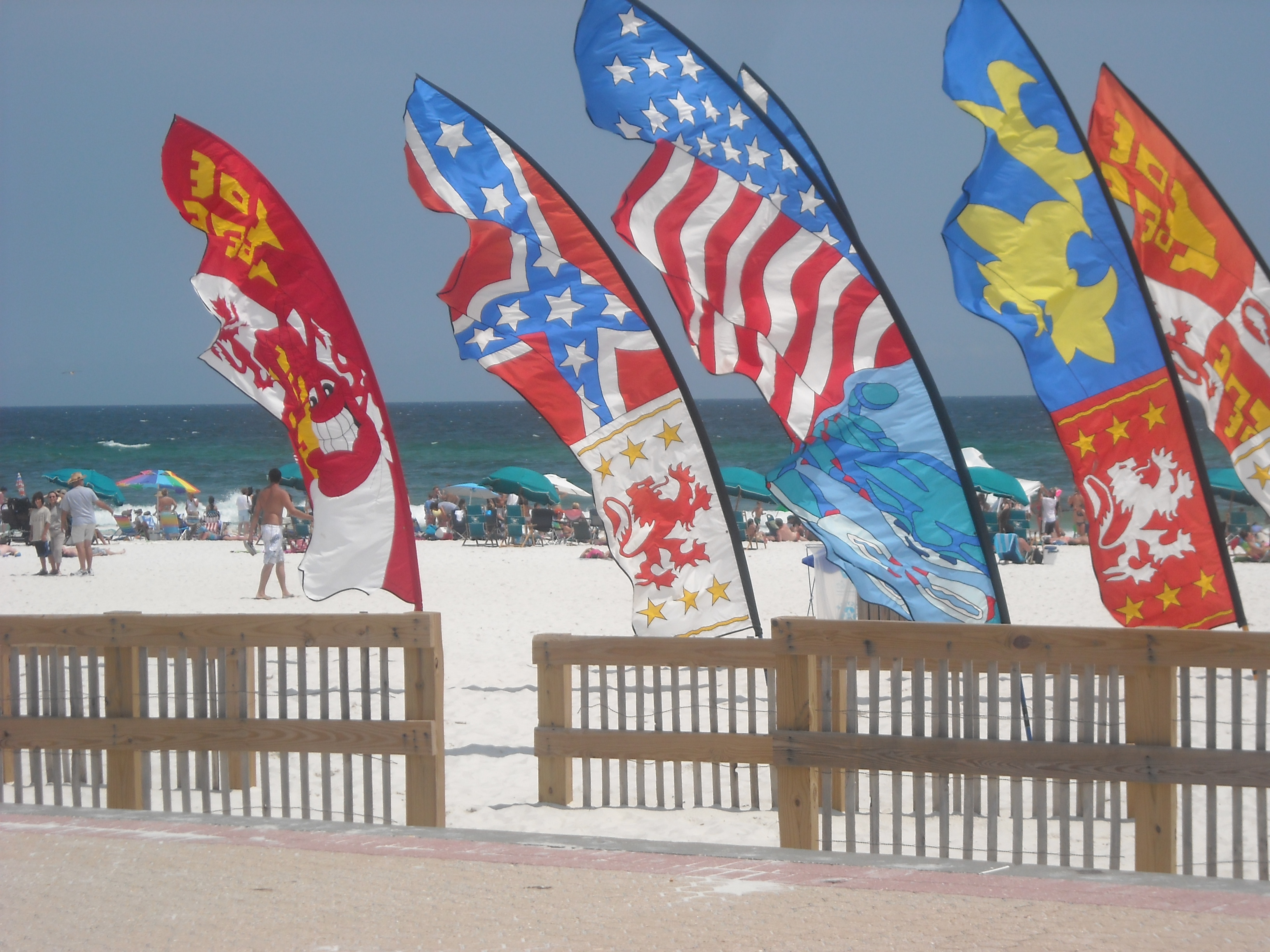
My parents moved to Pensacola as retired military. Nearby Pensacola Naval Air Station gave them access to the commissary, officer’s club, and other amenities. They were smitten, as are so many visitors, with the incredible beauty of the Gulf coastal region and relaxed Southern lifestyle.
After moving to Tucson in 1999, I began annual treks to the beach and back, linking me to what at first glance appears to be environments at opposite ends of a moisture continuum: desert to marine systems. But I began to find uncanny parallels:
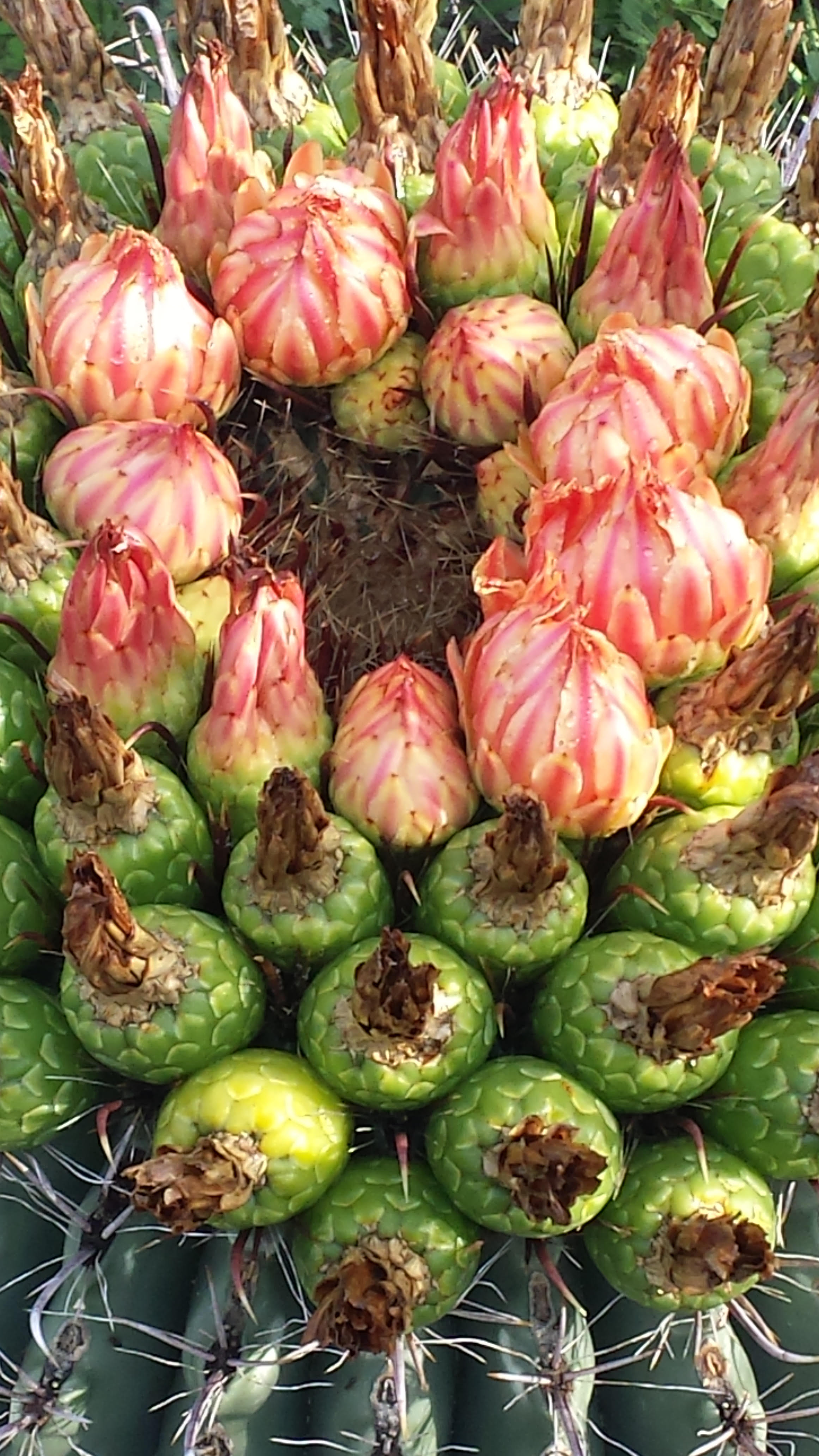
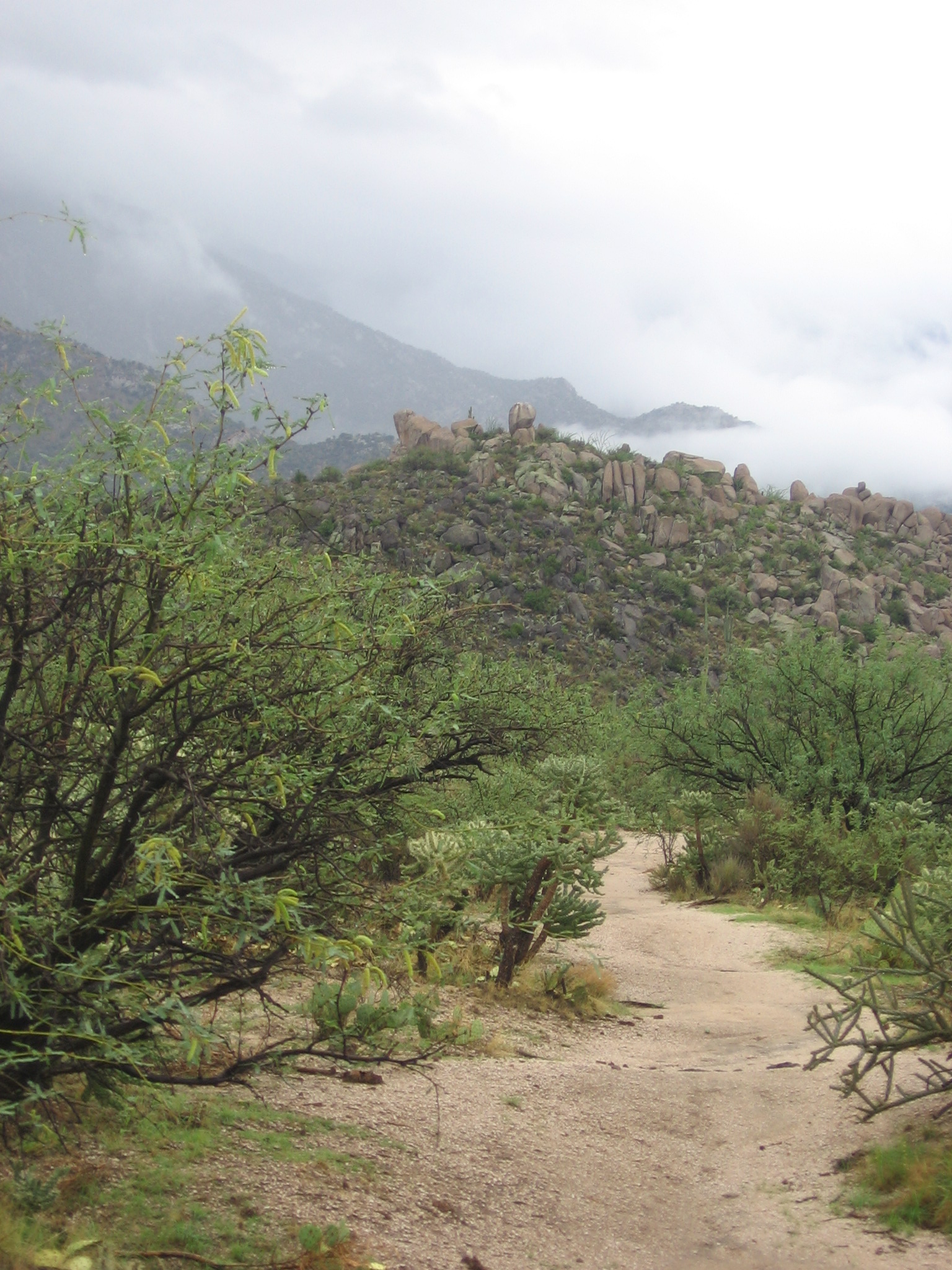
The spectacular high desert of Tucson with its tropical blooming cacti and tall saguaros, evolved from a subtropical environment as recently as 8,000 years ago – America once had a large inland sea in the Midwest;
The Gulf and coastal environs evolved from a dry savannah that supported lions, elephants, and other megafauna that thrive in dry, hot weather;
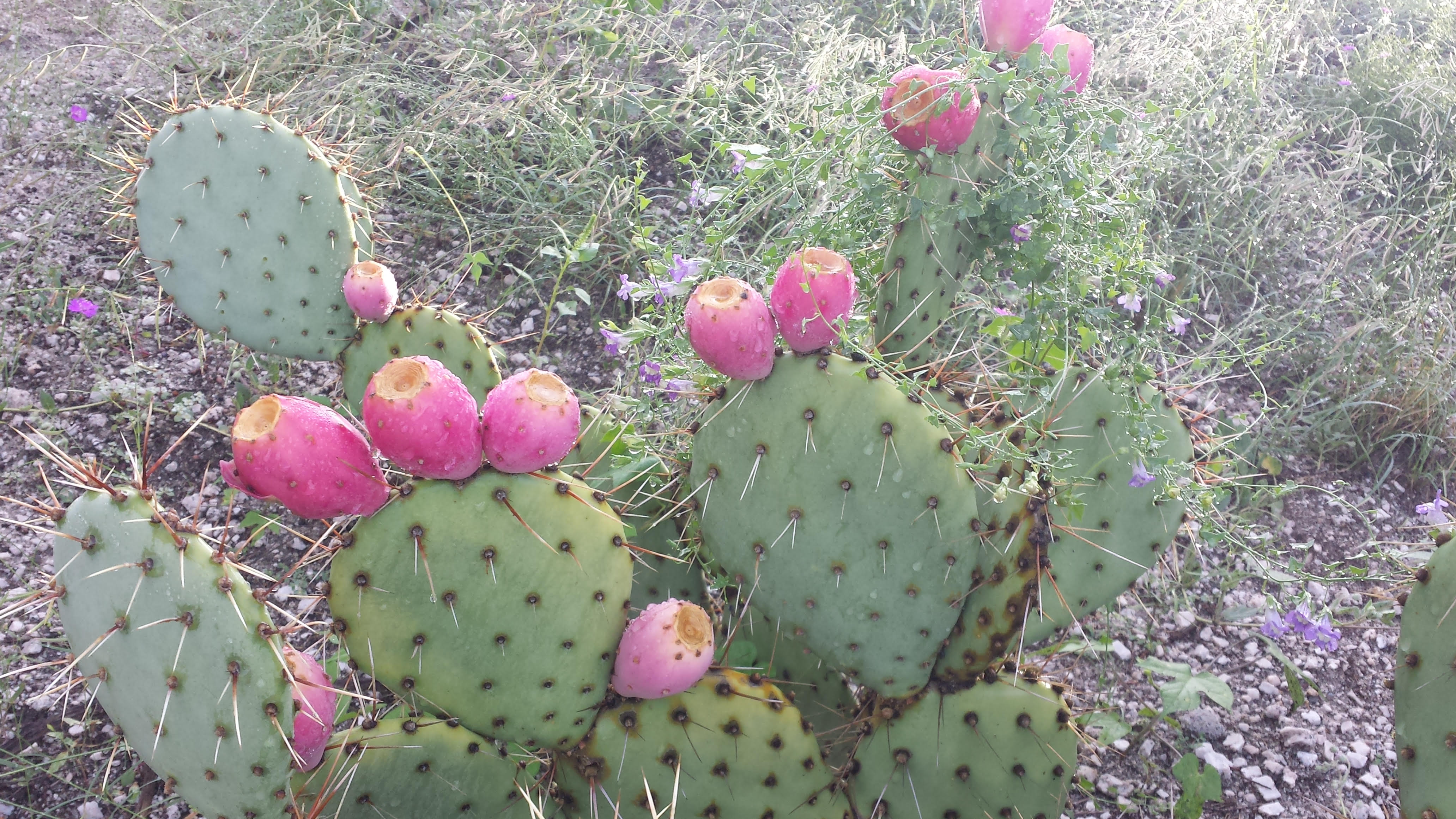
The desert hills of Tucson and the sugar white dunes of Pensacola both support prickly pear cacti and similar species of horny toads!
Prickly Pear Fruiting
I also found that we are on very close latitude lines: Tucson is 32.2217° N and Pensacola is 30.4213° N.
It’s those changes in latitudes,
changes in attitudes nothing remains quite the same.
With all of our running and all of our cunning,
If we couldn’t laugh, we would all go insane.
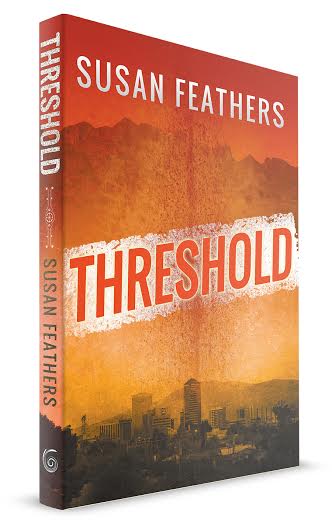
Readers know that I’ve been blogging about an uncanny web of contacts and events that keep me ever tied to Tucson. Last week I wrote about how I became friends with a fellow ex-Tucsonan through our mutual membership in the West Florida Literary Federation. We both settled in Pensacola never knowing each other while in Tucson. Victoria became an important part of the writers who helped me while I completed Thresholdwhichwill be released in November by Fireship Press in Tucson.
ANOTHER UNCANNY TUCSON CONNECTION
While assisting the West Florida Literary Federation to bring two major New York City poets to Pensacola, I learned that one of them – Barbara Henning – lived in Tucson (while I was there) and was on the faculty at the University of Arizona Poetry Center. This link to the Poetry Center features a series of upcoming readings by poets with the focus on climate change which is the subject of my novel. I plan to attend Joy Harjo’s reading and then stay on in Tucson to promote the release of Threshold which means I will miss Barbara Henning’s performances and workshops in Pensacola during the Foo Foo Festival — our local celebration of arts and culture.
What is it that draws people to Tucson? To Pensacola? Check back soon to read “A Tale of Two Cities” and my migratory route between them over a 20 year period.
My romance with Tucson seems predestined. This long relationship began in my childhood with Dad’s assignment to Davis Monthan AFB.
Fifty years later, I moved back to Tucson to accept a position as Director of Education at the Arizona Sonora Desert Museum. Little did I know that a future friend and writing fellow was finding her way to Tucson from her home in the Republic of Columbia, in northwest South America. We never met while we lived in Tucson but we would later share our love of the desert in a more tropical habitat.
That is because both of us left Tucson and ended up in Pensacola, Florida. Vicki is a member of the Portfolio Writers’ Group, one of many writing groups in the West Florida Literary Federation. She is a poet and talented painter who not only continues to inspire my writing, but who, by virtue of membership, became an early editor of drafts of the Threshold manuscript.
For me it was wonderful having a talented writer/friend who knew Tucson and is bilingual. She was able to spot problems and to provide correction to Spanish terms and translations. (Vicki is a Spanish instructor at the University of West Florida and provided instruction for students at the University of Arizona while in Tucson.)
It seems that wherever I go, Tucson follows along. I am so glad because it is a community that won my heart. I even bled for it (see previous blog). That initiation got buried in my unconscious. Good thing. I might never have returned!
Tucson became my home from 1999 to 2008, but I had been a resident in the Old Pueblo when I was just a babe. Dad (Major E. B. Feathers at the time) was stationed at Davis Monthan Air Force Base in Tucson. I was 2 years old when we moved there. I remember photos of my mother, sister and me in sundresses and sandals in front of a house with a large shaded porch, cacti and sand.
Little did I know that I would one day return to Tucson as an adult. When I was just getting started in life, I had an early encounter with the desert by falling into an Opuntia (prickly pear). Mom recalled she was pulling needles out of my arms and legs for a month.
In 1925, Tucson’s City Council purchased 1,280 acres of land southeast of town to relocate the city’s municipal airport. Unknown at that time this new site would become the nucleus of Davis-Monthan Air Force Base. Six years earlier Tucson had the proud distinction of opening the first municipal-owned airport in the nation. Located four miles south of the city on Nogales Highway, the present day location of the Rodeo Grounds, the 82.64 acres was designated Tucson Municipal Flying Field after several name changes. Following years of stalled negotiations with the War Department, city planners elected to purchase the larger site and transfer airport operations in hopes that the military would reconsider establishing an aviation branch in Tucson.
Construction at the new site was completed in late 1927, and on September 23 of the same year, Charles Lindbergh, who months earlier crossed the Atlantic in the “Spirit of St. Louis”, formally dedicated the site in honor of Lieutenants Samuel H. Davis and Oscar Monthan, two Tucson aviators whom died in separate plane crashes after World War I. The city shared another proud moment with the opening; Davis-Monthan Field immediately became the largest municipal-owned airport in the nation.
Military presence at the new Davis-Monthan Field began October 6, 1927 when Staff Sergeant Dewey Simpson transferred the military aircraft refueling and service operations from the old municipal airport. He also brought something very unique with him, a log book that was signed by the field’s patrons. Early aviation greats such as Foulois, Arnold, Spaatz, Vandenberg, Earhart, and Doolittle took the liberty of signing the registry as a record of service. (Currently the Registry is on display at DM’s Base Operations). With only two military personnel assigned to the field, negotiations between the War Department and Tucson would remain at a stand-still until 1940.
My Dad was stationed at Davis Monthan AFB in 1947. He had just rejoined the USAF after it formed from the Army Air Corps after WWII ended. Dad flew B-29s in the Air Force. Davis Monthan AFB began its revival after the war as a location for the successful Super Fortress (B-29 Bomber). The very dry air provided an ideal location to store the Superfortress, and other air craft accumulated during the 2nd World War in the desert.
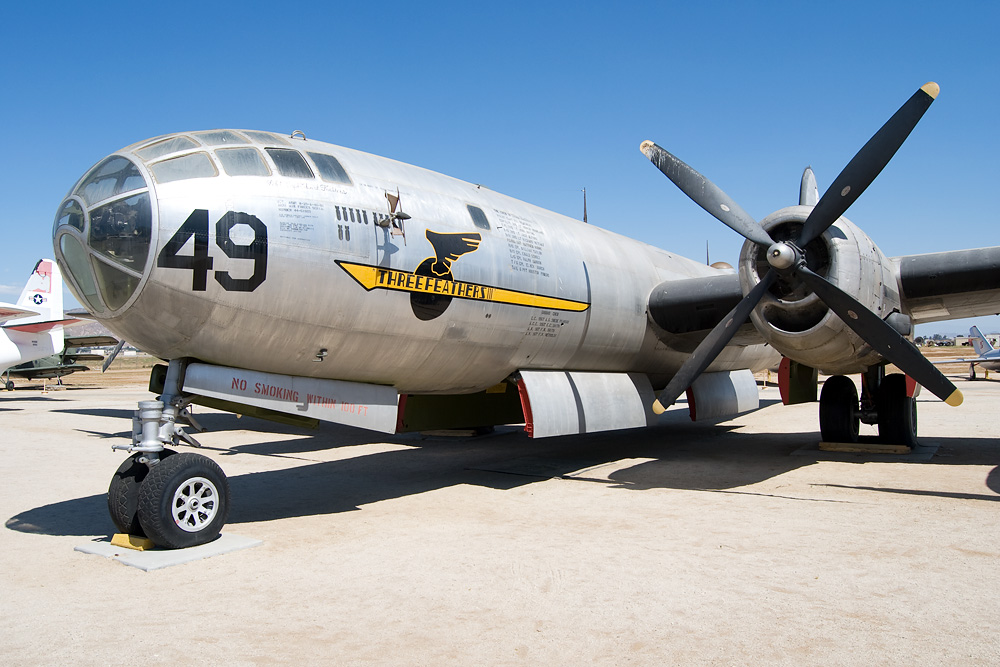
In another amazing connection with Tucson, the daughter of Dad’s co-pilot was instrumental in locating the Z-49–the B-29 my father and her father had flown 35 missions over Tokyo from their base in Saipan. It was found in an aircraft graveyard in the desert. The Z-49 was restored and is now on exhibition at March AFB in California:
Z-49 March Air Museum, CA
The B-29 was dubbed the Three Feathers, originally complete with three nudes on clouds following the pilots’ tradition of painting sexy women on the nose of their aircraft. The Three Feathers had a prestigious life. Read its history here.
Dad talked about flying in the desert. The pilots rose very early to beat the heat, and then cruised above the desert with a view that stretched for hundreds of miles. He recalled the heat and the electricity on the metal and how it gave them all a huge bolt of energy whenever they touched metal on a very hot, crackling dry day.
We soon left for Los Angeles where Dad studied meteorology, a fateful study which later sent him to Fletcher’s Ice Island T-3, a floating iceberg in the Baltic Sea. He was part of a global study, for his team it specifically encompassed ice flows in the arctic. I was 14 when Dad was featured in Time Magazine after being attacked by a polar bear on T-3. Now in 2016, my first book (Threshold) includes a polar bear–in Carla Conners’ nightmare. I think all this qualifies as the circularity of a life’s path.
When I fist moved to Tucson, Arizona, I was new to the high desert. Biologists refer to its flora and fauna as “lush”–a term that up until then I would not have chosen for a desert.
Dr. Zepeda is a member of the Tohono O’odham Nation, a lifelong desert dweller, a linguist, and cultural preservationist. In 1999 she was awarded the MacArthur Fellowship for her work creating a Tohono O’odham book of grammar. However, Dr. Zepeda’s poetry is what I wish to focus on and how the chance encounter with her performance in the first week of my residency in Tucson led to my deep feeling for a place and community as culturally rich as any I’ve known.
The poetry reading took place in the circular auditorium (kiva) in the American Indian Studies Department at U.A. In the large room with rows pitched down toward the lectern in its center, a soft voice rose and fell. Dr. Zepeda’s was reading from her book, Ocean Power. She spoke in O’odham and English, alternating between each as she read. I closed my eyes to listen to the language of desert communities at Tucson’s origin.
She explained the relationship of her family and community to rain in the desert, its precious nature, and how, after the long hot, dry foresummer, the first monsoon clouds gather, and people point and wait for the first cold dollops of rain.
After her lecture, I walked to my hot, dusty car to drive home. Not long after I was on the road, a massive monsoon cloud, as black as coal, threw lightening strikes like explosions on the ground, and rain burst from the sky, falling n buckets, cleansing the car and blinding my sight. I had to pull over. Flood waters gushed around drains, cars stalled as the water rose, but all the people smiled behind their windshields or stood outside their vehicles with open arms, letting the storm soak them to the bone. It was a celebration, first delivered through Dr. Zepeda’s poetry and, then, by the monsoon itself. I believe to this day that hearing about rain on the desert in O’odham made the impact of the storm much deeper for me. It was a true rite of passage. Listen to a short video about Dr. Zepeda.
As a new writer, taking on the task of a first novel with climate change as the protagonist is tantamount to declaring failure before lifting your pen.
Many dystopias have been written about climate change, and numerous Armageddon-style films produced which draw large audiences. Their stories are so outrageous that we count them as impossible. It may be an entertaining read or box office hit but these forms obfuscate the real threat we face.
When I first conceived the idea for writing Threshold, it followed on a years of reading climate science, talking to local scientists about changes they were seeing in local and regional environments, and reading the latest popular books written for the public’s understanding. The Weather Makers is one that comes to mind. The author, Tim Flannery, is an imminent zoologist who has continued to write about world-wide environmental issues related to climate change.
Yet, a great percentage of people still do not accept that climate change exists. Are we hard-wired to not accept climate change? What is it that defies logic, what we know, to respond instead to what we believe? Does it strike at our deep seated need to protect home and family, to disbelieve something as uncertain as uncertainty?
George Marshall devotes his professional life to studying these questions. In his recent book, “Don’t Even Talk About It: Why Our Brains Are Wired to Ignore Climate Change”, Marshall presents the results of interviews and research that make a credible case that our natural inborn defenses and beliefs keep us from responding. But, Marshall is hopeful because what we share in common is so much greater than what separates people about climate change. That fact may be key to bringing about a consensus to act in time.
Planning the book I had to consider who I was writing it for, who would be my readers. How could I write a popular story that gains the attention of people who normally would not read about climate change, may even vociferously deny it (like Ed Flanagan in Threshold). How could I invite everyone into a discussion about it, and what would I learn in doing so? These questions have occupied my mind over a decade, as I drafted, edited, put aside, and finally returned to finish the story.
Books I read that informed first draft of Threshold.
In terms of years spent writing as a principle activity, I am a relatively new writer. In 2003 I decided to leave working full time to begin a life as an independent businesswoman. This gave me time to write with more purpose. Up until then, I had written memoir and nonfiction pieces, attended a few writing workshops, but had not truly found my purpose nor honed a writing life.
When I made the Big Transition from working for an institution to working for myself, I had been serving the Desert Museum in Tucson as the Director of Education. This was a great privilege for me–one that brought me close to many experts and passionate defenders of the biodiversity and cultural diversity of desert communities.
At the same time, scientists were reporting increasingly disturbing forecasts about climate changes on global scale. The Tucson and Phoenix metro areas were also reexamining their water management plans. Working for myself gave me more uninterrupted time to read and to plan a book.
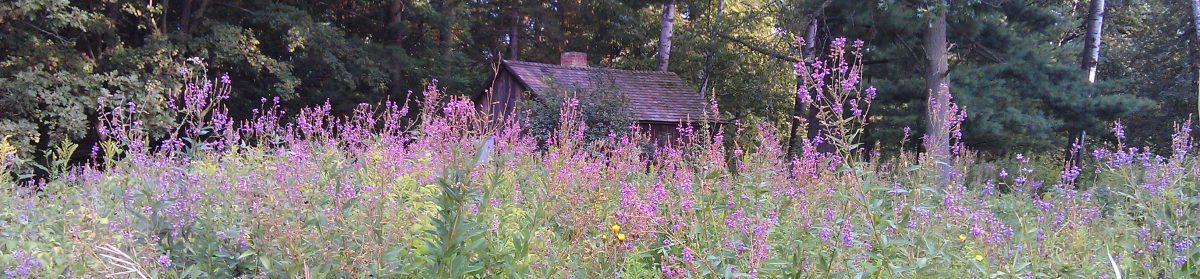
Writer’s Cabin – Frank Water’s Foundation
Threshold was first drafted at the Frank Waters Foundation in 2006 after I was offered an 8-week writer’s residency. The little adobe artist’s cabin on the Frank Water’s property sits at the base of the Sangre de Cristo mountains. Frank Waters’ spirit pervades the property. He is considered the grandfather of the Southwestern novel, writing and publishing fiction and nonfiction works from the late 30s to the 80s. All his books are still in print, a fact that proves the relevance of his thoughts and writing. As I wrote my story, I felt Frank’s spirit about.
Aspen grove by cabin – Frank Waters Foundation
Armed with an outline for a plot that spanned three novels stretching to 2100, I drafted a speculative fiction novel with an enormous cast of characters. I left the mountains with a 400-page manuscript.
This was an impossible task for a new writer of fiction. But, sometimes ignorance allows a creative mind to accomplish more than expected.
Numerous American films portray the desert as a place where victims crawl across the sand, silently screaming – “WAAATTTERRRR!”
There is nothing worse, or more dangerous, than thirst. Without enough water, anyone crossing or living in a desert region will become dehydrated. Athletes have to pay attention to the hydration of their body or risk serious health risks. If the weather or climate is also hot and dry, it is even easier to become dangerously overheated.
How much water do we need each day? We have all been advised to drink 8 glasses of water per day. Another rule of thumb is to drink half your body weight in ounces. Most of us do not drink that amount. We walk around dehydrated and functioning below our maximum energy level.
Heat stroke or hyperthermia has been identified as the two most dangerous health impacts of climate change on populations living in hot, dryland habitat. See how Tucson, Arizona professional community is addressing this with citizens:
Today I begin a new phase of writing and communicating on this blog. My first novel will be released in November by Fireship Press.
Threshold is a labor of love for the Sonoran Desert region and the people of Tucson, Arizona.
The Sonoran Desert is one of Earth’s most unique landscapes. It’s evolution from a semi-tropical region to its present-day high desert community, makes today’s Sci-Fi settings and characters pale in comparison. For example, there is a species of tree that sheds its foliage in the extreme heat to conserve water. It photosynthesizes through its pea green trunk instead. Another tree expands and contracts with rainfall or drought, while its fluted trunk casts shade upon itself.
I will tell some of those stories on this blog over the next 6 months as a preview to the novel.
Of equal fascination is the evolution of Tucson’s multicultural landscape. For example, the Tucson basin near the modern day, metropolitan city of Tucson, has been continuously farmed over the last 4,000 years. Successions of people came, split up, and formed new groups, ebbing and flowing in the desert’s own tidal rhythms of rainfall and climate, and cooperation or conflict among local human communities, and nation-states arriving with dreams of glory and conquest.
Look for links and pages that lead you to sources to learn more.
Teachers! This is a great way for your students to explore a very different ecosystem.
Questions and comments can be submitted to me on this blog page. I look forward to hearing from many of you as we begin to explore the land where my characters live, work, and struggle to find a way forward in an uncertain time.
Daniel Pink recommended Dave Pell‘s online news commentary, Next Draft, in a recent podcast. I subscribed and am so happy I did. Pell connects readers with fresh perspectives on news, not the same analysis barked from every media outlet. Pell is terribly funny, too. Today’s menu of stories included “Netflix and Ch-Ch-Chilly, a blog post by Rex Sorgatz on his return to Napoleon, a tiny community on the plains of North Dakota where he grew up. First, Rex is also funny, and a good writer who reflects on his childhood and adolescence growing up in Napoleon. Rex discovers that the Internet is a game changer for digital natives in his hometown. In fact, these kids are living a dual experience: small town America networked to a world community. Worth checking out. Wonderful photography. I highly recommend that you subscribe to Next Draft. You will not be disappointed. Pell selects excellent articles and stories that are relevant as well as rich in surprising content.
 My parents moved to Pensacola as retired military. Nearby Pensacola Naval Air Station gave them access to the commissary, officer’s club, and other amenities. They were smitten, as are so many visitors, with the incredible beauty of the Gulf coastal region and relaxed Southern lifestyle.
 The spectacular high desert of Tucson with its tropical blooming cacti and tall saguaros, evolved from a subtropical environment as recently as 8,000 years ago – America once had a large inland sea in the Midwest;





 Susan Feathers